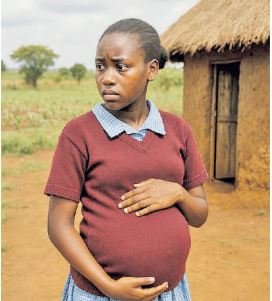
While the old may be dipping their head in the sand of culture in Kakamega county as the future of teen girls gets eaten away one defilement, rape and silence at a time, the youth are not sitting idly by.
The 20-year-olds, most of whom have had experience of early sex exposure due to peer influence and involuntary encounters through rape and incest, are leading the charge in not just raising awareness among the young girls in schools but also liaising with civil society in the area to call out the suspected perpetrators.
The six are a group of change champions under Mulika campaign organised by the Kenya Human Rights Commission, spotlighting incidents of teen pregnancies, the contributing factors and compelling the local political leadership to do enough to protect the young girls.
Take the case of Sitati and Naliaka (not their real names) who are passionate about football and are coaches.
They have witnessed many cases of defilement, which then get swept under the carpet to protect family members who have done it.
“As a coach, you suddenly see that this girl, 12, who is passionate about the game and schooling, is pregnant, and within no time, she is gone. The family has procured an abortion and moved her to Nairobi to live with a relative,” Sitati recounted.
And in another case, he said, one of the young girls in his team was pregnant and carried to term, but the child did not get off the hands of the midwife alive.
The innocent child got strangled at birth and later dumped near a river.
“We got to know this because the body of the tiny child was found by the riverside being eaten by dogs, covered by our team’s football jersey often worn by the girl. It not painful and infuriating,” he said.
Worse still, he said, the girl is suspected to have been defiled by a close blood cousin with whom they lived in the family homestead.
Another, 14, had a miscarriage and was disowned by the clan on the claim that she had bad omen hovering over her. She fled from home two years ago.
For Nasimiyu, her participation in the change champion group is not just born out of her conscience but also her personal experience.
She recounted how she was period-shamed in school and at home, making her vulnerable to fall into the hand of any caring man, a fact which accounts for the early birth of her little daughter.
It was her father who would openly talk to her about her delayed onset of adolescent changes, unlike her sisters, who experienced the changes early. He would encourage her that she is normal.
But when the menstrual cycle finally started, she said, she was naive and in high school. Again, it was her father who came through for her.
But the mother was harsh, repulsive and would mock her, calling her names.
“Most of the girls finding themselves in the situation I was in and get no option but to start experiencing early sex. The boys can also be taking advantage of them, and some are vulnerable to rape,” she said.
Another case is that of Sharon, which highlights the role of parents. She says that immediately after finishing Form 4 almost 10 years ago, she connived with her high school sweetheart to attend a disco matanga.
She managed to sneak out unnoticed by her parents but as the night wore on, while she enjoyed the rhythm of the night revelling, her father walked to her room to check on her, finding that she was not there.
“That is how my life changed,” she remembers.
She returned in the wee hours of the morning, sneaking back as though she never left, not knowing her cover had been blown.
Her father, a strict disciplinarian, firmly chased her from home, telling her to go back where she spent the night. And her mother was a loyal team player with the father.
“That is how they drove me back to the arms of my boyfriend and I was forced to get married young and naive,” she said.
The results of KCSE had not come yet.
The forced early marriage lost her the chance to go to college and possibly experience a different life, she says, her eyes welling up.
“It is time to cut off the cycle of silence that has seen many young girls lose their innocence early, made mothers when their bodies are still not prepared enough to be one and then faced with predictable patterns of early marriage, poverty and work as households,” Shihonzo (not her real name), one of the youths, said.
The campaign also aims to reinforce the coordination of the local administrative structures to hold the perpetrators accountable while affording psychosocial support to the affected girls.
The Mulika champions are six in number, coming from various spheres where they in win touch with the youth.
Alex Baraza, the Mulika campaign coordinator, says the young girl’s personal stories and their first-hand experiences are enriching the initiative in the county and are causing a reckoning.