At least Sh2 billion could be earmarked for 11 smaller counties that receive minimal allocations from the equitable share, as the Senate intensifies debate over the proposed fourth revenue-sharing formula.
The Senate Finance and Budget Committee has revised its original proposal to include a special affirmative allocation aimed at spurring development in these disadvantaged counties.
The counties targeted for this allocation are: Elgeyo Marakwet, Embu, Isiolo, Kirinyaga, Laikipia, Lamu, Nyamira, Samburu, Taita Taveta, Tharaka Nithi and Vihiga.
The counties receive less than Sh6 billion each in their equitable share.
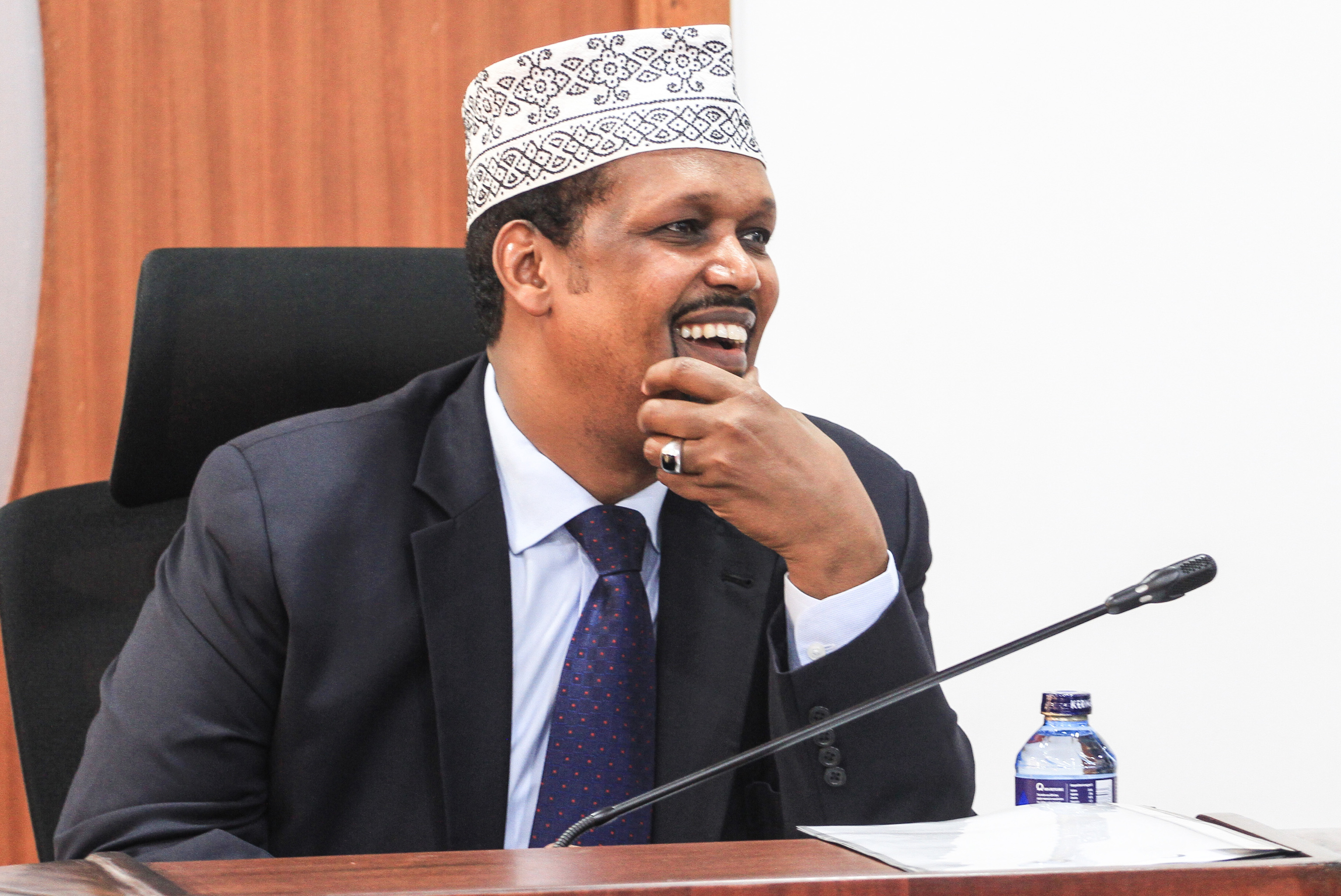
“These counties face challenges in remaining viable unless they receive some form of cushioning,” committee chairperson Ali Roba said.
“The proposal that came in, which now belongs to the House, is to set aside Sh2 billion within the formula, to be shared equally among these 11 counties, in order to carry everybody along.”
However, in a further push to strengthen the safety net for the marginalised counties, Nyamira Senator Okong’o Omogeni has introduced a fresh amendment seeking to increase the allocation to Sh4 billion.
“The amendment to the Motion that I have moved this afternoon seeks to support the 11 disadvantaged counties that receive allocations too low to enable them to perform their functions optimally,” Omogeni told the House.
He emphasised the importance of ensuring that resource allocation to counties empowers them to fulfill their constitutional responsibilities effectively.
“The spirit behind these amendments is to ensure that our big, rich counties carry along the smaller, poorer ones—so that we all progress together,” he said.
“If this amendment carries the day, the existing revenue formula remains intact, and no county will lose out. However, each of the 11 counties would gain an additional Sh400 million.”
Both proposals—the committee's Sh2 billion allocation and Omogeni’s Sh4 billion amendment—are expected to go to a vote this week, in what could mark a significant victory for the least-resourced counties.
Currently, Elgeyo Marakwet receives Sh4.82 billion in equitable share, Embu gets Sh5.37 billion, Isiolo receives Sh4.92 billion, Kirinyaga gets Sh5.44 billion, while Laikipia receives Sh5.38 billion.
Lamu gets Sh3.25 billion, Nyamira gets Sh5.36 billion, Samburu receives Sh5.62 billion, Taita Taveta gets Sh5.06 billion, Tharaka Nithi gets Sh4.40 billion and Vihiga gets Sh5.29 billion.
In its initial formula, the committee had set the current year’s allocation of Sh387.42 billion as the baseline allocation.
This guarantees that no county will receive less than its current allocation in future years.
This amount shall be subjected to the current formula, thus ensuring no county gets less than the current allocation.
“The committee recommends that the fourth basis for allocation of revenue under article 217 (1) of the Constitution for FY 2025-26 to 2029-30 be approved as follows," the report states.
“The first Sh387.42 billion (being county equitable share for FY 2024-25) be shared among counties based on the baseline allocation factor derived from each county’s allocation for FY 2024-25.”
The committee had proposed that any extra allocation, beyond the baseline, be subjected to a new formula.
According to the committee’s new formula, the basic (equal) share has been weighted at 35 per cent, up from 22 per cent proposed by the commission on Revenue Allocation.
The poverty index, which the commission had given a weight of 14 per cent, has been reduced to 12 per cent.
The committee has allocated geographical size a weight of eight per cent, capped at 10 per cent, down from nine per cent proposed by the commission.
Population, which has been the most controversial index in the political scene, has been retained at 45 per cent. The committee has dropped the ‘income distance’ index, which the commission had assigned a weight of 13 per cent.
“The data used to generate the Income Distance index is not directly derived from each county. The KNBS applies a top-down approach to determine each county’s contribution to GDP,” the report says.
In addition, the committee dismissed ‘a stabilising factor’ introduced by the commission to caution the counties from losing revenue.
In CRA’s formula, the commission proposed that the National Treasury and Parliament allocate the counties a minimum of Sh417 billion to ensure no county loses revenue.
Already, the National Assembly has allocated Sh405 billion to the counties. The Senate, on the other side, has proposed an allocation of Sh465 billion.
If approved by the House, the new framework will dictate revenue sharing among the counties for five years, from 2025-26 to 2029-30.
Article 217 of the Constitution says the revenue-sharing formula should be reviewed every five years.
However, the Sixth Schedule of the Constitution further provides that the first and second determinations of the basis of the division of revenue among the counties be made at three-year intervals.