

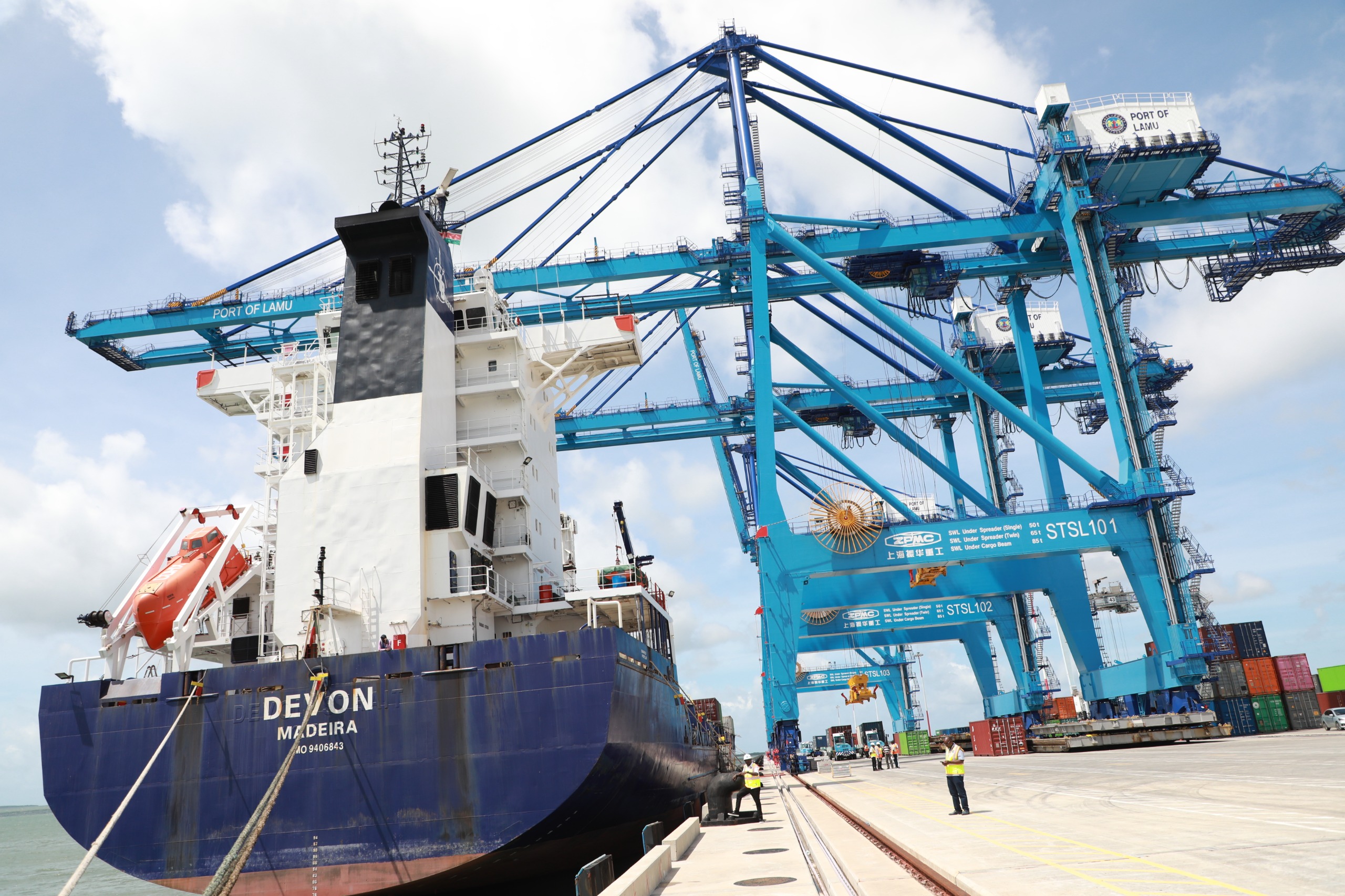
 Operations at the Port of Lamu/ KPA/HANDOUT
Kenya's second major seaport of Lamu has continued to claim its position in the global maritime industry, with the number of new vessels calling remaining stable amid a rise in throughput.
Latest data by Kenya Ports Authority (KPA) shows the port, whose first berth was officially operationalised on May 20, 2021, handled 74,380 metric tonnes last year, a growth of 98 per cent when compared to the 37,576 metric tonnes of cargo handled in 2023.
This, as the number of vessels remained steady with a total port call of 20 vessels mainly non-containerised vessels.
The Port of Lamu projects an increase of both transit and transshipment business following steady rise on the number of vessels making their maiden calls at the port since last year into 2025.
So far, the port, one of the Kenya's key projects under the Lamu Port-South Sudan-Ethiopia-Transport (LAPSSET) Corridor project, has welcomed four vessels on their maiden voyage, positioning it as a key gateway for East and Central Africa and continuing with a strong performance.
“The Port of Lamu recorded an increase of cargo in 2024, attributed to the arrival of the first bulk carrier, which delivered a consignment of 60,000 tonnes of fertilizer destined to the transit market of Ethiopia and other commodities, which added up to a total throughput of 74,380 tonnes,” KPA says in its annual review and bulletin of statistics.
In a week's time, the port will receive MV Mahmoud, a livestock carrier expected to transport over 5,000 cattle destined for Oman in the Middle East.
KPA managing director, Captain William Ruto, has since emphasised the port’s potential, growth of business and shipping lines preferring using Lamu.
Lamu Port general manager Vincent Sidai highlighted the authority’s incentives to enhance the competitiveness of the port, including a promotional tariff and extended storage periods for transshipment.
“We anticipate the growth of transshipment vessels and general cargo throughput this year. This is manly attributed to efficiency of the port,” said Sidai.
A fortnight ago, MV Devon docked at Lamu Port on a maiden voyage from Dar-es-Salaam laden with 809 containers.
The vessel operated by Sealead Shipping Express will be offering a dedicated transshipment service between the Port of Lamu and Dar-es-Salaam. On her voyage, she successfully loaded 539 containers destined for Dar -es Salaam.
Another vessel MV Zhong GU Beijing successfully berthed at port on her maiden voyage last week, discharging 222 TEUS of transhipment cargo destined for Port of Dar es Salaam.
Boasting a Length Overall of 179.99 metres, the container ship sailed from the Jebel Ali port in Dubai, before reaching the Port of Lamu.
While receiving the vessel, Lamu Port manager Mary Wangai said the increase in vessels calling the port is a recognition that the facility plays an important role in facilitating trade and growing economy.
Wangai presented the captain of the vessel, Niu Chao Fang, with a certificate of first call and a commemorative plaque during a brief ceremony held aboard the vessel.
The port further welcomed MV Zhong Gu Ri Zhao laden with 415 TEUS of transhipment cargo destined for the port of Dar es Salaam.
In January, MV Derby D made her inaugural call being the first vessel to call at the port this year. She loaded 371 Twenty-Foot Equivalent Units (TEUs) of transshipment cargo destined for Dar es Salaam, Tanzania.
Two more vessels MV Zhong Gu MV Devon return to the port this week to discharge more transshipment containers for Dar es Salaam.
Lamu compliments the Port of Mombasa serving countries like South Sudan, Ethiopia and other landlocked nations in the region.
It has a bigger vessel handling capacity than Mombasa as its berths are 400 metres long, compared to Mombasa’s 300 meters average while the depth at Lamu is up to minus 17.5 meters against minus 15 meters at the Port of Mombasa.
The government invested Sh40 billion in constructing the initial three berths of the planned 23-berth facility.
The port has the capacity to handle ships with a carrying capacity of up to 12,000 TEUs, compared to the 8,000 to 10,000 TEUs carrying capacity vessels that are calling at the Port of Mombasa.
Lamu can handle Post-Panamax ships. This are vessels that cannot pass the Panama Canal, with the word Post-Panamax being used to decribe world's biggest vessels.
Its natural depth and proximity to the open sea makes it potential for transshipment as it will attract lager vessels that cannot dock at Mombasa, according to the Shippers Council of Eastern Africa (SCEA).







