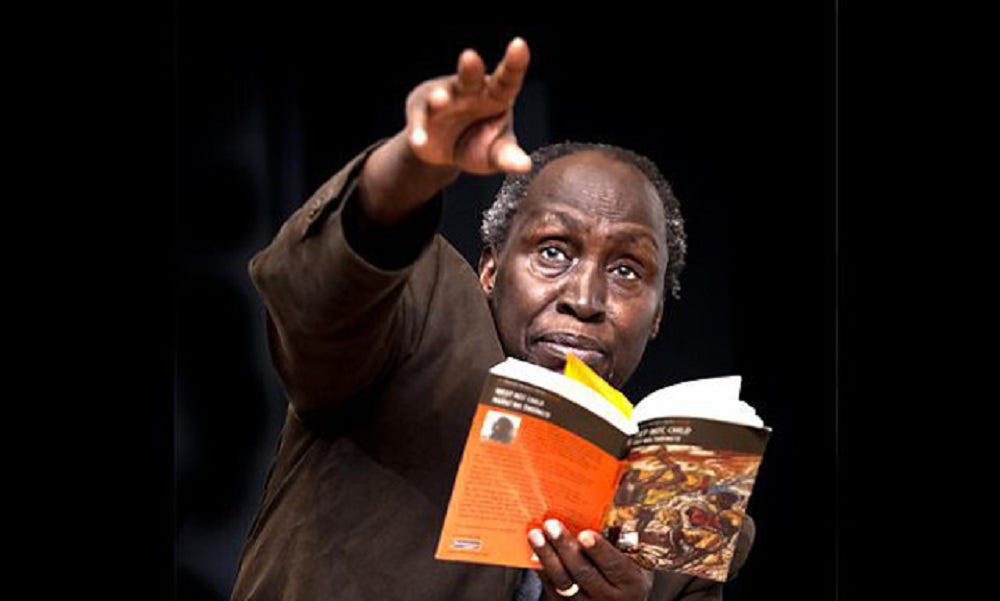
BY 1966, Ngugi Wa Thiong’o had written his second novel and was working on his third – all in English – but an incident in a New York meeting where he was to be recognised changed the course of his life.
An Italian panellist on stage made a comment to the effect that Italian was unlike “those Bantu languages with only one or two words in their vocabulary”.
The panel discussion featured two towering figures – Chilean poet Pablo Neruda and Italian novelist Ignazio Silone.
Then in his late twenties, Thiong’o believed the remark by the Italian showed the contempt the West has for Africans and that it was a relic of old slavery and colonisation.
In a past speech, Thiong’o said the comment did not “land kingly” with him and from that time, vowed to drop English in his writings.
When receiving the Pen/Nabokov award in New York in 2022, Thiong’o recounted his reaction to the dismissive comment.
“I stood up and protested angrily.”
But on returning to Leeds University, England, where he was a student at the time, he said, “I realised all at once, that I was writing my third novel, A Grain of Wheat, in English, the very language I had used for my first two, The River Between and Weep Not, Child.”
This was the start of his proud exhibition of his mother tongue, even addressing a global UN conference in Gikuyu last year.
He delivered the keynote address virtually– in his mother tongue – at the 2024 UN Academic Conference on Africa held at the United Nations Headquarters in New York.
Thiong’o shared a powerful message on the importance of African languages for true justice, including at the UN and beyond.
“If you know all the languages of the world and you don’t know your mother tongue, that is mental enslavement. But if you know your mother tongue and add to it all the languages of the world, that is empowerment. Justice is never justice if conducted in a language one does not understand,” he said, expressing pride in indigenous languages.
His extensive body of work spans novels, plays, essays and children’s literature.
Notably, his short story “The Upright Revolution: Or Why Humans Walk Upright” has been translated into over 100 languages.
The prolific author was also the founder and editor of Mutiiri, a Gikuyu-language journal and held teaching positions at several prestigious institutions, including the University of California, Irvine, Northwestern University, Yale University, and New York University.
He had numerous accolades, including the 2001 International Nonino Prize and the 2016 Park Kyong-ni Prize.
Thiong’o died on May 28 aged 87.
President William Ruto led the nation in mourning the renowned professor, rehashing the common grievance among Kenyans that Thiong’o was bypassed for the Nobel Prize in Literature.
“Many Kenyans cannot remember a time when we were not united in the hope that Prof Thiong’o would finally receive the Nobel Prize for Literature, which we all felt he more than deserved.”