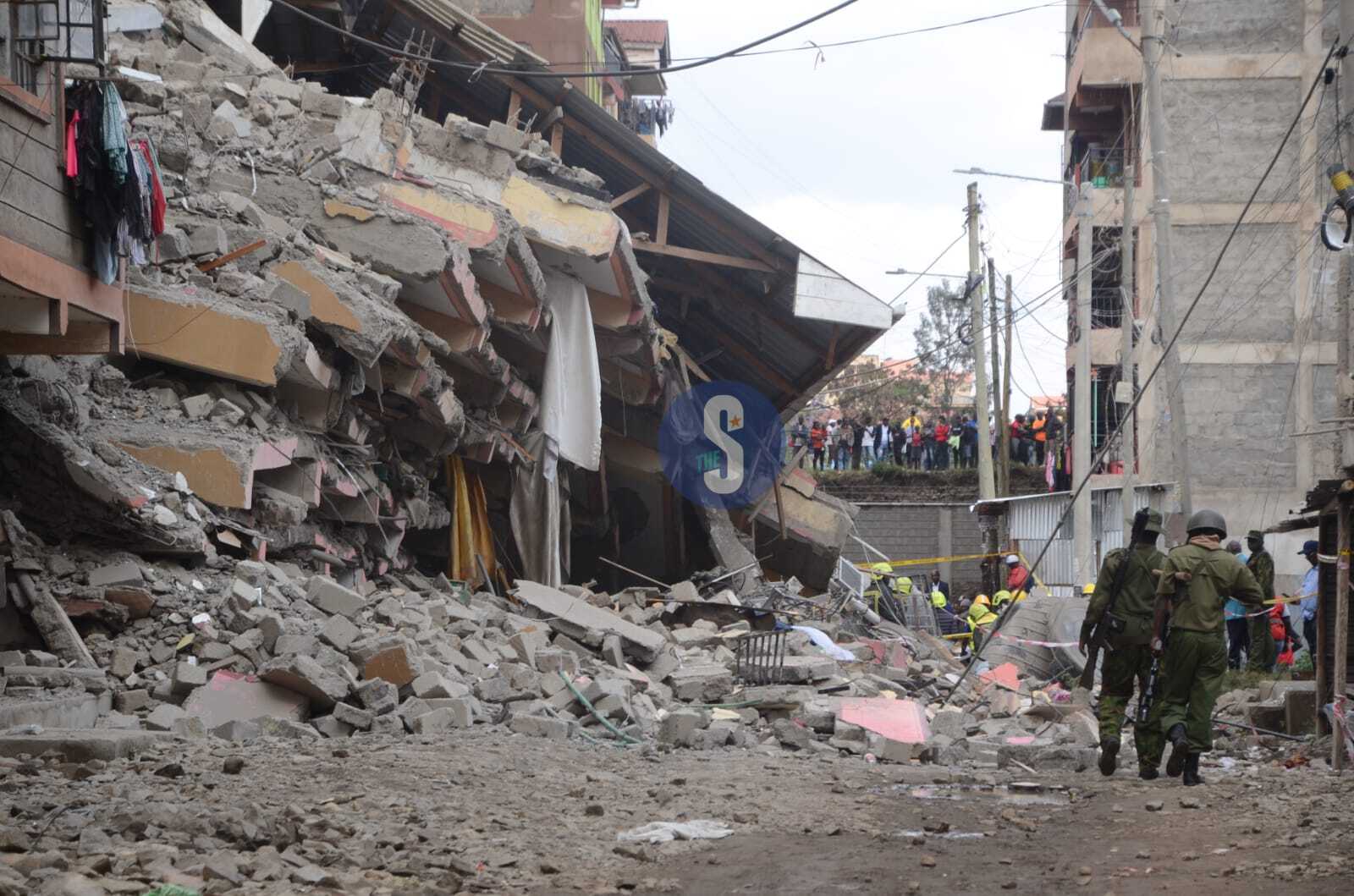
 A multi-storey building that collapsed in Kahawa West area, Nairobi in October 2024./FILE
When a building collapses, the first 60 seconds can mean the difference between life and death.
Whether caused by structural failure, earthquake, explosion, or other disasters, the initial moments are critical for survival and immediate response.
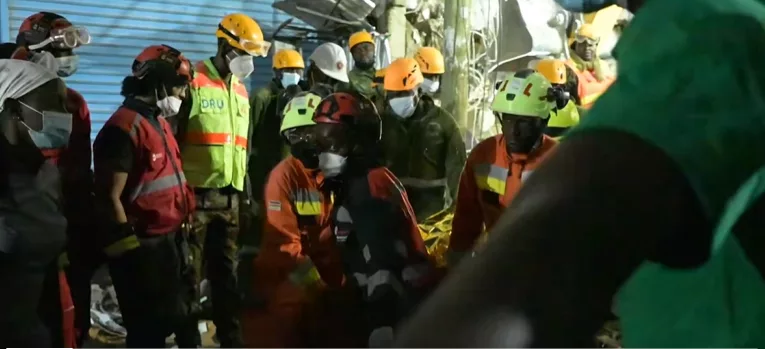
On May 27, 2025, one person was killed and 17 others were injured after a building they were in collapsed in Waruku area, Nairobi.
The semi-permanent two-storey building collapsed on Sunday night, and it is believed to have weakened the structure, leading to its collapse.
The upper floor of the building had church members who were singing and praying. There were also tenants who lived in the house.
Pius Masai, a safety, security, and disaster risk reduction expert, says that it is crucial for the public to understand what actions to take when signs of structural failure emerge.
According to Masai, recognising early warning signs is essential, as he explained that building collapses rarely happen without warning.
“It does not just happen like that,” he noted. “Some people normally see signs and ignore them.”
He outlined common indicators of impending collapse to include doors or windows that previously opened with ease becoming stuck, new or expanding cracks on walls or ceilings, unusual creaking or cracking noises and parts of the building starting to detach or peel away.
“These are red flags,” he said.
“If you notice any, then, the building is speaking to you. Act. Immediate action saves lives."
As for Edward Wanyonyi, a disaster risk reduction expert, buildings differ.
“A typical high-rise apartment is very different from a rural homestead. There are many dynamics on what to do when a building collapse,” Wanyonyi noted.
KNOW THE RISK
He urged people to know the risks, as every building is unique.
This is in terms of structural design, occupancy type, and the presence of utilities like gas and electricity noting that they significantly influence the danger levels and might become a secondary hazard during a collapse.
“You must consider if it’s a commercial building, a school, or a residential home,” Wanyonyi added.
“Are there children? A pregnant woman? Someone with a disability?”
If there are signs that a building may collapse, one is advised to evacuate immediately.
“Do not mind about the property that you have, but you should mind about your own safety first,” Masai emphasized.
While early signs are typical, not all collapses offer a forewarning.
“Explosions, sudden impacts by heavy objects, or extreme natural forces like earthquakes can cause an immediate structural failure.” Masai warned.
He added that such incidents reinforce the importance of routine inspection and maintenance of all residential and public buildings.
A SCENARIO
Masai recounted a case in Pipeline Estate where residents were successfully evacuated.
Unfortunately, a woman who had children remained behind, thinking she still had time. When the building started to collapse, she tried to flee, but it was too late.
“Better to run away and nothing happens than to stay and something tragic occurs,” he advised.
He further stressed on the need for an attitude shift among the public, as preparedness is everyone’s responsibility.
According to experts, the safest evacuation route is usually the staircase, especially if it is structurally sound.
Wanyonyi highlighted that a major cause for building collapse is that they are mostly overcrowded beyond recommended limits.
Reflecting on the Nairobi church collapse that happened on May 27, 2025, he criticized the laxity in adhering to safety codes, particularly in religious and educational institutions.
“These are high-capacity centers, they should follow strict structural and safety guidelines,” he explained.
“But people assume it's okay to skip proper planning just because it's a place of worship.”
He added that compromised construction often done to cut costs leads to structures that can’t support the intended weight and crowd size.
What to do in case of a suspected collapse
• Evacuate immediately using the safest, nearest route.
• Head directly to a designated assembly point to prevent additional injuries.
• Watch out for falling debris and structural hazards.
• Assist others if possible, especially the elderly and children.
• Remain calm and alert for further instructions from authorities.
• If possible, cut off utilities such as gas and electricity to avoid explosions or fires.
• Secure safe passage for first responders like paramedics.
• Contact emergency services.
• If trained, assist with first aid or crowd control.
What to avoid
• Do not use elevators; they may malfunction or trap occupants if power fails or structural shifts occur.
• Do not go back for personal belongings.
• Do not ignore warning signs; do not assume all buildings follow safety standards.
• Do not assume “it will be okay” act immediately.
• Do not rush inside to rescue people in the first minutes, it too soon for the unknown underlying dangers.
• Avoid windows and external walls while in top floor.