Kenya is once again involved in yet another diplomatic fight with Somalia after Nairobi invited Somaliland leader for a work visit.
As soon as Abdirahman Abdillahi — the leader of the breakaway region of Somalia — arrived for what his office called a strategic diplomatic visit, Kenya’s Ministry of Foreign Affairs fired a statement, clarifying the nature of the trip and restated its one-Somalia policy.
Somaliland remains a hot diplomatic potato as while the autonomous region in northern Somalian broke away and declared independence from Somalia in 1991, Mogadishu maintains its claim over it.
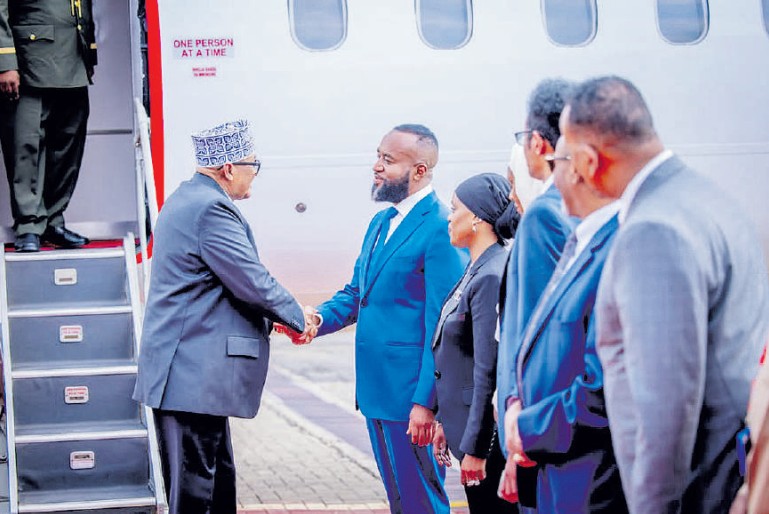
President Abdillahi was treated to a red carpet reception and was received by Mining CS Hassan Joho at JKIA.
Officials of the Somaliland Liaison office in Nairobi led by Mohamed Mohamoud also received Abdillahi.
Somaliland said President Abdillahi will hold talks with senior officials from the Kenyan government and engage representatives of international organisations and diplomatic missions.
“Discussions will focus on areas of mutual interest, including regional stability, economic cooperation and the strengthening of bilateral and multilateral relations,” the Somaliland presidency said.
The highlight of the visit would be the official inauguration of Somaliland’s new permanent diplomatic mission in Nairobi—a significant step in institutionalising Somaliland’s presence and deepening its diplomatic ties in the region, the presidency said.
This triggered Mogadishu, which reportedly protested the visit.
In reaction, Kenya’s Foreign Affairs Ministry issued a statement reaffirming its “unwavering commitment to the sovereignty, territorial integrity, national unity and political independence of the Federal Republic of Somalia”.
The ministry said it recognises Mogadishu as the sole and legitimate body responsible for administering the affairs of Somalia, including "those pertaining to its regions".
It, however, said it would continue to maintain contact and relations with Jubaland and Somaliland — but in consultation with the Somalia government for security cooperation and commercial interests.
The statement was followed by diplomatic letter to Somaliland, cancelling the launch of the diplomatic mission.
“The ministry further notes with concern that to the extent the event of the 27th May 2025 has not been granted approval from this ministry, its investiture of the status of a diplomatic office does not enjoy the imprimatur [approval] of the Republic of Kenya and cannot be allowed to proceed,” the statement said.
The ministry reminded Somaliland that Kenya maintains and reaffirms its “unwavering recognition of the Federal Republic of Somalia as a sovereign state”.
It went on to clarify that its relations with Somaliland and other regional governments is meant to enhance peace, security, trade and investment in the region.
Relations between Kenya and Somalia have in the past been negatively impacted over the Somaliland issue.
In June 2022, then Somalia envoys to Kenya Mohamud Ahmed Nur walked out of a meeting hosted by President Uhuru Kenyatta at State House over the presence of Somaliland flag and envoy.
State House had invited the two diplomats in the capacity of ambassadors and placed the flags of Somalia and Somaliland together.
The Foreign Affairs ministry expressed its regret for “the inadvertent and inappropriate” presence of Somaliland's flag at the event.
Foreign policy analyst Gordon K’achola says Kenya’s conflicted position on Somaliland is emblematic of a broader tension in its foreign policy, reflecting the challenge of balancing strategic interests with regional diplomacy.
K’achola adds the ambiguity reflects a foreign policy that is “reactive, inconsistent, and hesitant to lead boldly where evidence and historical context demand clarity”.
“In 2005, a fact-finding mission led by the then AU Commission chairperson Alpha Oumar Konaré reported that “the situation was unique and self-justified in African political history. It noted that Somaliland’s claim to independence did not violate the principle of the sanctity of colonial borders,” he said.
He says Kenya’s reluctance also exposes a broader inertia within African diplomacy.
“By not heeding the AU’s own precedent-setting report, Kenya and other African nations have allowed politics and fear of setting a secessionist precedent to override evidence-based diplomacy," he adds.
Kenya was once again forced to issue a clarification in October 2023, when President William Ruto’s appointee for the consulate in Hargeisa Abdi Weli Hussein was listed in the section of ambassadorial appointees in the communication by State House.
The confusion was that by appointing an ambassador to Hargeisa, Kenya was recognising Somaliland as a state.
This was despite then Foreign Affairs CS Alfred Mutua clarifying earlier in the year that Kenya was not planning to set up an embassy in Hargeisa.
Senate Speaker Amason Kingi was in December 2023 also caught up in a diplomatic goof on Somaliland when he said he had met “HE Dr Mohamed Ahmed Mohamoud, the Somaliland Ambassador to Kenya”.
“We deliberated on the need to enhance trade between Kenya and Somaliland by facilitating easy movement of people and commodities between the two countries,” he said in his social media statement, essentially treating Somaliland as a severing state.
Foreign Affairs PS Korir Sing’Oei was forced to issue yet another clarification, saying only the federal Republic of Somali is the recognised state entity.
“Somaliland, a region within the Federal Republic of Somalia, has a liaison officer for commercial purposes in Nairobi. This office is not an embassy," Sing'Oei said.
"Foreign policy of the republic is a function of the National government and that Parliament's role is to oversight the exercise of foreign relations by the national government," the PS said.
Instant analysis
Kenya's stance on Somalia and Somaliland involves a complex interplay of regional politics, historical ties, and security concerns. Kenya generally supports Somalia's territorial integrity and opposes Somaliland's declaration of independence. However, Kenya has also maintained diplomatic relations with Somaliland, recognizing its de facto governance. Kenya has engaged in practical cooperation with Somaliland on various issues, including trade, development, and security. This has, however, in some instances been interpreted differently by Mogadishu due to the sensitivity of territorial integrity.