The Senate has secured the support of ODM leader Raila Odinga to spearhead radical changes to the constitution in what may precipitate a referendum.
The move is intended to among others, elevate the Senate to an upper house with expanded veto powers over legislation, the national budget and decisions made by the National Assembly.
Under the Senate's proposal, its legislative mandate would be significantly expanded to include the vetting of state officers, including Cabinet Secretaries and deeper involvement in the national budgeting process.
Given that these proposals touch on fundamental aspects of the constitution, a referendum would be required to enact the changes.
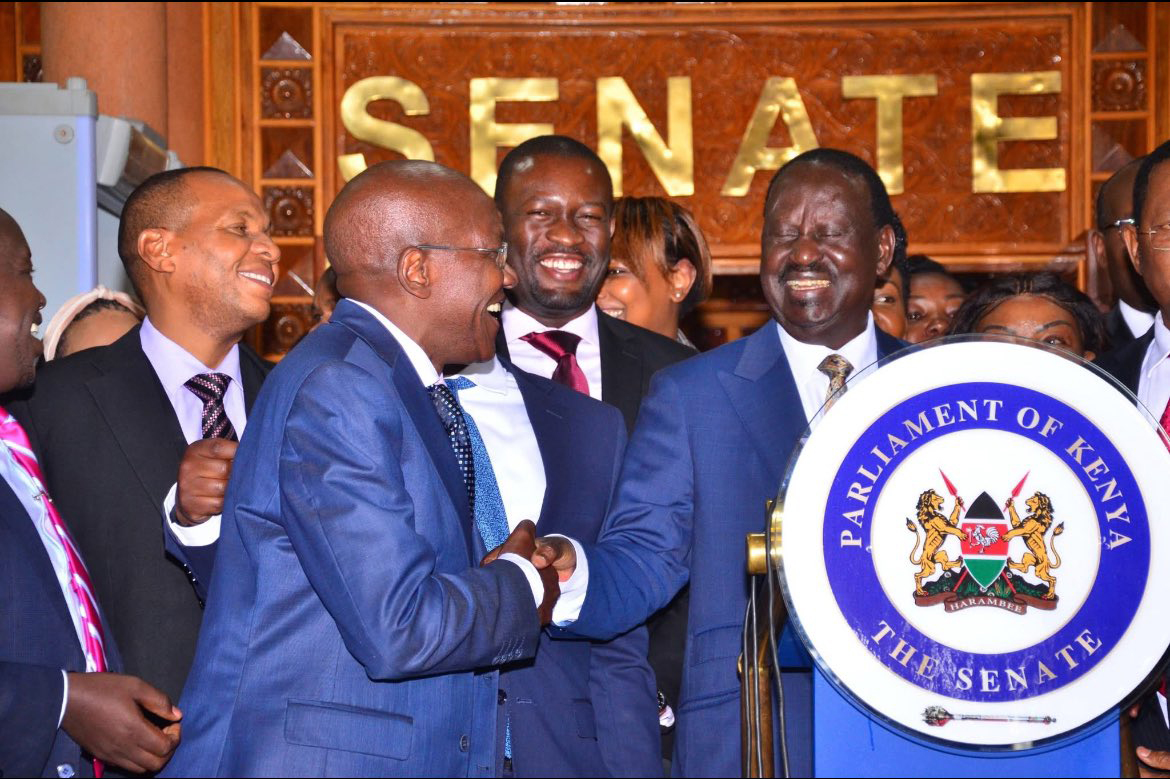
Raila, speaking to journalists after a two-hour closed-door meeting with the senators, underscored the urgency of strengthening the Senate, drawing comparisons to the United States Senate as a model for reform.
“We would like to see our Senate work like that of the US – give it proper powers and responsibilities,” Raila said amid applause from the lawmakers who flanked him.
The National Dialogue Committee (NADCO), a bipartisan process of both Raila and President William Ruto, had recommended sweeping changes to the country’s governance structure including creation of the position of Prime Minister and two deputies.
The report also recommended the establishment of leader of official opposition.
These proposals which require a referendum are still pending as the clock ticks to the 2027 general election.
Two parallel initiatives to alter the country’s supreme law are currently underway in Parliament.
Leading these efforts are the Senate and the National Assembly, each advancing separate constitutional amendment processes.
A high-ranking senator told the Star, "What we are looking at will touch on the governance principles and functions of Parliament of the country, which would call for a referendum."
The National Assembly is acting on NADCO recommendations seeking to entrench several key funds—including the National Government Constituencies Development Fund (NG-CDF)—into the constitution.
Lawmakers also aim to constitutionally anchor the National Government Affirmative Action Fund – managed by women representatives – and the Senate Oversight Fund to enhance the Senate’s oversight mandate.
Recently, Members of Parliament concluded a public participation exercise on the proposed amendments, paving the way for the next phase of the legislative process.
The Senate, however, has rejected the National Assembly-led initiative, alleging that they were excluded and that MPs hijacked the process to push their own interests—particularly the NG-CDF.
Instead, the senators have launched a parallel constitution amendment process, pushing for sweeping constitutional reforms.
They include elevating the Senate to veto any decisions made by the National Assembly.
Under Article 255 of the constitution, a referendum is mandatory if amendments relate to any of the following: the supremacy of the constitution, the territory of Kenya, the sovereignty of the people.
Others are the Bill of Rights, presidential terms, the independence of the Judiciary, commissions and independent offices, the functions of Parliament, or the structure of devolved government.
Demonstrating the seriousness of their push, senators on Wednesday hosted opposition leader Raila, who emerged from a two-hour closed-door session to publicly endorse the Senate-led initiative—delivering a major political boost.
Speaker Amason Kingi, who extended the invitation, described Raila as the "Father of Devolution" and emphasised the significance of his support.
The informal sitting drew nearly all senators, both from the government and opposition, in a rare show of unity.
Raila emphasised that Kenyans have had time to evaluate the constitution since its enactment and now better understand the areas in need of reforms.
“Since 2013, we have implemented the current constitution. We now know where the shoe is pinching us. We want to have a country that is working. The constitution is key for a country to achieve its vision,” Raila said.
Recalling the abolition of the country’s first Senate in the 1960s, Raila argued that the move stifled devolution and undermined checks and balances in Parliament.
“Parliament is one of the free institutions of governance in our country. It represents people, makes laws and allocates resources. Senate needs to play its role and the National Assembly should also play its role,” the opposition chief said.
Raila remains a pivotal figure in Kenya's political landscape, with significant grassroots support and a proven ability to rally national momentum.
He was instrumental in the passage of the 2010 Constitution, widely considered progressive, and successfully led the 2005 campaign that defeated state-sponsored constitutional amendments.
Amending the constitution has proved to be a tedious process that requires a national consensus.
Attempts by former President Uhuru Kenyatta and Raila to amend the constitution were flagged after they ruled out the process as unconstitutional.
Senate Deputy Minority Leader Enoch Wambua revealed that talks with Raila focused on securing the Senate's position in Kenya’s bicameral Parliament.
“It is very clear that the original thinking of coming up with a bicameral Parliament was to make the Senate an upper House, especially on matters of legislation.”
“No law should be passed by the National Assembly and assented into law by the President without passing through the Senate,” he said.
He also opposed the inclusion of NG-CDF in the constitutional amendments proposed by the National Assembly, citing multiple court rulings that have declared the fund unconstitutional.
“Even if they bring that Bill here, even if they hold public participation everywhere, that Bill will fall. That is why we are pushing to change the constitution—to empower the Senate and eliminate NG-CDF,” he added.
The Star has established that the Senate is currently drafting a comprehensive constitutional amendment bill.
A committee led by Majority Leader Aaron Cheruiyot and Minority Leader Stewart Madzayo is spearheading the effort, supported by top legal experts within the House.
Members of the drafting team include Senior Counsels Tom Ojienda (Kisumu) and Okong’o Omogeni (Nyamira), as well as Nairobi Senator Edwin Sifuna, Bomet Senator Hillary Sigei, and nominated Senator Catherine Mumma.
Wambua confirmed that the committee is expected to table the draft bill next week.
“The committee is already working. We gave them two weeks, so next week is the deadline for bringing their draft,” he said.
Vihiga Senator Godfrey Osotsi said they have resolved to forego the oversight fund provided they secure the expanded legislative mandate of the Senate.
“We have unanimously rejected the Senate Oversight Fund. The National Assembly are using it to hoodwink us to pass the illegal NG-CDF,” he said.
Makueni Senator Daniel Maanzo added that the Senate’s proposals aim to correct flaws in devolution.
“Senators are committed to ensuring that all devolved functions are adequately funded, especially in critical areas like health, agriculture, housing and roads,” Maanzo said.