Former Prime Minister Raila Odinga has called for an end to lavish funeral expenses, warning that the practice is financially crippling many households.
Raila called for a sober re-evaluation of the extravagant burial traditions that are prevalent, especially in Nyanza and Western.
Many burial ceremonies in Kenya are usually turned into feasting festivals with families insisting on what they see as "decent sendoff" for their relative.
Raila, a towering political figure amongst the Luo community, said the current system is financially draining bereaved families and the community at large and must come to an end.
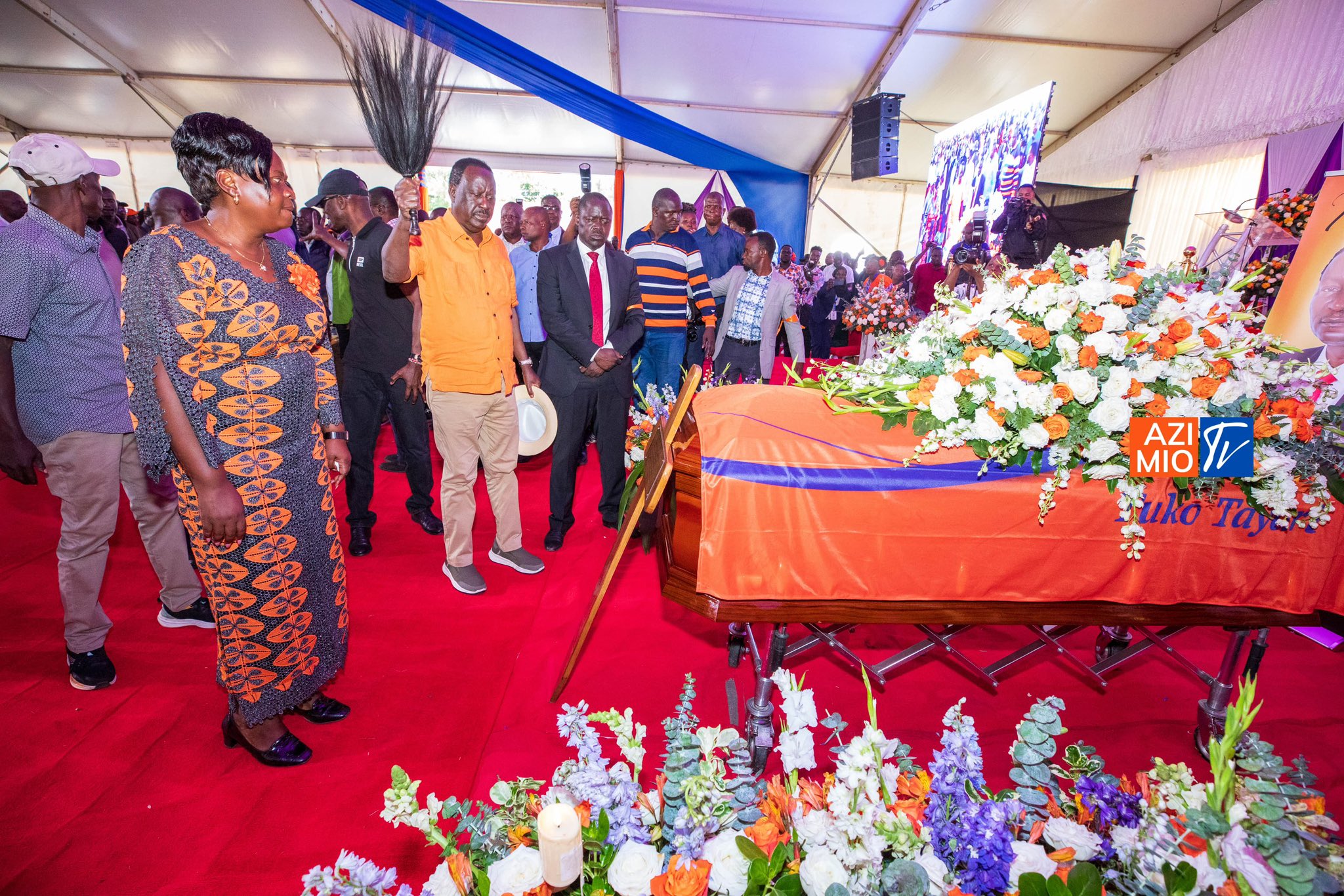
Speaking on Sunday during the burial of Angela Ambitho’s father in Ang’uka village in Rarieda constituency, Siaya county, the former premier urged council of elders to take charge to avoid plunging the community into poverty.
Angela is the founder and CEO of InfoTrak Research and Consulting Limited.
“Funerals have become an industry and it is impoverishing our people every day, every week people are involved in endless planning of expensive funerals.
“Other communities are not doing that, our Muslim brothers send off their loved one hours after death. In our case, it takes even a month before one is buried; all we are doing is organizing send off to our loved ones, we must change this,” Raila said.
The ODM leader argues that these traditions, though rooted in respect and honour for the dead, have morphed into an expensive venture.
“Council of elders, this is where you must focus your energies so that you give our people a way forward or else it is going to impoverish our people who are now incessantly organising funeral,” Raila said.
Funerals amongst the Luo community and Western part of the country are always marked by grandeur — elaborate ceremonies, extended mourning periods, and significant feasting.
According to a study by Ipsos, commissioned by the Association of Kenya Insurance, the average funeral budget for a middle-class family in Kenya is between Sh50,000 and Sh300,000.
The costs increase if there are extended hospital stays, with more elaborate funerals costing up to Sh2.5 million.
Many businesses thrive during times of death, including funeral homes, crematoriums and casket manufacturers.
Other businesses that benefit from funerals include insurance companies, caterers, printers, media houses and burial services.
In a past interview, a sales executive in one of the media houses said death announcements is one of their major revenue streams.
The smallest advert costs about Sh30,000, with the most expensive, which is a full page, being sold at Sh400,000.
“On a good day, death announcements alone can bring in close to Sh5 million,” the executive said.
One of the SMEs that has been in the trade for long is Jaluki Funeral Services in Nairobi’s Huruma estate, near the Dandora-Kariobangi roundabout on Outering Road.James Chege, the proprietor, in a past interview with the Star said his business comprises coffin making and selling, hearse business, public address, tents and other burial services.
When business is good, he can make up to Sh200,000 per month, he told the Star during an interview at his shop last month.
“On a bad month, maybe around Sh100,000. It is just a business like any other, but location and how you deal with your customers matters a lot,” he said.
However, the cost of production, mainly material, has increased, which is eating into his bottom line. These include coffin handles that are mostly imported from China, shroud (clothing used inside coffins), varnish, nails, timber and other material.
For instance, timber prices have increased by about 64.7 per cent in the last three months.
“We used to buy a 12-foot piece at Sh1,700, but it has gone up to Sh2,800,” he said.
“Everything is very expensive now. This means we have to increase our prices if we are to make a profit.”
In some cases, families spend upwards of millions on funeral preparations, an amount that can bankrupt households and delay burials for months as funds are mobilised.
With Raila’s bold call to re-examine funeral spending may well mark the beginning of a cultural transformation. He said that traditionally, among the Luo, burial customs were simple and timely.
He cited Luo Kitgi gi Timbegi, a book authored by Paul Mboya that documents traditional Luo customs.
He referenced a section of the book, which outlines the proper timing and manner of burials according to age and gender.
“If an old man dies at night, he should be buried the following day in the evening, after the sun has gone down. A child or a woman should be buried around lunchtime,” Raila said.
“Now, bodies are kept in the mortuary for two to three weeks, even up to a month, all in the name of planning a ‘proper’ funeral.”
He contrasted these practices with Muslim traditions, where the dead are often buried within 24 hours.
“They don't hold harambees or delay the burial. The body is taken to the cemetery and buried, usually by lunchtime,” he said, suggesting this approach is more respectful and less financially burdensome.