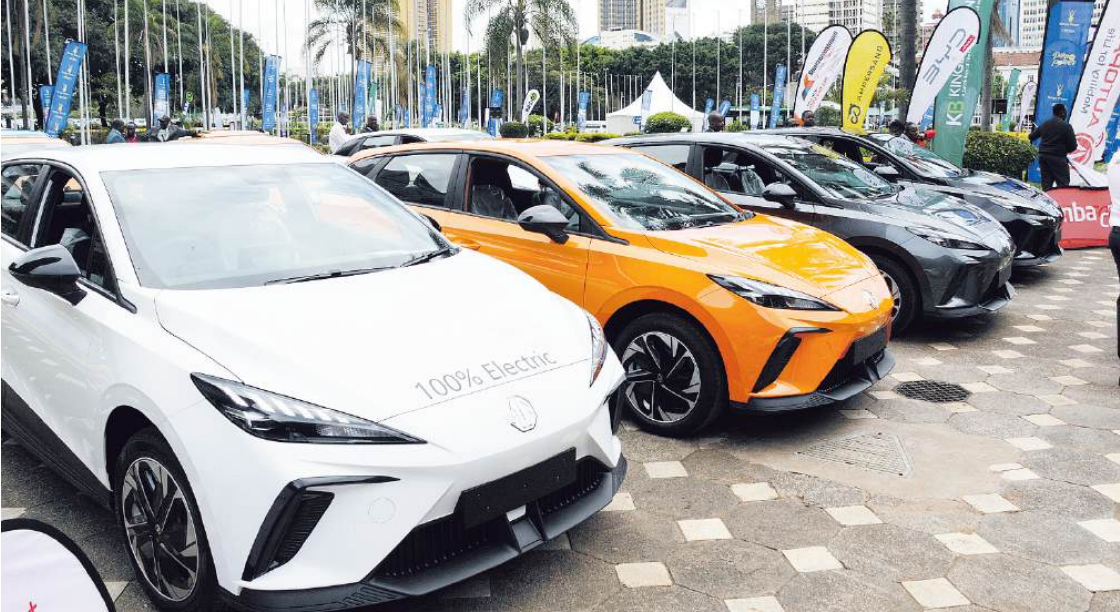
Kenya's drive towards electric mobility (e-mobility) has been slow, blamed for policy gaps despite both the government and the private sector being keen to drive the agenda.
The country had targeted to have at least five per cent of newly registered vehicles to be electric by 2025, as outlined in the National Energy Efficiency and Conservation Strategy.
This was part of a broader strategy to transition to e-mobility, which includes reducing greenhouse gas emissions and increasing the use of renewable energy the transport sector.
The Roads and Transport Ministry unveiled Kenya's first Electric Mobility (e-mobility) Draft Policy in March last year, which it described as “a pivotal moment for Kenya, ushering in a new era in transportation.”
The was aimed at guiding the development of electric mobility in all transportation modes–road, rail, air and maritime, by providing a transition framework from the use of conventional internal combustion engine (ICE) vehicles.
Benefits include reduction in emissions, lower operating costs, decreased reliance on imported fuels and the creation of green jobs.
“Electric mobility has obtained executive approval to make the policy operational, but the Traffic Act must be updated to accommodate emerging technologies,” Roads and Transport CS Davis Chirchir said.
To reignite the push for EVs adoption, National Treasury has since proposed a number of measures to support the adoption of e-mobility in the country with the private sector mainly importers and assemblers the main target.
The Finance Bill 2025 proposes to amend the VAT status to exempt for the supply of electric buses of tariff heading 87.02 (motor vehicles for the transport of 10 or more persons, including the driver, in a move expected to increase the uptake of electric buses which are increasing on the Kenyan roads mainly city transport led by Nairobi.
While manufacturers could be disadvantaged as they cannot claim input tax, it is expected to continue driving the e-mobility growth in the country as opposed to imposing taxes on the same, which could curtail growth.
The supply of electric bicycles and solar and lithium-ion batteries will also be exempted from the 16 per cent VAT tax.Exempt supplies are not taxable and any related input tax is therefore not deductible.
In 2023, the government introduced VAT and Excise Duty incentives to the e-mobility sector, through the Finance Act 2023, that has since helped drive the mass adoption of EV in Kenya, according to the Electric Mobility Association of Kenya (EMAK) president, Hezborn Mose.
Other incentives for both Internal Combustion Engine vehicles and EV's included reduction of duty from 25 per cent to 10 per cent for localisation with an assemblers licence.
Total EV registration in Kenya is at 9,047 vehicles (0.2 per cent of total registered vehicles). Registration increased from 2,694 in 2023 to 5,294 in 2024 (100% increase) with motorcycles accounting for 89 per cent of the total EV registration in the country.
EMAK has since proposed a number of tax and duty incentives among them being zero excise duty and VAT on e-mobilities and lower power tariffs, to drive the uptake of these units.
The association is also of the opinion that e-mobility should remain under zero rated to allow investors input taxes, saying the removal from VAT zero rating to VAT exempt means that suppliers of EVs will not be able to claim back the VAT on the inputs into their business, which poses the risk that EV supplies may be higher for consumers as the VAT on input becomes a sunk cost.
“These reforms are a critical policy step toward aligning Kenya's tax and regulatory environment with its green mobility goals. By formally recognising EVs in local assembly rules, the amendments should support the growth of Kenya's emerging EV manufacturing sector, encourage investment and innovation in clean transport and help streamline the importation and approval process for EV components,” Mose said.
Some of the challenges in the sub-sector, according to EMAK, include high upfront cost where the purchase price of EVs remains significantly higher than other vehicles, costly batteries, limited charging infrastructure where charging stations and mostly concentrated in Nairobi and delay in the implementation of the e-mobility policy which could build investor confidence.
This, even as the number of newly registered road motor vehicles declined by 21.4 per cent to 93,646 in 2024, the Economic Survey 2025 indicates.
There was a 4.7 per cent decrease in newly registered motor and autocycles, and three wheelers to 72,868 in 2024 with the number of assembled motor vehicles decreasing by 14.6 per cent, from 13,527 in 2023 to 11,555 in 2024.
This the economic growth which slowed to 4.7 per cent in 2024, down from 5.6 per cent in 2023, with the deceleration influenced by various factors, including a subdued agricultural sector and tighter credit conditions.
the Kenyan private sector is actively driving e-mobility adoption, investing in electric vehicle charging infrastructure and partnering with the government to create a supportive ecosystem.
They are also developing innovative solutions like battery-as-a-service and manufacturing EVs, pushing for widespread adoption and addressing challenges like charging infrastructure and affordability.
Overall EV passenger vehicles are forecasted to be over 30,000 by the year 2030.
The country is expected to have over 200,000 electric two-wheelers by 2030 and more than 1,865 three-wheelers or commonly known as tuk tuks.
Kenya Power has announced a robust plan to install a total of 45 electric vehicle (EV) chargers across six counties in the next one year.
The chargers will be installed in Nairobi, Nyeri, Kisumu, Eldoret, Nakuru, Mombasa and Taita Teveta counties.
“Kenya Power is committed to enable the country’s transition to electric mobility to catalyse the reduction of carbon emissions. Part of our plan is to create an enabling environment for players within the e-mobility ecosystem through provision of adequate power supply and the requisite infrastructure such as charging stations that will enable motorists to travel with ease,” managing director Joseph Siror said during the recent 3rd Annual E-mobility Conference and Expo in Nairobi.
Out of the 45 EV chargers, six will be located at strategic locations within the Jomo Kenyatta International Airport. So far, Kenya Power has installed 3 EV chargers within Nairobi.
Official statistics indicate that the transport sector accounts for about 23 per cernt of global carbon emissions. The government has committed to a 32 per centreduction of greenhouse gas emissions by the year 2030, a target that will partly be achieved by adoption of green transport systems.
As the transport sector shifts toward electric vehicles and motorcycles, including local assembly, it is opening up new doors in the spaces of manufacturing and consequently jobs, all while supporting the rapid growth of e-commerce by enabling last-mile delivery for both large and small businesses by motorcycles.