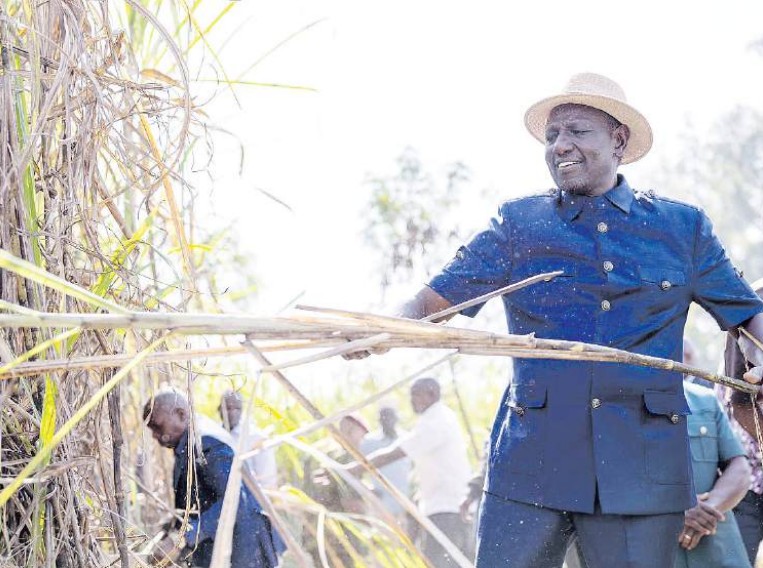
President William Ruto's plan to lease struggling state-owned sugar factories is rapidly becoming a political issue that could significantly impact his 2027 re-election prospects.
The leasing programme – a bold economic fix – could endear Ruto to the voters from the sugar belt region if successful, or boomerang and alienate him from the farmers who consider cane their economic mainstay.
In Western and Nyanza—regions that heavily depend on sugar for livelihoods—the ongoing reforms have triggered fireworks, with some political figures publicly opposing the President's actions.
Observers warn that unless the government engages in more transparent consultations and ensures that local communities benefit from the leases, Ruto risks transforming a once-loyal voting bloc into a group of protesters.
The government last week unveiled its leasing programme, handing over the four public sugar factories to private players.
Under the deal, Nzoia Sugar will be managed by West Kenya Sugar Company, Chemelil by Kibos Sugar and Allied Industries, Sony Sugar by Busia Sugar Industry Limited and Muhoroni by West Valley Sugar Company.
This initiative is part of broader reforms aimed at revitalising the sugar industry, which has long suffered from mismanagement, debt and inefficiency.
However, the move has triggered widespread protests across the sugar belt, with some leaders demanding the revocation of the transfers to allow for a more transparent process.
Recent events indicate that the leasing plans are quickly evolving into a political minefield that could undermine Ruto's potential support base ahead of the 2027 general elections.
Leaders from larger Western Kenya – including Nyanza – where the mills have been leased, have protested the move demanding for the entire process to be halted and reconsidered.
They are accusing the government of sidelining local stakeholders and failing to provide transparency on who the beneficiaries of the leases will be.
Some of these leaders, who were instrumental in rallying support for Ruto's UDA party, are now distancing themselves from the plan.
Kabuchai MP Majimbo Kalasinga, in whose constituency Nzoia Sugar is situated, reads betrayal, saying Ruto had promised to revive the factories, not lease them out.
“During campaigns, we talked about the revival of the company; this leasing came after the elections,” Kalasinga protested.
His stance is supported by other Western lawmakers who have publicly pledged to block the takeover of the public mills.
“We are not going to allow Rail (Jaswant Rai, owner of West Kenya Sugar Company) to take over against the court order,” Majimbo said.
The MPs are concerned that the leasing deal mirrors the controversial Pan Paper takeover, which resulted in the local community losing a valuable asset to private players.
“Let us be clear that the land on which Nzoia Sugar sits is owned by the people of Bungoma; therefore, you must involve them,” Nairobi Senator Edwin Sifuna said.
Busia Senator Okiya Omtatah added, “The issue of leasing is unacceptable; there is no common sense in leasing one sugar company to another. The entire foundation of leasing is nonsensical.”
In Kisumu, MPs James Nyikal (Seme), Onyango Koyoo (Muhoroni), Aduma Owuor (Nyakach), Shakeel Shabir (Kisumu East), Joshua Oron (Kisumu Central) and Woman Representative Ruth Odinga have also opposed the planned leasing of Muhoroni and Chemelil Sugar companies.
“What is being inflicted on the hundreds of households who depend on cane production for a living is an affront to their rights. In fact, it is warfare to decimate a whole community,” said Nyikal, who chairs Duol, an informal platform for Luo elected leaders.
“We, the elected leaders of Kisumu county, completely reject the leases and affirm the call by farmers and other stakeholders that the sugar factories and assets be returned to the people of Kenya until there is comprehensive consultation on the leasing process.”
Politically, the backlash is risky for Ruto as the sugar belt is expected to play a decisive role in tilting the 2027 race.
The issue could also undermine Ruto's gains in opposition strongholds through his working relationship with former Prime Minister Raila Odinga.
There is also concern over the future of factory workers.
Koyoo criticised Chemelil Sugar Company's poor industrial relations record, fearing that employees, many of whom are his constituents, could lose their jobs or be exploited.
“There is no clarity on the duration or conditions of employment under the leases. These are people with families and responsibilities,” the Muhoroni MP said.
However, not all leaders from the region oppose the leases.
Homa Bay Town MP, Peter Kaluma, has thrown his weight behind the exercise, terming the reforms a ‘step in the right direction’ toward restoring profitability and sustainability in sugarcane farming.
He accused politicians of exploiting the plight of sugarcane farmers for political gain while doing little to implement meaningful reforms or provide support to the sector.
“The revival of sugarcane factories and productivity has become the dominant political slogan in Nyanza and Western Kenya for far too long, building political careers while farmers are pushed deep into poverty and destitution,” Kaluma stated.
Agriculture CS Mutahi Kagwe and the Kenya Sugar Board have also defended the leasing process, saying it was above-board.
“I dismiss the assertion that the process was opaque, considering all stakeholders were involved. We are ready to submit any document for scrutiny by Parliament and the general public,” Kagwe said on Tuesday.
Senators have invited the CS to provide further clarification on the leasing process next Thursday.