President William Ruto's choice of men and women to steer the Independent Electoral and Boundaries Commission (IEBC) has kicked off a political storm and threatens to dent the credibility of the team even before they are sworn in.
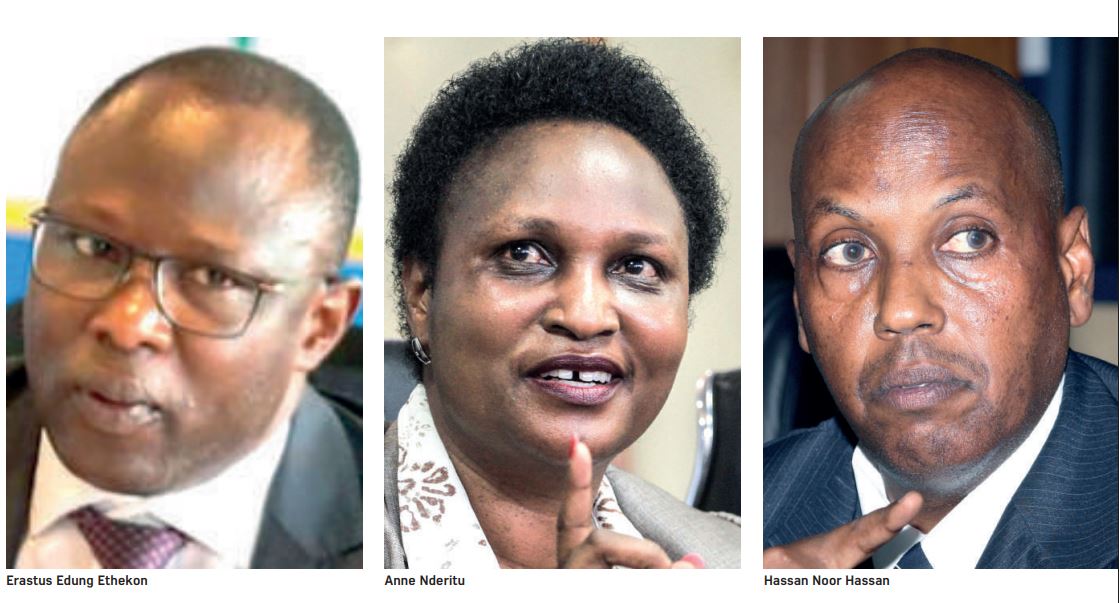
After months of pensive waiting, the president nominated little-known Erastus Edung Ethekon from the minority Turkana community as the chairperson of the IEBC.
Also nominated as members are: Registrar of Political Parties Ann Njeri Nderitu, lawyer Moses Alutalala Mukhwana, former University Vice-chancellor Francis Aduol, Mary Karen Sorobit, Hassan Noor Hassan and Fahima Araphat Abdallah as members.
Ethekon, 48, said on Twitter that he felt honored to be appointed chairperson of the IEBC.
“Thank you, President Ruto, for your trust. I pledge to serve Kenya with integrity, impartiality, and dedication to democratic principles,” he said.
Ethekon once served as Turkana county coordinator and has been technical adviser on development, and holds three masters degrees.
Nderitu, from Nyandarua County, has been at the helm of the ORPP since her appointment by Uhuru in 2020.
Mukhwana, Sorobit, Noor, Aduol, and Fahima are from Kakamega, Uasin Gishu, Mandera, Kisumu, and Lamu respectively.
There were 116 candidates, from which the panel settled on two for chairperson and nine for member roles.
The nominations have, however, sparked fierce criticism, with opposition leaders lamenting the lack of proper consultation.
Wiper leader Kalonzo Musyoka rejected the list, accusing the president of failing to engage key stakeholders. He was joined by Eugene Wamalwa in the call for a relook into the nominations.
“We are extremely concerned that Ruto chose to be partisan by ignoring the principle of consultation and concurrence in his recommendations of the chairman and members of the IEBC,” Kalonzo said.
He argued that the move “has automatically created a low-trust institution,” adding, “As we had stated in prior correspondence on the subject, it is now evident that the intention is to rig not only the next election but also the upcoming by-elections.”
The opposition is expected to issue a comprehensive statement on the matter on Monday, May 12.
Asked whether it was the position of the team, Jubilee Secretary General Jeremiah Kioni said it was best to wait for the comprehensive statement.
“For the sake of harmony, let’s wait for Monday,” he told the Star on the phone on Friday.
Irungu Nyakera, a once Ruto ally turned fierce critic, however, struck a different tone saying the list was 80 per cent fairly balanced.
“We will judge them by their work. I know that not everyone is happy but the 80 per cent is okay. The team looks promising,” the former PS said.
Lawyer Miguna Miguna also criticized the appointments, citing nepotism and alleged connections between some nominees and top government officials.
He claimed that the chair nominee is related to a senior State House official and that former Provincial Commissioner Hassan Noor has ties to a prominent politician.
The allegations have fuelled scepticism about the independence of the new commission, with critics expressing fear the team as is could undermine public confidence in future electoral processes.
Even so, a number of Kenyans, including renowned rights activists have welcomed the selection, citing the win for minority groups.
Augustus Muli, the leader of National Liberal Party whose suit delayed the start of interviews, dismissed Kalonzo and Eugene’s call for further political consultations.
“These remarks are presumptuous and undermine our Constitution. IEBC positions are not political tokens, they must be filled through open, competitive, and merit-based processes,” he said.
He added, “NLP will oppose any attempt to return us to the era of patronage. We stand for integrity, fairness, and the rule of law. Kenya belongs to all of us, not a privileged political class.”
Elog national coordinator Mule Musau said the questions political class is raising are not covered by any law.
He said the selection panel should consider publishing the entire list that was submitted to the president, to end speculation, and how they were scored.
Musau added that Parliament has an avenue for dissatisfied individuals to address their grievances - through petitions and memos to MPs.
"There is nowhere the constitution speaks of consultations. There is no framework. We are heading to a slippery slope if we ignore the role of Parliament in this process."
"That is the space for dialogue, the side conversations are the ones that raise speculation. The president's decision is not final, so anyone with issues should whip their MPs. Parliament is whether the contestation is done," Musau stated.
The new team will take over at a critical time, with the IEBC facing immediate tasks, including the conduct of by-elections in six constituencies namely Ugunja, Banisa, Malava, Magarini, Kasipul, and Mbeere North.
The Ugunja seat became vacant after Opiyo Wandayi was appointed Energy Cabinet Secretary, while Banisa MP Kullow Maalim Hassan died in a road accident.
Malava MP Malulu Injendi passed away after a long illness, and Kasipul MP Ong’ondo Were was assassinated in Nairobi.
The Magarini by-election follows the nullification of the 2022 results, and Mbeere North’s vacancy arose after Geofrey Ruku was appointed Public Service CS.
Given the current political tensions, the new commissioners will be under intense scrutiny to ensure fairness and transparency in the by-elections.
Beyond the by-elections, the commission is expected to give direction on the boundaries review process which was overtaken by constitutional timelines.
Past commissions, including the most recent one under Wafula Chebukati (deceased) have faced accusations of bias, leading to violent protests and legal battles.
As the nominees await parliamentary approval, the debate over their suitability will likely intensify.
The National Assembly’s Justice and Legal Affairs Committee will be under pressure to scrutinize their backgrounds, professional records, and potential conflicts of interest.
“We will vet them promptly. I assure Kenyans that we will be thorough in the process,” committee chairman Gitonga Murugara (Tharaka MP) said.
Should any of the nominees be found unfit, it could force a re-evaluation of the entire list, further delaying the reconstitution of the commission.
As per the IEBC Act, President Ruto would have a chance to send new names from the two (for chair) and nine member nominees that the panel submitted.
The stakes are high, and the new IEBC team must navigate a deeply divided political landscape.
INSTANT ANALYSIS
For now, all eyes remain on Parliament as it prepares to vet the nominees, and on the opposition as it strategize its next move. The coming weeks will be crucial in shaping the credibility, or lack of it, of Kenya’s electoral management body.