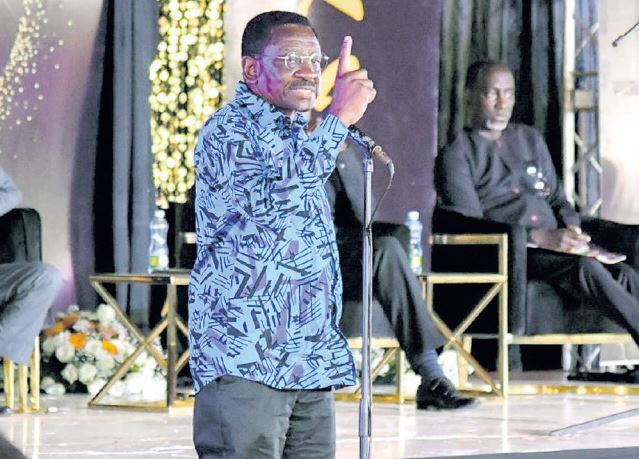
 Siaya Governor James Orengo during the burial ceremony of George Oduor, who was Raila Odinga’s bodyguard. HANDOUT
The political landscape in Kenya has long been shaped by competing philosophies of governance, with idealism and realism often clashing in debates over strategy and ethics.
The recent collaboration between President William Ruto and opposition leader Raila Odinga has reignited this tension, epitomised by the contrasting positions of Siaya Governor James Orengo and the pragmatic wing of the Orange Democratic Movement (ODM).
While Orengo champions an idealistic, activist approach rooted in historical principles of resistance, ODM realists argue that the partnership offers a pragmatic path to addressing urgent national needs.
This dichotomy mirrors age-old philosophical and theological debates about balancing immediate material needs with long-term moral aspirations – a balance that Kenyan leaders must strike to serve both the "body" and "soul" of the nation.
Orengo’s stance reflects Platonic idealism, where politics is a pursuit of superior principles such as justice, equity and resistance to perceived oppression.
For Orengo, collaboration with Ruto risks legitimising a regime he views as hostile to the values championed by ODM luminaries since the era of the “seven-bearded sisters,” a reference to the fiery oppositionists of the 1980s and 1990s who prioritised moral purity over compromise.
This tradition demands unwavering adherence to principle, even at the cost of short-term political gains.
In contrast, the realist faction within ODM aligns with Aristotelian pragmatism, which prioritises practical outcomes over ideological rigidity. Aristotle argued that the purpose of politics is not merely to contemplate the “good life” but to create conditions for its realisation.
For these realists, the Ruto-Raila partnership is a necessary step to stabilise the economy, implement reforms and deliver services to citizens drowning in poverty.
Their focus is on the “body” of the nation – the tangible needs of healthcare, education and infrastructure – that cannot wait for the perfection of political conditions. Indeed, they offer evidence in the economic growth celebrated in the Kibaki years marked by the Narc wave and later, the coalition (Nusu Mkate) government.
The tension between idealism and realism finds biblical resonance in teachings that emphasise holistic care for humanity. Jesus’ ministry, for instance, balanced immediate physical needs with spiritual renewal. In feeding the 5,000 (John 6:1–14), he addressed hunger (the body) before preaching about eternal life (the soul).
Similarly, the Book of James admonishes believers to pair faith with action: “Suppose a brother or sister is without clothes and daily food.
If one of you says to them, ‘Go in peace; keep warm and well fed,’ but does nothing about their physical needs, what good is it?” (James 2:15–16). Applied to Kenyan politics, this duality suggests that leaders must address starvation, unemployment and healthcare gaps (the “body”) while also safeguarding democratic ideals and ethical governance (the “soul”).
To focus solely on one is to risk either moral bankruptcy or societal collapse. Orengo’s idealism, while noble, risks becoming a form of spiritualised neglect if it dismisses the urgency of alleviating suffering.
Conversely, realism without moral safeguards could enable corruption or authoritarianism.
As the governor of Siaya, Orengo occupies a unique position that demands both idealism and pragmatism. His primary duty is to improve healthcare, education and economic opportunities for his constituents, many of whom struggle daily to access basic services.
This requires a realist’s focus on budgets, partnerships and incremental progress. For instance, building a hospital in Siaya demands collaboration with national authorities, even those he may ideologically oppose.
At the same time, Orengo’s legacy as a veteran activist obliges him to advocate for constitutionalism and equity at the national level. However, his role as governor tempers this activism; he cannot simultaneously boycott government structures and effectively deliver for Siaya.
Herein lies the paradox: the same principles that define his idealism—justice and equity—require him to engage pragmatically with existing power structures. To refuse this balance would be to abandon his duty of care to the people who elected him.
The Luo community, from which both Orengo and Raila hail, offers cultural wisdom that reinforces the realist approach. A key Luo proverb states “One does not insult the person who helps bury their dead.”
This underscores the importance of gratitude and collaboration, even with rivals, in times of crisis. To publicly berate Raila for partnering with Ruto, a collaboration aimed at resolving national crises, would violate this ethos.
Criticism, even if valid, must be channeled through “feasible platforms” that preserve dignity and unity. Historically, Luo politics has thrived on strategic alliances.
The 2002 Narc coalition, which ousted Kanu and the 2008 Grand Coalition government exemplify moments where pragmatism achieved what purism could not. The current partnership, though controversial, follows this tradition of prioritising stability and progress over division.
Kenya’s challenges are too complex for a binary choice between idealism and realism. The Ruto-Raila collaboration, flawed as it may seem to some, represents an attempt to synthesise these approaches: addressing immediate needs (economic recovery, public services) while keeping the door open for long-term reforms (electoral justice, devolution).
For Orengo, the task is to straddle both worlds, to fight for ideals while delivering results in Siaya. Philosophy and scripture remind us that human flourishing requires nurturing both body and soul. A government that feeds the hungry but tramples rights is as incomplete as one that preaches justice while ignoring poverty.
In this light, we as leaders must embrace a politics of “both/and,” rejecting the false choice between moral purity and pragmatic care.
As Orengo navigates this balance, he would do well to heed the Luo wisdom: you cannot shun the hands that help you dig a grave, especially when your own people still need healing.
The path forward lies not in rigid dogma but in adaptive leadership, one that honours the past while securing the future.
The writer is the MP for Gem constituency