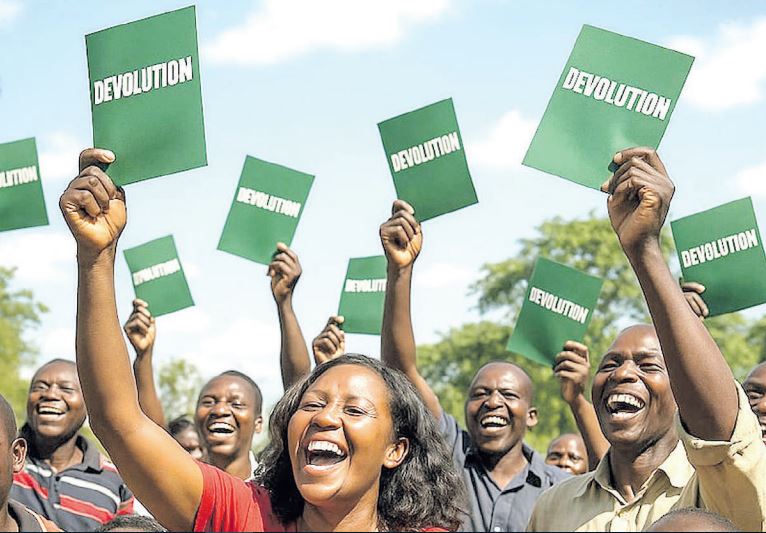
Sustainability concerns have emerged as Kenya marks 12 years of devolution, reigniting debate over the system's impact, structure and long-term viability.
Since 2013, the 47 county governments have received over Sh4.7 trillion from the exchequer—including equitable share, conditional and unconditional grants—to drive development and transform lives.
Yet, opinion remains sharply divided on whether the system has delivered on its promise as a vehicle for equity and grassroots empowerment.
“We need to have a serious conversation about the sustainability of our devolution model,” Homa Bay Senator Moses Kajwang’ said last month, triggering national debate. Kajwang’ proposed reducing the number of counties from 47 to 13.
His sentiments were echoed by Treasury Cabinet Secretary John Mbadi, who floated the idea of cutting them down to 14. “Each of the 47 counties operates as a full-fledged government, with a governor acting like a mini president, a deputy, 10 ministers, more than 10 chief officers, and a county assembly.
“Many are struggling to find work to justify this structure,” Mbadi said.
“I’d go for a maximum of 14 counties. Remember, there were originally eight provinces, and regions like Rift Valley could equate to two or three provinces combined.”
However, these proposals have been met with stiff opposition from devolution proponents, who view such reductions as regressive.
“This is a knee-jerk reaction by an accountant mesmerised by the simplicity of figures,” Kisumu Governor Anyang’ Nyong’o said.
“At the dawn of devolution, there were extensive discussions on the appropriate number of counties. These historical and constitutional considerations cannot be dismissed casually.”
This development comes amid calls by some quarters to increase the number of counties. In 2023, a group of MPs unsuccessfully pushed for the creation of an additional 10 counties.
The new proposed counties were Kuria, Teso, Mt Elgon, East Pokot, West Pokot, Mwingi, Gucha, Suba, Ijaara, Nakuru West and Wajir South. Separately, Kitui senator Enoch Wambua is pushing for the splitting of the county into two: Mwingi and Kitui. Devolution observer Martin Andati said the processes that led to the creation of 47 counties were emotive and that attempts to tinker with the current number would trigger a heated political debate.
“The issue is not about the number of counties. It is about governance. We have not had proper governance. MCAs are not doing effective oversight and governors have adopted the bad habit of corruption,” Andati said.
While some of the devolved units are too large, no one will allow their counties to be merged, he said. “The intention of the counties was not to rely on the Exchequer.
The former councils used to get less money from the Exchequer, but they achieved a lot. Currently, counties are getting billions, but we cannot see much progress. It means there is a lot of theft and pilferage,” he stated.
Governance expert Javas Bigambo observed that the current devolved system of governance is financially unsustainable. According to Bigambo, counties should be formed around regional economic blocs, which are able to generate their own revenues.
“Sustainability is a challenge to all the devolved units. For example, giant counties like Nairobi, Mombasa, Kisumu and Nakuru cannot stand on their own,” he said.
However, he reckoned the push by some politicians to create more counties along tribal lines is a misguided thought that would defeat the whole meaning of devolution.
Lack of political goodwill to fully implement devolution and pilferage and deep-rooted corruption in the counties have posed the greatest challenge to devolution, he said.
COST OF GOVERNANCE AND DEPENDENCE
Devolution was ushered in following the 2010 constitution, aiming to decentralise governance and resources.
Today, the 47 counties are headed by governors, each earning around Sh800,000 per month, supported by deputies, county executives, chief officers, directors and large support staff. Each county also has an assembly led by a speaker and more than 2,000 MCAs collectively.
Despite constitutional provisions for revenue generation through levies, nearly all counties remain financially dependent on the national government.
“We demand that the National Treasury immediately release funds owed to counties. Without this, county governments will have no choice but to shut down,” Council of Governors chairman Ahmed Abdullahi warned last year.
Counties continue to fall short of their revenue targets. According to the Commission on Revenue Allocation, counties have, on average, only achieved 63.5 per cent of their annual targets.
The Intergovernmental Relations Technical Committee has finalised the unbundling process, paving the way for a full transfer of responsibilities.
A report by the IGRTC on the unbundling of devolved functions tabled in the Senate showed that the central government is still holding onto devolved functions valued at Sh272.2 billion.
“They rely on the national government, which is the biggest revenue collector. But what are counties doing to bridge the deficits? That is the conversation we need to have,” IGRTC CEO Kipkirui Chepkwony said.
Chepkwony disclosed that the agency has concluded the unbundling of devolved functions, pending transfer to the counties.
“We concluded the unbundling of the functions and gazetted it on December 16. In the next week or so, we will be rolling out sensitisation on exactly what we have been able to unbundle and clarify the details,” he said.
“There would be subsequent processes on how, then, eventually, these functions will be resourced from the national government.”
RISING PERSONNEL COSTS AND STALLED PROJECTS
Personnel costs remain a major burden. A Senate Public Accounts Committee report revealed that 36 counties spend more than the legal limit of 35 per cent of their revenue on salaries.
From 2013–23, counties spent Sh1.47 trillion on personnel emoluments, compared to just Sh925.18 billion on development.
Annual spending on wages rose from Sh77.4 billion in 2013–14 to Sh195.09 billion in 2022–23. In addition, counties have accumulated Sh168 billion in unpaid bills to suppliers and contractors. Ghost workers and stalled projects plague many counties.
In 2023, Kisii reported 1,341 ghost workers, while Machakos reported the lowest figure at 37. The Auditor General continues to flag stalled or abandoned “white elephant” projects across counties.
“The Controller of Budget recommends that counties prioritise development programmes to improve citizens’ quality of life,” said Controller of Budget Margaret Nyakang’o.
Graft and political interference Devolution has also created new centres of corruption.
At least three former governors – Moses Lenolkulal (Samburu), Ferdinand Waititu (Kiambu) and Daniel Waithaka (Nyandarua)– have been convicted in major graft cases.
Senators Boni Khalwale (Kakamega) and Enoch Wambua (Kitui) have accused the National Assembly and corrupt county leaders of undermining devolution.
“The biggest threat to devolution is the National Assembly. The second is governors willing to play ball for personal gain,” said Wambua.
Khalwale added that senators have failed to champion devolution, allowing the National Assembly to dominate revenue-sharing discussions.
SIGNS OF PROGRESS
Despite the mismanagement, many believe devolution has delivered tangible benefits.
Counties have improved healthcare, upgraded road networks and invested in agriculture, tourism, and manufacturing, boosting local economies and creating jobs.
“Devolved governance in Kenya has steadied and progress on various fronts is notable,” Bigambo said.
Nyeri Governor Mutahi Kahiga called devolution “the best gift Kenyans ever gave themselves,” highlighting successes in ECDE education.
“Since independence, the national government has never funded ECDE. Under devolution, we have hired teachers and built over 15,000 classrooms,” he said.
However, he also criticised the Treasury for delaying fund disbursements, which he said undermines county operations.
Human rights advocates Boniface Mwangi and Suba Churchill also praised devolution, citing achievements in health, infrastructure, and local economies.
“Former Makueni Governor Kivutha Kibwana and Kisumu’s Anyang’ Nyong’o have shown what devolution can achieve. The problem is theft,” Churchill noted.