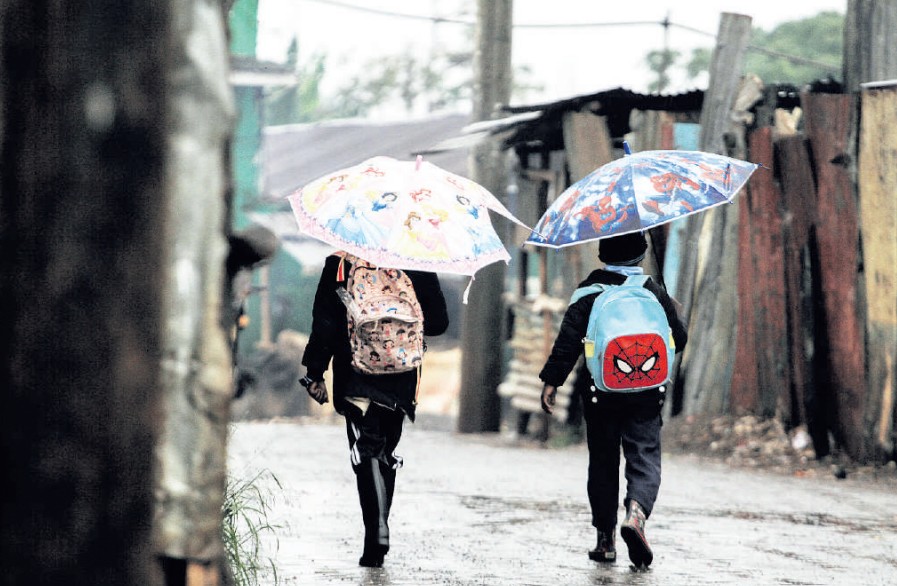
Even as Kenya’s education budget continues to grow each year, many children are still going without the basics they need to learn — a warm meal, a clean classroom and in some cases, sanitary towels.
A new civil society report paints a troubling picture of the reality behind the numbers, revealing that despite an increase in national education funding – from Sh460 billion in 2018 to Sh628 billion in 2022 – the amount allocated directly to students, known as capitation, has remained unchanged.
And that’s a problem, the report warns, because the cost of living has not stood still.
“Capitation per learner has remained the same, while the prices of everything else – food, books, uniforms – have gone up,” the report states.
“This gap is pushing schools to quietly ask parents for extra fees just to keep the lights on and lessons going. It’s hurting the most vulnerable learners.”
The report, submitted to the United Nations as part of a review of Kenya’s human rights record, highlights how most of the education budget is spent on salaries and operational costs, while support that reaches individual learners — especially in public schools — remains stagnant.
Today, the government allocates Sh1,420 per year for each primary school pupil, Sh15,000 for junior secondary and Sh22,240 for secondary school students.
Learners with special needs receive slightly more. But these figures haven’t been adjusted to match current economic realities.
Even worse, many schools say these funds arrive late — or not in full — disrupting lesson plans and learning activities. Teachers and administrators are forced to improvise. Parents, especially in rural and informal urban settlements, are left frustrated and financially stretched. And the effects go beyond the classroom.
The report raises deep concern over school feeding programmes, often the only reliable source of food for many children in vulnerable communities.
While the government committed to a national school meal strategy back in 2017, implementation has faltered.
Recent budget allocations for school health and meals have dropped significantly, from Sh6 billion last year to Sh3 billion this year.
Worse, all the money is routed through the National Council for Nomadic Education in Kenya, which means support is limited mostly to children in arid and semi-arid regions.
“What about children in urban slums, or in poor rural areas that aren’t technically ASALs?” the report poses.
“Hunger doesn’t follow a map. When children don’t eat, they can’t focus. They don’t stay in school. They don’t pass exams. We are raising a generation that is being left behind.”
One of the most heartbreaking issues raised is the state of the government’s sanitary towels programme.
Initially hailed as a breakthrough in girls’ education, the initiative is now facing budget cuts, poor coordination and allegations of corruption.
Only girls in public primary schools currently benefit from the programme, excluding their peers in public secondary schools and private institutions.
“It’s deeply unfair,” the report reads.
“It violates their right to dignity, to education and to equal treatment. A girl who misses school because she doesn’t have a sanitary towel is not just falling behind – she’s being told she doesn’t matter.”
The report calls on the government to revisit the distribution of education funding – not just in headlines and budgets, but in classrooms and schoolyards, in lunch queues and sanitary facilities.
“More money is not enough if it doesn’t reach the children who need it most. Every child deserves a chance to learn, to be fed, to feel safe and to be treated with dignity. Right now, we are failing too many of them.”