The race to reconstitute the Independent Electoral and Boundaries Commission (IEBC) has entered a critical phase as the balls moves to President William Ruto and Parliament.
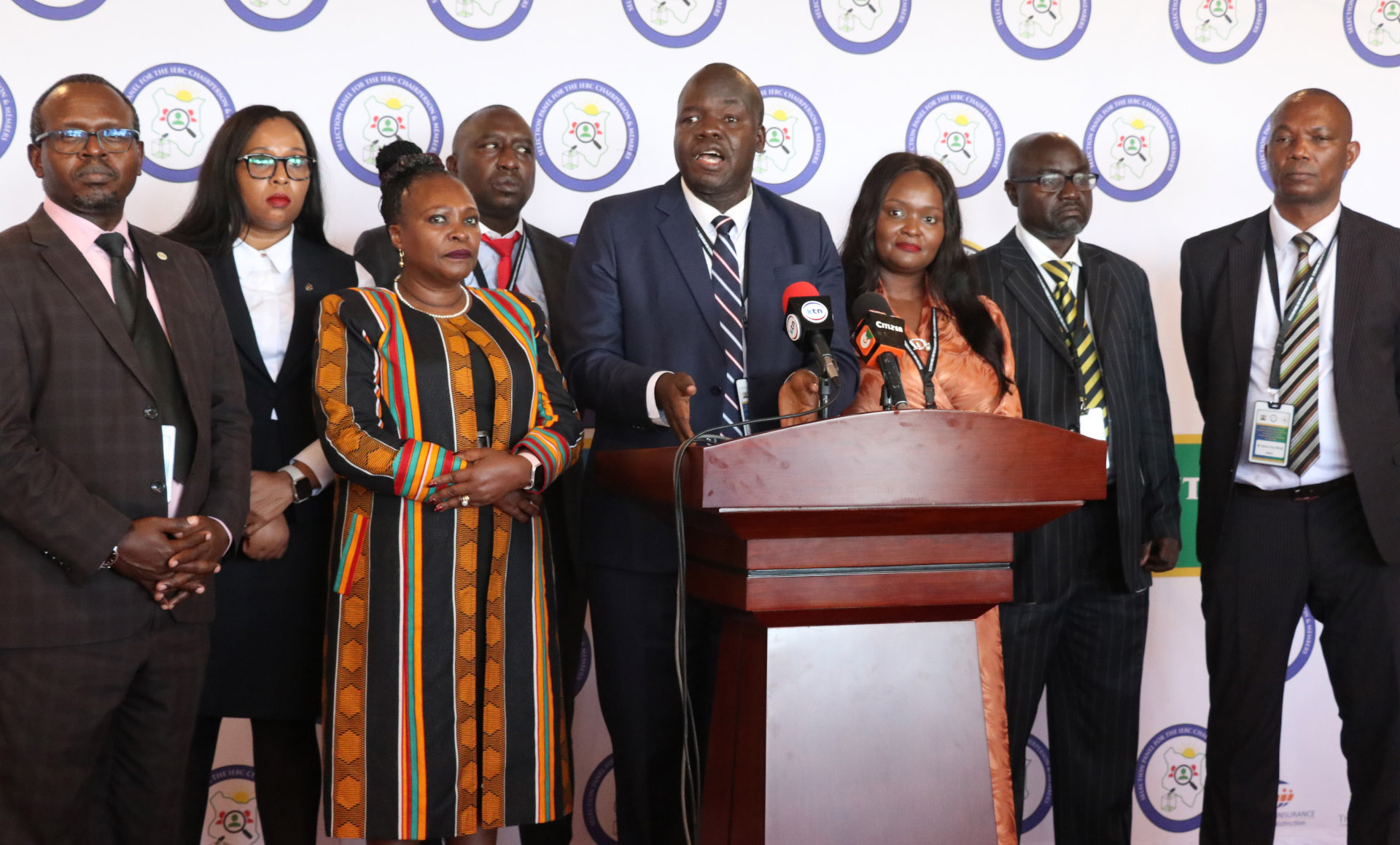
The recruitment panel concluded interviews on Friday and the team retreated to compile the final list of nominees.
According to the law, the team led by Nelson Makanda should submit two candidates for the IEBC chairperson to President Ruto for appointment.
The team will also send nine names for commissioners jobs out of which Ruto has the leeway to pick six.
This latitude given by the law to the President has caused unease within the opposition who want to be consulted on the eventual nominees.
Notable names that faced the panel for IEBC chair include, Judge Charles Nyachae and former Judiciary registrar Anne Amadi.
After submission of the names next week, President Ruto will have seven days make his decision.
He would then submit the list of nominees to Parliament for approval.
The National Assembly Justice and Legal Affairs Committee (JLAC) is required to vet the nominees and report its recommendations to the plenary.
The Public Appointments (Parliamentary Approval) Act, Cap7F grants the House team 28 days to report its findings.
JLAC chairman Gitonga Murugara concedes that "the interview process has been painstakingly slow", but was quick to note that the selection panel "had to do a thorough job".
The Tharaka lawmaker, a lawyer by profession, estimates that the earliest the process would conclude is June.
"As soon as the nominees are picked, we will vet them quickly, and I assure Kenya that by the end of June, the commission will be in situ," Murugara said.
But even as the panel scrambles to meet the timeline, fears are rife that political interference and bureaucratic delays could play out.
With the deep-seated mistrust between the political camps and a history of last-minute interference in such high-stakes appointments, few believe the process will go smoothly.
The opposition team, led by Wiper leader Kalonzo Musyoka, has already warned it will reject any nominees it views as biased. He alleged attempts to manipulate the process.
The assertions raise the spectre of a protracted parliamentary standoff that could push the country into uncharted legal territory.
Kitui Central MP Makali Mulu, also Wiper secretary for devolution, said they anticipate a protracted debate when the names arrive in the assembly.
“The earliest the process can vacate parliament is June, especially now that we are heading to recess. The critical budget process, which takes a lot of our time, is also here,” the MP said.
MPs are proceeding on recess this Thursday and are expected to resume sittings towards the end of May.
A civil society group has also sued, demanding that the process be started afresh, citing among others, claims that some candidates were slotted midway.
Election experts warn that as the haggling continues, and with the elaborate approval process that usually characterises the picks, the urgency of time cannot be overstated.
By mid-2026, the commission must oversee party primaries, conduct a fresh voter registration drive, audit the existing voter roll, and certify election technology—all under strict legal deadlines.
Election Observer Group says a newly reconstituted IEBC would be hard-pressed to prepare for the 2027 polls adequately.
Elog national coordinator Mule Musau told the Star that, from his assessment, this year is already off the table.
This, while the team must tackle two issues already lapsed by time, that is, the boundary review and the by-elections in several parts of the country.
“Together with induction and administrative engagements, this will probably take this year off the table,” Musau said.
The expert pointed out that the new commission has to implement critical electoral reforms by mid-next year.
With the 2027 general election now less than two years away, a delayed or disputed IEBC appointment risks derailing the country’s tightly regulated electoral calendar.
Any slippage now could force a rushed and error-prone process next year, raising fears of a repeat of 2017 when a shambolic election led to a historic Supreme Court annulment.
Past recruitment crises offer little comfort even as the country hurtles towards the second part of Ruto’s first term.
In 2016, political infighting and court battles delayed IEBC appointments, leaving the commission weakened ahead of the contentious 2017 polls.
In 2022, the process was again mired in disputes, with then-President Uhuru Kenyatta and his handshake partner, Raila, accused of stacking the commission with allies.
This time, with the 2027 race already heating up, experts are alarmed that a flawed or delayed appointment could deepen public distrust in the electoral system.
“The bottom line is that the new team must address all the major issues – boundaries, by-elections, voter register cleaning, IT procurement and electoral reforms between now and July next year. That is 15 months on the maximum,” Musau explained..
The expert observed that a new register is best put in place by mid-2026 while procurement and testing of the required technology should be done by mid-next year.
“Why most of these have to be done by mid-next year is that one year to the elections (July 2026 to August 2027), we shall get to the homestretch, which has clearly stipulated process timelines,” Musau stated.
In the lead up to elections, IEBC gets busy monitoring spending limits, registering voters, auditing registers, nominations and candidates’ registration.