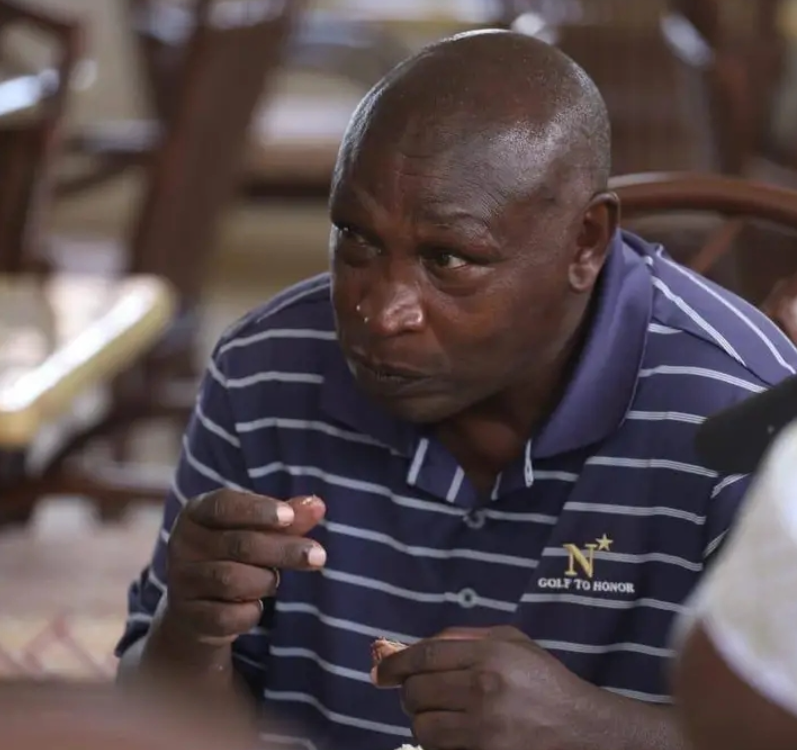
Patrick "Mont" Waweru, 69, embodies the quiet strength of a champion long retired from the ring.
His journey is a mosaic woven with threads of triumph, discipline and an unwavering commitment.
From his debut at the 1976 regional tournament to his final appearance at the 1988 Seoul Olympics, Mont's career is a testament to the spirit of perseverance.
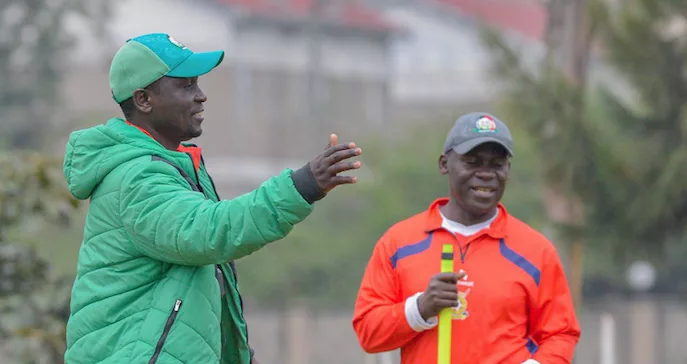
At the Mathare Depot in Nairobi, where he has been guiding the national boxing team since he was appointed an assistant coach, the scent of sweat and liniment hangs heavy in the air, a phantom echo of countless sparring sessions.
As he settles down for an interview, his face is etched with the map of a thousand battles, and his eyes, though softened by time, still hold the steely glint of a champion.
His story transcends the boxing ring; it's a narrative of dedication, resilience, and the unwavering pursuit of a dream. It's a story that deserves to be told and retold, inspiring generations to come.
He speaks of the glory days, of the thrumming energy of bustling boxing clubs —Breweries, KCC, KPA—each a crucible forging Kenyan boxing talent. Now, only ghosts remain, replaced by a void that swallows the dreams of aspiring pugilists.
Mont’s eyes light up as he recounts his boxing career, which began at the Starehe Boys Centre, where his raw talent was honed under the guidance of dedicated coaches.
The nickname "Mont," he explains with a grin, stems from a resemblance to a short, soft-spoken police colleague. It's a fitting moniker, encapsulating his quiet strength and the unexpected twists of fate that shaped his career.
A smile dances on his lips as he shares the story: "I had a police colleague named Montero, who was Muhindi (Asian). He was short, and like me, he spoke softly, so we looked a lot alike."
My co-workers started calling me 'Mont' when I returned from the Commonwealth Games in Edmonton, Canada," he explains. This nickname has become synonymous with his identity, a reminder of the journey he embarked upon long ago.
Born on June 9, 1956, Waweru's entry into boxing was serendipitous. He had never envisioned a future in the sport; it was a twist of fate that led him there, a chance encounter with a boxing tutor at Starehe Boys Centre.
In 1968, the late director Dr. Geoffrey Griffin hired a boxing tutor at Starehe Boys Centre, and Mont was among the first cohort to benefit from this initiative.
Surrounded by peers like Francis Peter Kinuthia, who later joined the Kenya Air Force, Mont began to embrace the sport that would define his life. From there, his talent blossomed, nurtured by dedicated coaches and honed in the crucible of competition.
His journey took a pivotal turn at an intermediate tournament in Pumwani in 1970, where senior GSU officers recognised his potential. "I was asked if I wanted to join the police force by a senior officer after the tournament. I then went directly to Embakasi in 1973 to attend the GSU Training College," he recalls.
His early years in the police force, however, were fraught with challenges. "I was assigned to police work for two years without any training as soon as I graduated. It was not until a few weeks before the tournament that my bosses realised I was working as a boxer," he laments.
He faced a disheartening setback during his first significant international competition, where he nearly succumbed to the physical toll of the sport; a brutal lesson that fueled his unwavering commitment to rigorous training.
His initial reluctance to compete stemmed from a lack of preparation, but the insistence of a senior officer, Hamisi Abdalla, compelled him to represent the unit.
"I attended the tournament and nearly died from beatings. I even believed that Hamisi wanted me dead," he recalls, a hint of humour masking the pain of that experience.
Yet, from adversity came determination. After enduring a barrage of punches, Mont made a promise to himself: he would never again be a punching bag.
"I emerged stronger, committing to rigorous training. Soon enough, I earned my first medal at an inter-services competition," he said.
His boxing odyssey began young, a natural talent blossoming into a national champion. At just 19 years old, he made a remarkable debut for Kenya at the 1976 regional tournament, clinching a bronze medal.
A wisp of a man at 5'2 ft, Mont's stature belied his formidable skill and tenacity. His early success laid the groundwork for a burgeoning career, one that would see him rise through the ranks of amateur boxing.
His debut at the 1976 regional tournament was a whisper compared to the thunderous applause that followed his masterclass act at the 1978 Commonwealth Games in Edmonton.
Two years. That’s all it took for this Kenyan boxing prodigy, born under the June sun of 1956, to transform from a casual enthusiast into a Commonwealth Games silver medalist.
The silver he tucked away at the Games, a hard-fought battle against Gerard Hamill, solidified his position as a rising star, a beacon amidst a constellation of Kenyan boxing talent – Stephen Muchoki, Mike "Stone" Irungu, and others who shared the glory of that Edmonton campaign.
"From there, people started to recognise me even though I was tiny in size," he reflects, a sense of pride evident in his voice.
Aged 22, "Mont" added another medal to his collection after taking home silver in the Canadian city, where he lost to Northern Ireland's Gerard Hamill in the lightweight finals.
The image of Gerard Hamill, the Northern Irish champion, remains a bittersweet memory—a testament to the razor's edge of victory.
Edmonton wasn't just Mont's triumph; it was Kenya's boxing showcase. Gold medals shimmered around him, won by compatriots Stephen Muchoki and Mike "Stone" Irungu, their names etched into the annals of Kenyan boxing history.
Other Kenyans, too, tasted victory – Abdulrahman Athumani's silver and the bronze medals from Edward Thande, Dougals Maina and Michael Mwangi was a constellation of talent illuminating the Canadian sky.
The name "Mont," once just a nickname, became etched into Kenyan sporting folklore, a testament to unwavering dedication. The path of a champion is rarely straight. Injuries, perhaps, or the capricious hand of fate, kept Mont from several international competitions.
Missed opportunities in Belgrade, Benghazi and Brisbane threatened to dim his star. But the fire within Mont refused to be extinguished.
"I missed several international competitions in the years that followed my stellar Edmonton debut, including the 1978 World Amateur Boxing Championships in Belgrade, the 1979 African Championships in Benghazi, the 1982 Commonwealth Games in Brisbane, Australia and the World Championships in Munich that same year," he lamented.
The years between Edmonton and Kampala felt like a boxing purgatory, a period of absence punctuated by the gnawing regret of missed opportunities.
Yet, the fire within never dimmed. His return in Kampala, at the 1983 Africa Boxing Championships, was a phoenix rising from the ashes. The Ugandan soil, the scene of his triumphant victory over Joseph Gama, bore witness to a renewed glory. The gold medal, a hard-won prize, felt heavier than any before, a testament to resilience and the enduring spirit of a champion.
The four gold medals Kenya secured that year – thanks also to Ibrahim "Surf" Bilali, John Wanjau, and James "Demosh" Omondi – were a collective roar, a resounding victory echoing the quiet determination of Mont Waweru's journey. Throughout his boxing career, Mont remained steadfast in his commitment to the lightweight category.
"I was severely beaten the only time I attempted to switch my category while I was still a recruit. I then decided to only compete in one category, lightweight (60 kg)," he explains.
This decision underscored his discipline; he trained diligently to maintain his weight, allowing him to compete at a high level consistently. The Los Angeles Coliseum in 1984 roared—a deafening cacophony that swallowed his whole Olympic dream.
The sting of defeat to South Korean boxer Chil Sung Chun, a first-round knockout, was far louder than the crowd's thunder. The weight of Kenya's hopes pressed down, crushing his promising debut.
But defeat, it turned out, was merely a prelude. Bangkok, later that year, offered a different soundtrack. True to his character, Mont did not allow this setback to define him.
His spirit, a resilient flame flickering against the winds of adversity, refused to be extinguished. Later that year, in the humid Bangkok air, he ignited. The King's Cup tournament shimmered with the sweat of exertion and the gleam of ambition. Here, amidst the bustling city, Mont found his redemption, securing gold and silencing the ghosts of Los Angeles.
A whirlwind of controlled fury, Mont danced around his opponent, Wisut Meesuantong, ultimately securing a gold medal – a personal redemption echoing through the stadium.
His journey continued, escalating to the electrifying atmosphere of the 1987 All-African Games. Mont, now part of the legendary Hit Squad that included Martin "Nyoka" Ojuang and Harold Obunga, achieved the unthinkable—eight gold medals, a collective triumph that resonated far beyond the arena.
Their camaraderie, a symphony of shared sweat and unwavering support, inspired a generation. Mont, a leader by example, nurtured the burgeoning talent around him, forging a legacy of excellence. The 1987 All-African Games presented a new chapter, a collective narrative. Mont wasn't a lone warrior anymore; he was part of the Hit Squad.
Their combined gold medal haul was a resounding declaration of Kenyan boxing's might, a triumphant chorus where Mont's brilliance harmonised with the team's success.
Despite missing the 1987 King's Cup, Mont made a triumphant comeback with the 1987 All-African Games HitSquad. In addition to Harold Obinga, Joseph Akhasamba, and Martin "Nyoka" Ojuang, all eight boxers—including Patrick 'Mont' Waweru—won gold in this momentous occasion.
The 1988 Seoul Olympics marked the culmination of Mont's illustrious boxing career. The Olympics, though ending in a first-round loss to Andreas Zuelow, held a different kind of victory.
It was the stage for Robert Wangila's historic gold medal, a moment that cemented Kenya's place in boxing history and served as a powerful testament to the unwavering spirit that Mont embodied.