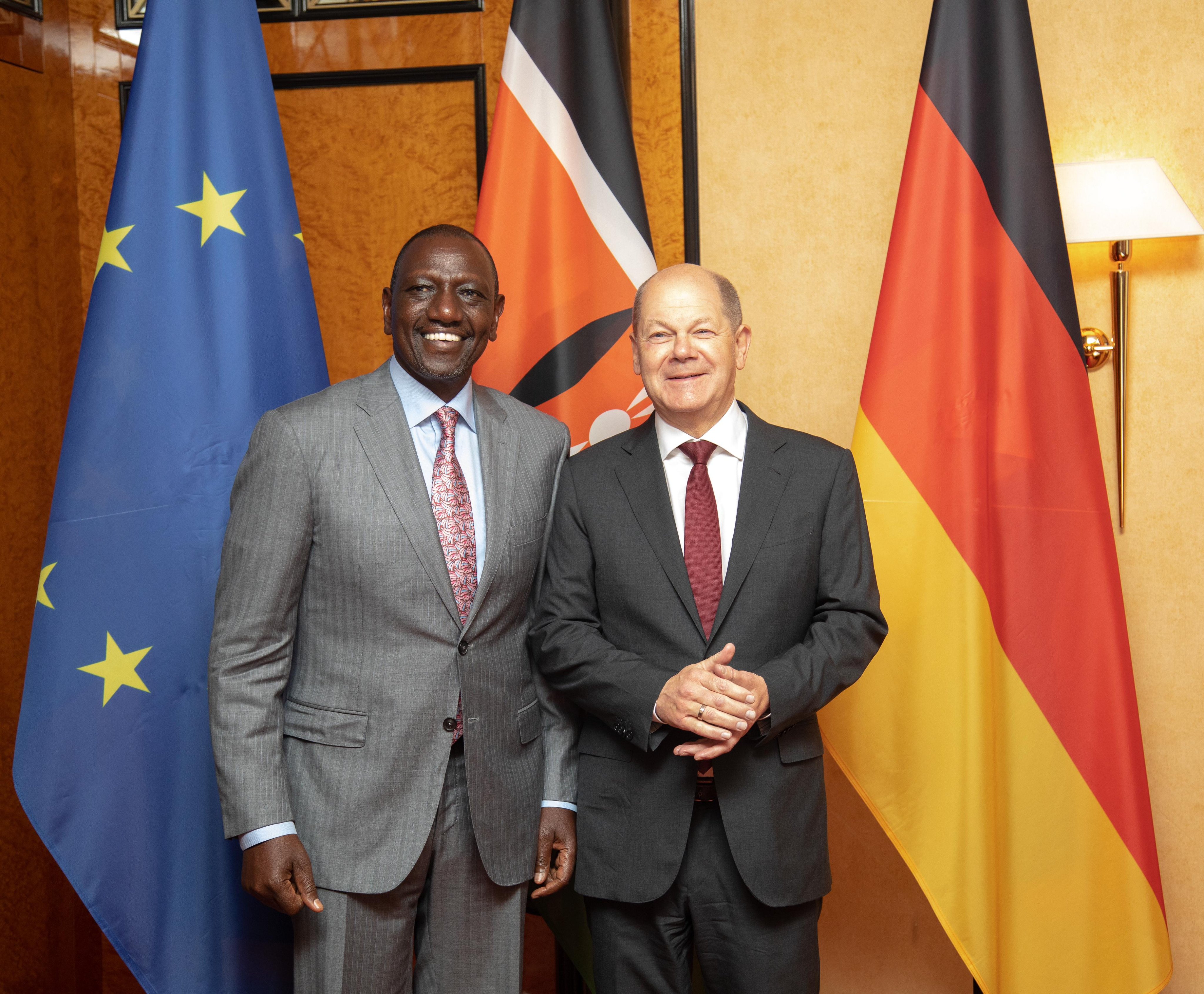
Combating human trafficking, labour exploitation and smuggling of persons are at the centre of the labour migration agreement signed between Kenya and Germany last year.
This emerges even as the deal reveals that Kenyan students and skilled personnel stand to gain significantly from the agreement.
In the deal disclosed by Labour PS Shadrack Mwadime, Kenya and Germany agreed to combat irregular migration, prevent and fight forced labour and protect victims of human trafficking.
Kenyan students studying in Germany will have the opportunity to seek jobs upon completing their academic or vocational training there.
President William Ruto and German Chancellor Olaf Scholz signed the agreement on September 13 in Berlin, Germany.
However, confusion soon arose over the number of Kenyans expected to benefit from the agreement.
An international media house had reported that Kenya had secured 250,000 job opportunities in the European nation, a statement that was denied by the Federal Republic of Germany.
“This information is false. The agreement between Germany and Kenya does not include any numbers or quotas of skilled workers who will have the opportunity to work in Germany,” Germany’s Interior Ministry said.
Ruto’s administration is leveraging labour migration overseas to combat unemployment in the country.
In the document shared with the National Assembly’s Labour Committee, the PS neither mentioned the number of Kenyans set to benefit from the deal nor those who have already secured jobs since the agreement was signed.
“The purpose of this agreement is to provide a framework for cooperation and information exchange on labour mobility, apprenticeships, student training, labour market needs, employment and welfare of employees,” the agreement says.
The agreement states that students or apprentices of the Kenyan Party, who complete their academic or vocational training in the territory of the German Party and those who wish to gather initial professional experience there may, within the framework of applicable law, be granted permission to continue their temporary residence in the territory of the German Party for a limited period to seek employment.
If they have secured a ‘concrete’ job offer, one would be granted a temporary residence title allowing them to take up employment.
This is subject to evidence that relevant requirements are met in accordance with the Residence Act of the German Party. Such a temporary residence title may be extended.
“If relevant requirements are met, in particular with regard to the duration of residence, Kenyans may be granted a permanent settlement permit,” the document states.
For skilled workers, it states that Germany and Kenya shall encourage the immigration of skilled workers who have completed vocational training or a university-level degree.
This will apply to degree holders whose qualifications or degrees have already been recognised by the competent authorities of the other party.
For this category, the deal states that Germany, in accordance with applicable laws, will waive the requirement for a labour-market test prior to employment.
In the agreement, Kenya and Germany agreed to promote fair mobility of skilled workers and apprentices.
The two countries agreed to promote temporary migration for purposes of vocational education and training for purposes of gainful employment, including exploring possibilities for seasonal work.
“The parties agreed to promote residence for gainful employment, including temporary residence for purposes of seeking gainful employment,” the document states.
In addition, they agreed to collaborate on skills development and training and cooperate on fair and ethical recruitment practices.
They agreed to provide labour market information, cooperate on consular services for skilled students and apprentices, prevent and combat irregular migration and smuggling of persons and prevent forced labour, exploitation of labour and human trafficking, as well as protecting victims.
They also agreed to facilitate the return of nationals of either party residing in the territory of the other party who do not or no longer fulfil the conditions for entry to or residence in the territory of the other Party.