On a rainy Friday night in upscale Lavington, Nairobi, 25-year-old Barrack is hosting a dozen of his campus friends at a popular club.
They wiggle to the music as they sip exotic French cognac. The Star counts at least three Hennessy VSOP, two Martell VSOP and a litre of Hennessy James, too much alcohol for the small group of young men and women, averaging 24 years.
Sporting designer labels, his iPhone 16 Pro Max buzzing nonstop with WhatsApp messages and crypto alerts, the third year international relations student at a private university in the city is ready to share with the Star a few tips on how he mints his money – but, first, the amount he has spent on alcohol in just two hours tonight.
“It is Kimberly’s birthday and I’m treating her tonight. Look, they are pissing on my Sh180,000 already. I plan to spend Sh300,000 tonight. Money has never been our problem. Each bottle there goes for not less than Sh25,000,” he gushes.
“Forex pays; see, you have come to interview me as I sip expensive cognac you will probably never taste in your whole boring journalism career. By the way, you people look poor. My chauffer will drop you in town in my Mercedes-Benz GLE. You need some love.”
From the outside, Barrack poses like any young tech entrepreneur living the Kenyan dream. But behind the flashy façade, Barry, as he is fondly referred to by his peers, lives in fear. He is always looking for recruits to help him repatriate millions to his masters in Eastern Europe, United Arab Emirates and China with calculated precision. He is a mere cog in an extremely risky banking fraud machine, punctuated with a trail of stolen identities, cloned cards, and millions laundered across borders.
“I was introduced to the trade by a friend who we believe was taken out by beasts mid last year for becoming a bit greedy. In our trade, honesty and secrecy are top currencies. We move millions for a good cut.”
Barry is among university students who have been recruited into a complicated underground web of mega dealings involving carding - a discrete financial crime that has turned youths into overnight millionaires.
Local and international authorities who have been tracking the syndicate, which changed form during the Covid-19 pandemic, fear a trail of mysterious deaths in short-stay homes witnessed mostly last year could be linked to the scams.
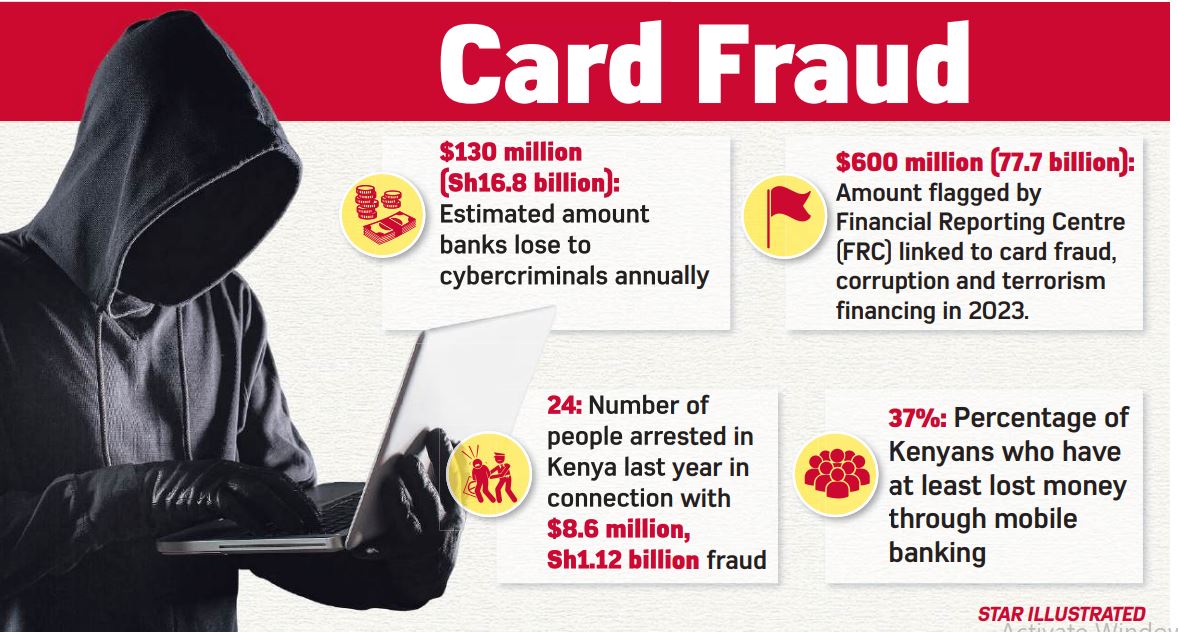
Interpol reported at least 24 individuals arrested in Kenya late last year in connection to $8.6 million (Sh1.12 billion) fraud. According to a senior investigative officer privy to the findings, struggling university students are easily lured into laundering proceeds of investment, advance payment, romance fraud and business email compromise frauds conducted by sophisticated fraudsters in the international market.
“They are sent huge sums of money via cryptocurrencies or Paypal accounts, which they have to clean and reintroduce into the legal money market for a commission of up to 30 per cent. They are threatened and monitored closely by shadowy agents. Those who become greedy pay heavily,” he said.
The officer revealed that Black Axe, Airlords and Supreme Eiye cartels, with origins in West Africa and working for shadowy masters in Belgium, Russia, UAE, the USA, Kazakhstan and other states in Eastern Europe have recruited a significant number of university students for money laundering purposes.
The fraudsters, often posing as luxury lifestyle influencers or self-made entrepreneurs, flash designer clothes and stacks of cash. Their digital persona is curated for one purpose — to convince students they have found a legal side hustle.
Cybercrime expert Levis Kenani warns that it doesn’t always end well for those recruited.
“These fraudsters thrive in secrecy. There is a consistent pattern where local dealers tend to live on the fast lane before dying in mysterious circumstances. It is by design to ensure ‘traces’ are eliminated. Come easy, go easy,” Kenani said.
He gave examples of the mysterious death of Dennis Oduor Ouma, popularly known as Denno Bright. The 25-year-old, believed to be among young people recruited into carding, was found dead in a hotel room in Mombasa in October last year. An autopsy report indicated he died from acute pancreatitis and a depressed central nervous system that pointed to abuse of some substance.
He never missed a chance to inform his TikTok followers that he was into ‘money traps’, displaying huge wands of money, sporty cars and other luxuries in live social media videos.
His Kirinyaga University campus mate and close associate Sospeter Onyango, popularly known as Billionaire Akoko Sirkali, died a month later in street night gang attack in Kibra, Nairobi. The fourth-year architecture student was known for splurging money in nightclubs.
“It is a dangerous ground. Two things are for sure for those who are lured into the vice - arrest by the authorities or get killed by dark web agents. Our young sons and daughters getting into higher learning centres must be told that no money falls like manna from heaven. There is always a catch,” says Pauline Muturi, a sociology lecturer at the University of Kent.
“Crime is advancing with technology but a right and a wrong remains constant.”
In March last year, Interpol secretary general Jürgen Stock warned that the world is facing an epidemic in the growth of financial fraud, leading to individuals, often vulnerable people, and companies being defrauded on a massive and global scale.
“Changes in technology and the rapid increase in the scale and volume of organised crime have driven the creation of a range of new ways to defraud innocent people, businesses and even governments. With the development of AI and cryptocurrencies, the situation is only going to get worse without urgent action.”
The KPMG Global Banking Scam Survey 2025 released in February shows that criminals fall back to traditional methods when they notice authorities are closely monitoring.
After a crackdown dubbed ‘Operation Serengeti,’ conducted from September 2 to October 31 last year by officials from Interpol and Afripol, local bank card scammers who were laundering money for their masters retreated to banking card theft.
“While there are few who are still helping international big boys to launder money, the majority have fallen back to bank card hacking, which was largely witnessed in the country pre-Covid-19 pandemic before two notorious groups, Forkbombo and Silent Cards, were cracked down,” the head of cybersecurity at one of the tier-1 banks in the country told the Star.
He revealed that the number of local customers complaining of losing money via their cards has increased in the past four months.
He explained that hackers target mainly young and new bank account holders. They ride on details of ignorant account holders to find easy entry into banks and safe passage for money siphoned off.
According to TransUnion Africa, a credit reporting agency, Kenyan banks lose approximately $130 million (Sh16.8 billion) to cybercriminals annually, primarily through loan stacking and identity theft. The country’s Financial Reporting Centre also flagged over $600 million (77.7 billion) linked to card fraud, corruption, and terrorism financing in the three years leading up to July 2023.
A cyber security study by Serianu, an information technology services and business consulting firm, in 2017 revealed that Kenya was losing at least $210 million (Sh21 billion) out of $394 million (Sh39.4 billion) in East Africa, most of it coming from banks.
The study ranked banks top in cyber attacks, indicating that the motives for data breaches are increasingly financial. Other sectors include government and mobile money.
According to the study, more attacks targeting Kenyan banks ranged from insider threats to spear phishing and ransomware attacks.
In a past interview with the Star, Bevan Smith, head of risk, Visa sub-Saharan Africa, said hackers looking for easy ways into banks systems are having a field day using genuine cards. “Ignorant customers, especially young ones, have become easy targets. A hacker needs a slight security blunder to loot. It is even much easier when genuine customers provide the way and are cleared by rogue employees in the financial sector.”
His sentiments were echoed by Andrew Henwood, CEO Foregenix, who discussed ATM cash-out in detail.
Henwood said that although most banks in Kenya have tough security buffers to counter cyber-attacks, they continue to lose millions of shillings daily, thanks to some ‘silly’ and deliberate mistakes perpetuated by customers and employees.