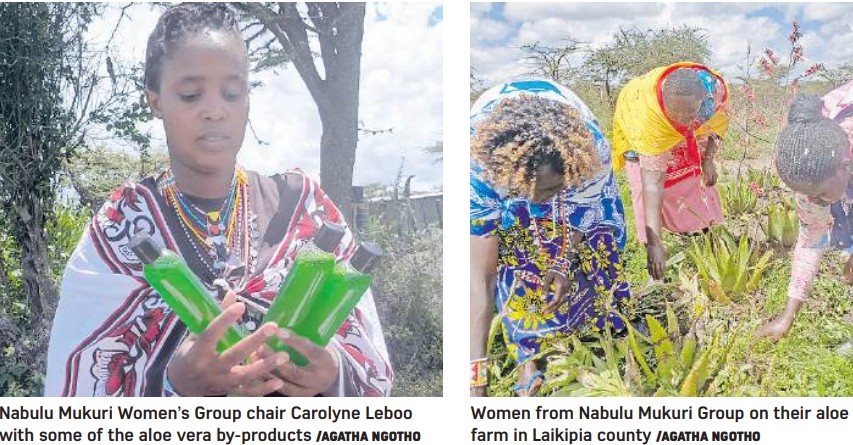
In the heart of Laikipia county, a group of 25 women from Mutiriria village are turning aloe vera plant into a source of income and hope.
The Nabulu Mukuri Women Group is not just growing aloe vera, they’re growing a sustainable future for their families and community.
Since its formation in 2019, the group has embraced sustainable farming practices to turn aloe vera into a thriving source of livelihood, creating a ripple effect of empowerment across the village.
What started as a small project focused on kitchen gardening and crafting aloe vera-based cosmetics like lotions, shampoos and soaps, has blossomed into a vibrant, self-sustaining enterprise.
The group’s chairperson Carolyne Leboo said they began with a simple goal, to empower women in the community.
“Most women are the providers for their families, so we started contributing Sh500 from each member then after six months give it back to members. Later, we joined Laikipia Permaculture, where we learned about kitchen gardening,” she said.
The group’s journey took an exciting turn when they were introduced to PELUM Kenya, a partnership that provided invaluable training in agroecology, including how to make fertiliser, practice intercropping and develop sustainable farming methods.
“These trainings brought huge changes in our farming practices. We learned how to add value to the aloe vera that grows naturally in our area. We now produce various by-products like soap, lotions and shampoos. I’ve become an expert in making soaps,” Leboo said.
Josphine Kasoo, another member, said they were also taught how to handle money through table banking, good record-keeping and how to practice intercropping.
“I even traveled to Tharaka Nithi to learn more from other groups and learned so much that I passed on the knowledge to other members,” Kasoo said.
“We now make our own herbicides from pepper, ginger or aloe vera. I made sure my fellow members practiced what I taught them.”
She pointed out that market linkage for their value-added products is a big challenge.
“Our products include soap, shampoo, gel and body cream, but we don’t have a steady market. We sell at ranches, shows and exhibitions, hoping to attract more customers,” Kasoo said.
Prices for their products range from Sh50 to Sh100 for soap and Sh200 to Sh400 for lotion, depending on the size.
Other than aloe vera, the women also grow maize, vegetables and potatoes.
Today, their dreams are growing bigger. They envision expanding their enterprise, securing reliable markets and receiving further support from the county and funding bodies.
“We plan to expand our aloe vera farm and have already bought half an acre for more production. We’ve also planted trees. We have approached the county for help with our value addition project, and hope to receive the Uwezo Fund,” Leboo said.
She added that life was tough before they got into value addition, especially during droughts.
“Getting food was difficult, but with kitchen gardening and the money we earn from selling soap, we can now provide for our families,” she said.
Laikipia Permaculture Centre community liaison officer Francis Leyiangire said the support the group has gotten from PELUM has been a game-changer.
He said the group received a grant to start kitchen gardening and aloe vera value addition.