SPEAKERS, MCAs and clerks of the county assemblies are in the eye of a storm following revelations of financial mismanagement within the regional assemblies.
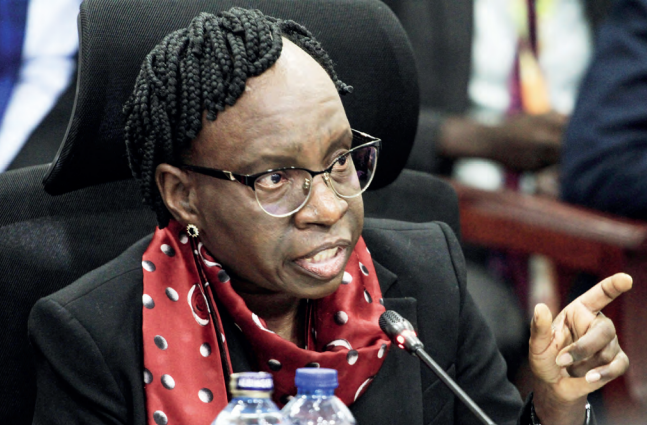
The latest report by Auditor General Nancy Gathungu uncovers the financial chaos in the assemblies, marked by blatant wastage and irregular, suspicious spending.
The 2023-24 fiscal year reports shows MCAs could be embarking on dubious trips and pocketing millions of shillings in irregular allowances.
Amid significant losses of public funds, the assemblies struggle to account for expenditures, even as they engage in illegal payments and procurements.
For the first time, the auditor has also highlighted the issues within the payroll of the county assemblies.
Gathungu also pointed out a significant ethnic imbalance in the composition of these entities.
In Taita Taveta, Gathungu raised issue with the expenditure of ‘unsupported’ Sh229.08 million, which the assembly reportedly used for MCAs and staff domestic travel and subsistence.
Of that amount, Sh10.83 million was paid to officers at flat rates between Sh3,000 and Sh19,000 without necessary approval from the Salaries and Remuneration Commission.
Additionally, Sh3.05 million was paid out regarding domestic and subsistence allowances; however, there were no acknowledgment receipts provided by the beneficiaries.
“In the circumstances, the accuracy and regularity of the domestic travel and subsistence expenditure of Sh229.08 million could not be confirmed,” states the report.
In Wajir, taxpayers lost millions due to overpayment of mileage allowances to MCAs by the county assembly. In total, the ward representatives received Sh91.55 million in mileage allowances, exceeding the approved limit.
“An analysis of claims based on actual distances from the Wajir county headquarters to the respective wards, as provided by the Ministry of Transport and Infrastructure, revealed that members were overpaid by Sh11.19 million,” the report states.
Furthermore, the county assembly overspent its budget for the year, totaling Sh1.19 billion, which corresponds to 11 per cent of the government’s revenue.
The law provides that the county assemblies’ expenditure shall not exceed seven per cent of the total revenues of the local governments.
The auditor also flagged unsupported procurement of advertising services amounting to Sh2.2 million, raising concerns that it might be fictitious.
“The expenditure was not backed by user requisition as the basis for initiating the procurement process, and the services were single-sourced from just one media house,” the report states.
The assembly also processed payments to its staff and MCAs through a manual system, which is vulnerable to manipulation.
In Marsabit, the auditor highlighted the ‘wasteful’ spending of Sh4.03 million allocated to staff for writing a report in Isiolo.
The National Treasury circular mandates accounting officers to ensure that all workshops and retreats primarily comprising participants from one duty station are conducted within the same.
Additionally, Gathungu disclosed that Sh8.13 million is tied up in the stalled construction of the county assembly chambers.
The construction of the Sh344.20 million chambers was expected to be completed in August 2019.
“In the circumstances, value for money from the expenditure of Sh8.13 million on the project could not be confirmed,” the report states.
Moreover, the auditor indicated that the assembly improperly paid Sh900,000 for the speaker’s rent.
This is despite the SRC deadline for leasing speakers’ residences ending on June 30, 2022.
The county audit chief also flagged the manual payment system, which is easily subject to manipulation, potentially allowing for ghost workers.
In Isiolo, the potential loss of Sh4.49 million reportedly disbursed as ‘responsibility allowances’ to county assembly members was revealed.
However, management failed to provide a list of officers in leadership positions, a list of all assembly committees and their members, attendance registers and minutes from various committee meetings.
“In the circumstances, the accuracy and completeness of employee compensation amounting to Sh277.63 million could not be confirmed,” the report says.
Additionally, Sh4.42 million was spent on retreats for two official occasions of the county assembly’s sectoral committee held at a conference venue located 10km away.
A 2023 SRC circular states that daily subsistence allowances are not payable for locations within a radius of 50 km.
“Moreover, attendance registers confirming that the members participated in the activities on the days they were paid were not provided for audit review,” the report states.
MCAs in Makueni pocketed between Sh50,000 and Sh70,000 for participation and oversight activities.
“This is contrary to the rates specified by the SRC in the gazette notice on remuneration and benefits of state officers dated August 9, 2022,” the report states.
They also received a transport allowance of Sh6,000 or Sh8,000 per day, regardless of the distance traveled. In another shocker, the assembly spent Sh10 million to acquire land for construction of the speaker’s residence, with Sh19.77 million allocated to build a perimeter wall around the property.
“However, it was noted that the septic tank was already full, clogged and could not be utilised; the guardhouse had begun to crack and deep trenches had developed around the wall,” the report states.
The Nyeri county assembly spent Sh10 million on air tickets for MCAs and staff.
Of this amount, Sh9.95 million was paid to a single-sourced company for the tickets.
Ethnic hiring was rampant in Murang’a, where 91 per cent of employees belong to one community, 95 per cent in Kirinyaga and 84 per cent in Kiambu.
Only one of the 205 county assembly workers in Turkana is not from the dominant community.
The auditor flagged a potential loss of Sh2.40 million in Elgeyo Marakwet, due to a questionable trip to Dubai.
The report states that the auditor did not justify the foreign travel. The same is evident in Nandi, where the auditor highlighted a potential loss of Sh10 million spent on MCAs’ travel, with no documents to confirm the claim.
The management failed to provide supporting documents, such as minutes from the county assembly service board meeting that approved the travel or a signed attendance register.
Additionally, there were no certificates of participation, back-to-office reports, training programme overviews, justifications indicating that the training was not locally available, or relevant approvals from the human resource advisory committee.
The assembly also spent another Sh2.5 million on training without justification.
In Homa Bay, the leadership of the
county assembly disbursed Sh40.63
million for domestic travel and subsistence, training expenses, hospitality, supplies and routine maintenance
without any vouchers.