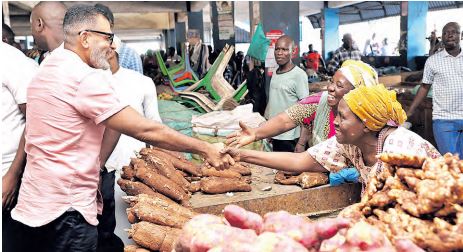
 Mombasa Governor Abdulswamad Nassir meets traders at Marikiti market/HANDOUT
The wouldbe groom’s family seemed most satisfied by her response to my bewilderment. Little did I know then that in lieu of a negative response, everyone understood her silence as willingness.
Formal agreements that are less personal, whether business or political, tend to have five recognizable stages.
The first stage is primarily to protect confidentiality of anticipated discussions and is aptly named a non-disclosure agreement. The second stage is a definition of the hierarchy considerations.
This is the statement of works. A memorandum of understanding sets objective goals and aligns values of parties and conflict resolution mechanisms. This is the third stage.
A letter of intent is the fourth stage and signals that an agreement is at hand. Lastly, there is the agreement, which legally binds the parties to its contents.
Now that I have attempted to clarify what the stage of negotiation between UDA, the ruling party, and ODM, the principal opposition party, might be, let’s look how it affects the politics of Mombasa and the coastal region at large.
There are two dominant forces in Mombasa represented by three major personalities. Mombasa Governor Abdulswamad Sharif Nasir, who is also ODM’s deputy leader, represents the party.
Equipped with the instruments of his office, a vibrant media presence, and likeable stature, he cuts a formidable figure. Unfortunately, having largely been assisted by his predecessor, he is yet to gain control of the political network that propelled him to office.
His tentative leadership style also doesn’t promise the impactful development Mombasa residents demand.
He, however is now at liberty to engage with the national government openly , now that the MoU is in place, without attracting rebuke from the local party members as witnessed with his previous dalliance with the government.
Hassan Joho, who was not only succeeded by the incumbent governor but was also replaced by him as deputy party leader, has to date continued to have full custody of the ODM political network in Mombasa.
He has been also one of the greatest benefi ciaries of the negotiations between UDA and ODM as he is currently the Cabinet Secretary of Mining and Blue Economy.
The department of blue economy and its Sh11.3 billion budget for priority projects gives the minister an opportunity to change lives within the coastal counties and maybe attain the desired role of regional kingpin.
The big challenge for Joho, however, remains that his party is a less equal member in the MoU, so his influence in government circles is measured, and the path to be regional kingpin necessitates securing Mombasa’s gubernatorial seat, perhaps through a proxy like the county assembly speaker Aharub Khatri, since the incumbent governor continues to remain independent.
ODM in Mombasa is faced by UDA, which has a more unitary front under former Senator Hassan Omarwho wears several significant caps for his party and is also credited for being instrumental in creation of his party’s political network in Mombasa and the coastal region at large.
As a two-time contender for the gubernatorial seat, he has no doubt sharpened his game, while being an MP in the East Africa Legislative Assembly gives him cross-ethnic acceptability.
He sits not only at the centre of negotiations but also as secretary general of UDA, the dominant party in the MoU, his infl uence in government is substantial.
Whereas the UDA network has remained largely intact and upbeat, the MoU has opened access to the hitherto inaccessible ODM members, some of whom may be willing to shift loyalties due to perceived lacklustre leadership and internal feuds of their party.
In political negotiation, unlike marriage agreements, foundations made of ambiguities and mutual understanding can be a recipe for disaster, perhaps the reason for the stage-by-stage negotiation we are currently witnessing.
No doubt the Magarini constituency by-election shall indicate who among the three is a frontrunner.