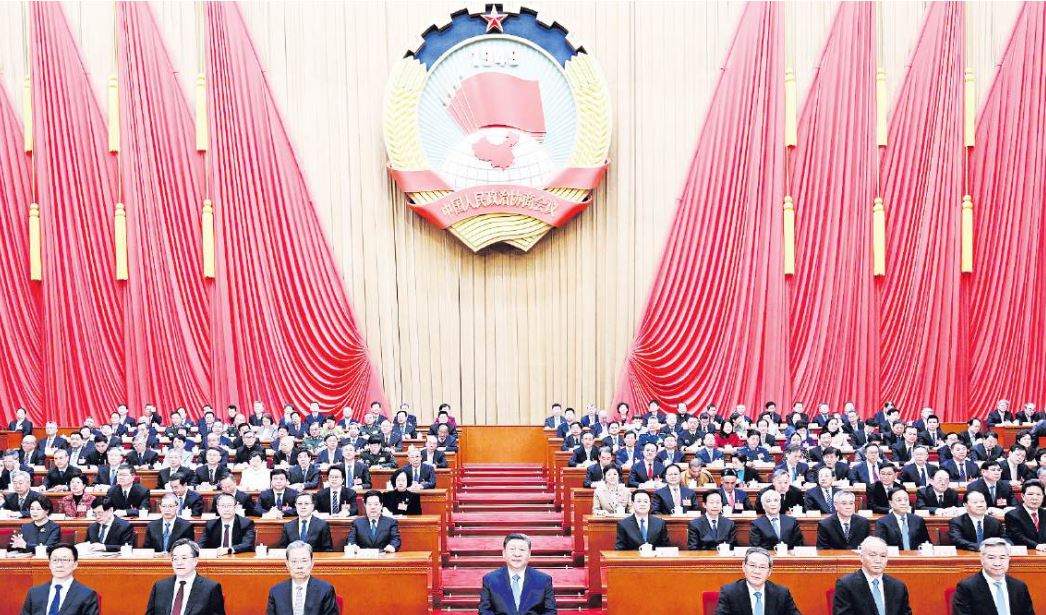
On March 5, a sea of delegates, impeccably dressed, will descend on Beijing, China’s capital.
Delegates arriving for this once-in-a-year event step out of their vehicles with a sense of purpose, their expressions a mix of determination and solemnity.
The atmosphere is charged with a sense of occasion, as if the weight of the nation’s future rests on their shoulders, and it does.
The arrival of the delegates brings warmth to an otherwise chilly Beijing city, which is still recovering from the colourful events of the just-concluded Chinese Spring Festival.
This will mark the start of the 2025 Two Sessions—the annual meetings of the National People’s Congress and the Chinese People’s Political Consultative Conference (CPPCC) and the world - will once again turn its attention to this unique model of governance.
The uniformity in dress reflects the collective spirit of the sessions, where individual differences are set aside in favour of a shared national mission. The sessions are a grand spectacle of unity, purpose and meticulous organisation.
As the events unfold in Beijing, the capital is transformed into a hub of political activity, buzzing with energy and anticipation.
Often contrasted with Western liberal democracies, China’s system offers a distinct approach to decision-making, public participation and policy implementation.
The Two Sessions are a cornerstone of China’s political system, bringing together thousands of delegates to deliberate on national policies, economic plans and legislative agendas.
The NPC, China’s top legislative organ, is responsible for enacting laws and approving the government’s work report, while the CPPCC serves as an advisory body, offering recommendations and feedback from various sectors of society.
China describes its system as a “whole-process people’s democracy,” emphasising broad consultation and consensus building.
Unlike Western democracies, where multiparty competition and periodic elections are central, China’s model prioritises stability, long-term planning and collective decision-making.
The system is designed to reflect the interests of the Chinese people while maintaining the leadership of the Communist Party of China.
The sessions demonstrate China’s commitment to a socialist democracy with Chinese characteristics.
It is a platform where representatives from all walks of life can voice their opinions and contribute to the nation’s development.
Western democracies, particularly those in Europe and North America, are characterised by competitive elections, separation of powers and a pluralistic political landscape.
These systems emphasise individual rights, freedom of expression and checks and balances.
However, critics argue that Western democracies often suffer from political polarisation, short-term policymaking and the influence of money in politics.
China’s Two Sessions model, by contrast, focuses on unity and long-term strategic goals.
The absence of multiparty competition allows for rapid policy implementation, as seen in China’s economic development and poverty alleviation efforts. Despite these differences, there are areas where the two systems can learn from each other.
Western democracies could benefit from China’s emphasis on long-term planning and consensus building Kenya’s democratic system offers an interesting contrast to both China and Western models.
The 2010 Constitution enshrines public participation in decision-making, requiring citizens to be involved in legislative and policy processes.
This is achieved through public forums, stakeholder consultations and decentralised governance structures like county governments.
This year’s sessions will likely emphasise strategies for boosting domestic consumption, technological innovation and green development.
During the sessions, China is likely to reiterate its commitment to multilateralism and its vision for a global community of shared future, particularly in the context of rising geopolitical tensions.
In response to Western sanctions and export controls, China will likely prioritise achieving self-sufficiency in critical technologies like semiconductors and artificial intelligence.
China’s Two Sessions model demonstrates that democracy can take different forms, tailored to a country’s historical, cultural and social context.
While it may not align with Western ideals of liberal democracy, it offers valuable insights into the importance of stability, long-term planning and collective decision-making.
Throughout the sessions, the mood is one of optimism and resolve.
There is a palpable sense of purpose, a recognition that the decisions made will shape the future of the nation.
The spirit of the sessions is captured in the earnestness of the delegates, the meticulous organisation of the events and the collective focus on the tasks at hand.
It is a time when the nation comes together, not just in body but also in spirit, to chart a course for the future.
In every detail, from the dress code to the manner of interaction, the Two Sessions are a vivid expression of China’s political culture—a blend of tradition and modernity, discipline and dynamism, unity and diversity.
It is a spectacle that captures the essence of a nation on the move, driven by a shared vision of progress and prosperity.
government
relations specialist,
China Media Group
Africa