President William Ruto and Majority leader Kimani Ichungwah at JKIA on February 13, 2025/ PCS
President William Ruto’s team has drawn tough
new transition laws that will for months clip the wings of top government
bureaucrats and render the incumbent head of state a lame duck president.
Advertisement
Advertisement
The bill for instance, bars state officers from
entering into commitments with suppliers and contractors 90 days before the
presidential election.
“No Cabinet Secretary or Principal Secretary
shall make any commitment that is or is intended to be binding on the
government,” the proposed law reads.The Assumption of the Office of President and
Transition of Executive Authority Bill, 2025 has been formally introduced in
Parliament.The government-backed legislation sponsored by
Majority Leader Kimani Ichung’wah only allows “necessary commitments”, with
ready budgets.The proposed law further prohibits cabinet
secretaries and principal secretaries from making fresh appointments of public
officers.
Advertisement
Advertisement
The officers would also be barred from traveling
outside Kenya without express and prior written approval of the Head of Public
Service.Ruto team is also barring accounting officers
from making or authorizing payments above Sh50 million without Treasury
approval.During the transition, public officers would be
barred from entering into contracts on behalf of the government.International obligations binding on the
government would also be prohibited, with those in breach poised for hefty
fines of up to Sh10 million.In the new rules, ministries, departments and
agencies will be required to issue handover reports by July 15 of the
election year.In the reports, ministries and government
departments would be required to disclose bank accounts and their reconciled
balances, policies, ongoing programs and projects, and human resource matters.
The staff data is to include their
establishment, pay, achievements, training, performance appraisal, and ongoing
disciplinary matters.
Also to be stated would be assets, pending
bills, ongoing acquisitions, procurements, and disposal of assets.Ongoing court cases and related liabilities are
also to be disclosed, so are planning matters including performance contracts
and work plans.Allegations of sabotage rocked President Ruto’s
takeover from his predecessor Uhuru Kenyatta in 2022.
Ruto’s team at that time complained that they
were denied the right treatment deserved by a president-elect, including access
to security briefs.
They further claimed that the transition team
was not heeding the then-President-elect’s requests.Attempts to block the government printer from
churning the gazette notice detailing Ruto’s election were cited.At that time, key members of the committee,
including then Interior Cabinet Secretary Fred Matiang’i, were not seeing
eye-to-eye with Ruto.A transition committee, to be established under
the new law, is to receive the reports, for subsequent briefing of the
president-elect.In the proposed dispensation, accounting
officers would continue to hold office until a new one is appointed in their
place.The bill further expressly provides that the
absence of the outgoing president wouldn’t affect the swearing-in.
“The absence of the outgoing president at the
inauguration shall not invalidate the assumption of office by the
president-elect,” the proposed law reads.
As such, there would be no ‘sword and
constitution’ to be handed over when the outgoing president is absent or when
the incumbent is the president-elect.
The president-elect and deputy president-elect
would be entitled to full security as is assigned to the sitting president and
deputy president.The bill has expanded the transition committee
to include nine nominees by the president-elect besides the designated state
officers.They would be bound by the Official Secrets Act
regardless of whether they are public officers or not.One of the President-elect’s nominees would be
appointed as co-chair of the transition committee. The Head of Public Service
would also be the co-chairperson.“The president-elect shall nominate a
co-chairperson from among the nine persons, and that co-chair shall be the
spokesman of the committee,” the bill reads.Others are the Attorney General, Secretary to
the Cabinet, Immigration, Internal Security, Defence, Foreign Affairs, ICT,
Finance, and Culture principal secretaries.Chief of Defence Forces, National Intelligence
Service director general, Inspector General of Police, Clerks of Parliament,
and Judiciary chief registrar are also members.
They would need a quorum of two-thirds to make
decisions and the absence of a member wouldn’t matter as long as the threshold
is met.
“The committee shall hold office until the
expiry of the transition period,” the bill reads in part.
Should MPs approve the bill, a transition
secretariat would be set up to handle the technical aspects, such as briefings.
“The secretariat shall include public officers
from various offices,” the bill reads, indicating they would be drawn from
among others the head of public service’s office.One person would be from the Cabinet Office,
another from the national government administration office, a counsel from the
Attorney General, one officer each from NPS, NIS and KDF, and three persons
from the National Treasury.A transition centre would be set up to serve as
the transition centre in Nairobi to serve as the transition office of the
president-elect and deputy president-elect.


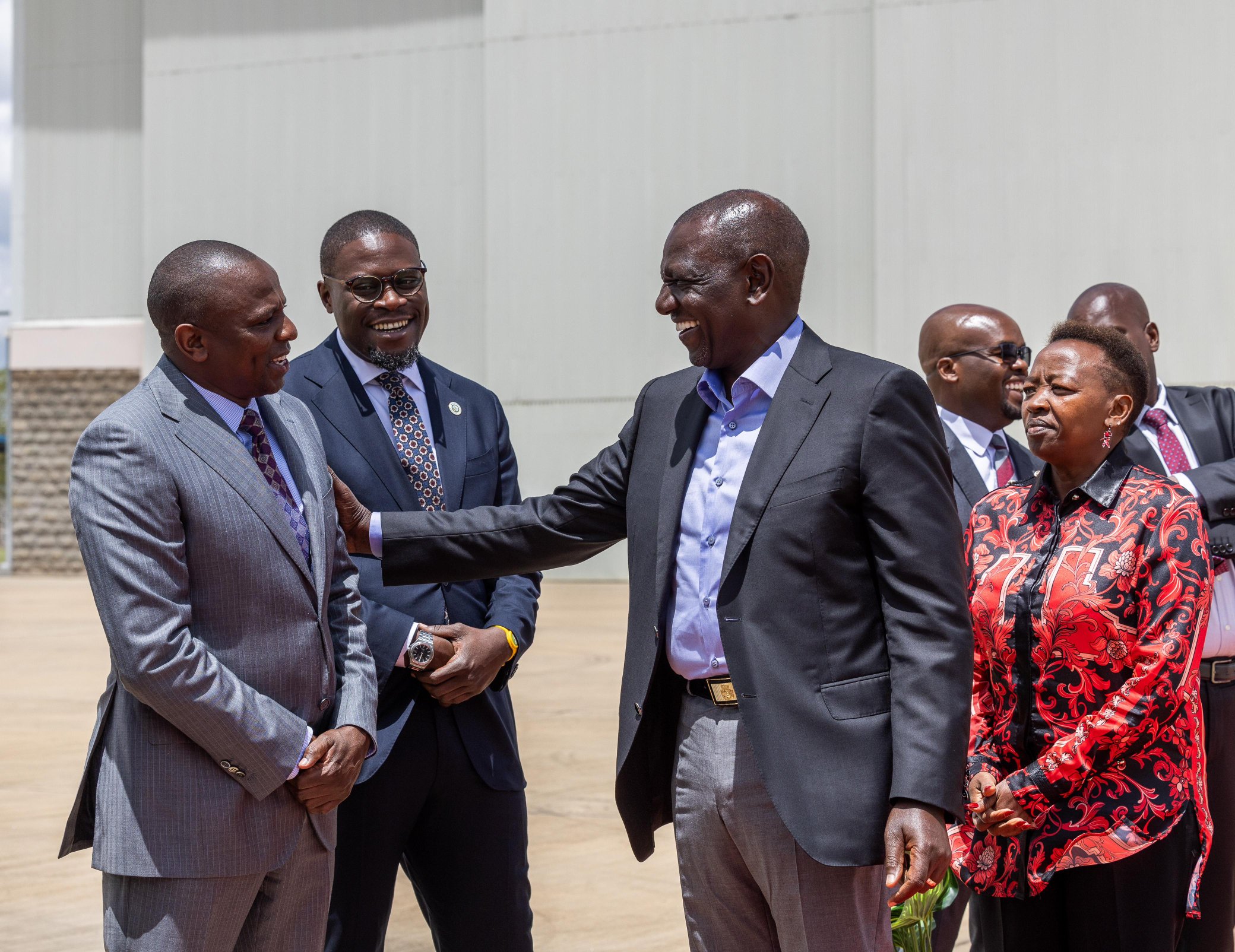 President William Ruto and Majority leader Kimani Ichungwah at JKIA on February 13, 2025/ PCS