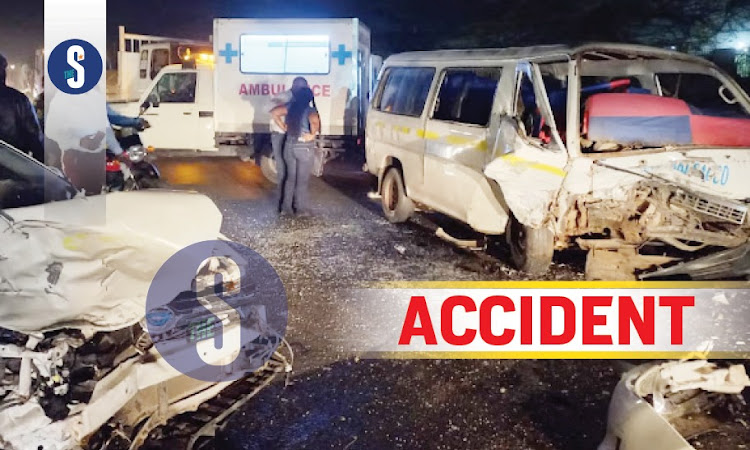
 An accident scene, the Star illustrations
Driving a car is not instinctive. Monkeys do not drive cars. If they were to do so, they would face several challenges. One key challenge is their anatomy. Monkeys have arms and legs that are almost equal in length.
That gives monkeys an advantage in their habitat, which is in and around trees, where having arms and legs almost equal in length is a good thing. Human beings are distinct from other primates in that they have much longer legs compared to arms. The advantage is that humans can stride long distances.
That is one reason human beings are now found all over the earth. This advantage of being able to travel long distance on foot, has been compounded by the invention of the car. What you can walk in one hour, a car can cover in just a few minutes. So far so good, except when as a driver of a car, you disobey basic principles of physics.
Einstein, the famous Nobel prize physicist, gave us the equation relating space, time and distance. Understanding the equation fully requires a lot of learning. But in everyday driving, a car moving requires a certain distance to come to a complete stop.
The distance required for it to stop, depends on how fast the car was traveling initially and how much braking force the car has. The bigger the car, the heavier it is, the greater the force required for it to stop. Aside from characteristics of the car, the main issue that must be addressed it the driver.
Experience counts for a lot, in terms of awareness of road conditions and behaviour of other road users. In addition, the health of the driver is also important. One obvious potential health issue is the driver’s eyesight. Another is how physically fit they are in relation to reaction time, when danger is imminent.
An average driver, focused on what they are doing, has a perception time of three-quarters of a second. That is the time it takes for their eyes to notice something wrong, record in their brain and begin to do something about it.
There are many factors that can influence the reaction time of a driver. The more experienced a driver is the quicker they can perceive danger. A driver with good eyesight will spot danger better. A tired driver for whatever reason, one who has been on the road for several hours, has not slept well previously, is stressed, is under the influence of alcohol or drugs will have a much longer reaction time than average.
The story does not end there. It is one thing to note danger, it is another to figure out what to do next. The brain must know what to do and the body must be able to do what the brain tells it to do.
The period of time while the driver is processing what to do and starting to do it is the distance time. This is the distance travelled by the car, from the time danger is noticed to the point where the car stops.
Often, at the scene of a car crash, you will find several bystanders around, each with a story, but none, able to explain fully how a particular car has ended up, in such a strange position. What is often missing is a full understanding of what it takes to avoid a car crash, what in lay terms we call an accident.
The full understanding can be summarised as an equation where stopping distance equals thinking distance plus braking distance. The braking part is the condition of the car, is it well maintained, fully serviced or overloaded with some parts not working well. The thinking distance is about the reaction time, which includes how quickly the driver perceives danger, that is the health and experience of the driver.
Monkeys do not drive cars. Even if they could, they would struggle. It might appear, the way they scramble over tree branches, when scared, that having monkey reaction times would be great for the average car driver.
But one has to remember that the monkey is not in control of a car weighing several tons and is not traveling at any great speed. Nor are there other monkeys traveling in the opposite direction. Instinctively monkeys may be able to apply einstein’s theory, but understanding and applying the theory is a human thing. That is why drivers learn theory of driving on top of basic education. The challenge for our road systems is when road users disregard education and road safety theory and want to manoeuvre around using just instinct.




![Africa CDC Director General Dr Jean Kaseya at a past event. [Photo: Arthur Mbuguah, WHM]](https://cdn.radioafrica.digital/image/2026/10/8ced213c-affb-4dff-97ca-1b6bac1f958e.webp)