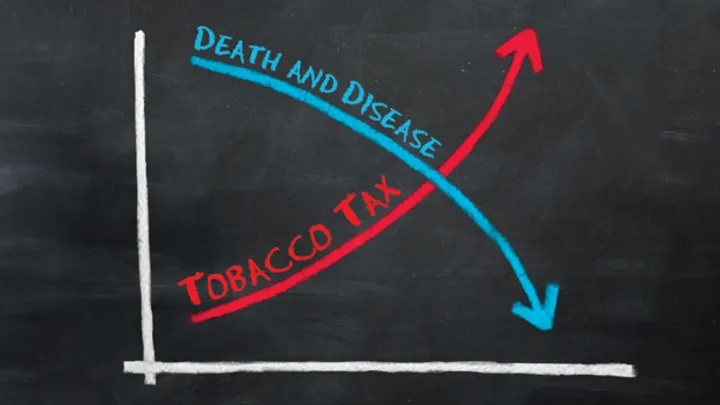
Kenya stands at a critical crossroads in its battle against the tobacco epidemic. On one hand, the country has made commendable strides in tobacco control through legislation and public awareness campaigns.
On the other, it continues to fall short of a key
weapon in this fight: effective taxation. Tobacco taxation isn’t just an
economic tool it’s a proven public health intervention that could save
thousands of lives and significantly bolster the economy. Yet, our current tax
policies are akin to fighting a forest fire with a water hose.
As it
stands, cigarette taxes in Kenya constitute 32% of the retail price. This falls
far below the 75% threshold recommended by the World Health Organization (WHO)
to effectively curb tobacco consumption.
Cigarettes with filters, for instance, are taxed at Sh4,067.03
per mille. while Cigarettes without
filters (plain cigarettes) are taxed at Sh2,926.41 per mille. This implies that
for every 50 packets of cigarettes, the government generates Sh4,067.03 for
filtered cigarettes and Sh2,926.41 for unfiltered cigarettes.
Nicotine pouches and liquid nicotine for electronic
cigarettes are taxed at Sh 1,595.00 per kilogram and Sh 74.41 per milliliter,
respectively.
Despite these figures, recent developments have shown
that the tobacco industry continues to influence Kenya’s fiscal policies.
According to a January 2024 report by Africa Intelligence, Big Tobacco is
actively steering Nairobi's cigarette tax revamp to ensure favourable outcomes
for their industry. This undue influence undermines Kenya's commitment to
reducing tobacco consumption and protecting public health (Africa Intelligence,
2024).
Tobacco use in Kenya claims an estimated 6,000 lives
annually, translating to 16 lives lost each day a grim reminder of the toll
this addiction takes on our communities. Beyond the staggering human cost, the
economic impact is equally harrowing. Tobacco-related illnesses, including lung
cancer, heart disease, and chronic obstructive pulmonary disease, drain an
estimated Kshs. 2.8 billion annually from Kenya’s economy. This figure includes
healthcare costs and lost productivity, placing an undue burden on an already
strained healthcare system.
Kamukunji Sub-county, a known hotspot for tobacco
and nicotine products use, offers a stark illustration of this crisis. With its
dense population, high unemployment rates, and thriving informal markets, the
constituency serves as a microcosm of Kenya’s broader tobacco-related
challenges. Public health facilities in the area are inundated with cases of
tobacco-related illnesses, often among young people who began smoking as
teenagers.
The link between increased tobacco taxes and reduced
consumption is well-documented. A report by the Tobacco Atlas shows that a 10%
increase in the price of tobacco products leads to a 4–8% decrease in
consumption, with the largest impact observed among young people and low-income
groups. Countries like South Africa and the Philippines have successfully
implemented higher tobacco taxes, resulting in significant declines in smoking
prevalence.
The economic benefits are equally compelling. In
Thailand, for example, higher tobacco taxes generated substantial revenue that
was reinvested into public health programs. Kenya, too, has the potential to
channel additional tax revenue into healthcare, education, and smoking cessation
programs resources desperately needed in communities like Kamukunji.
The tobacco industry often argues that higher taxes
will lead to an increase in illicit trade, but evidence suggests otherwise. A 2019
study by the World Bank found that strong enforcement measures, coupled with
tax hikes, can effectively mitigate illicit trade. Kenya’s robust tax
administration infrastructure, including the Excise Goods Management System
(EGMS), provides a solid foundation for tackling this challenge.
Additionally, higher taxes do not necessarily harm
the economy. On the contrary, reducing tobacco consumption alleviates the
long-term financial burden of tobacco-related illnesses, freeing up resources
for other pressing needs.
Raise Taxes to WHO Standards: The government must
immediately increase the tax burden on tobacco products to at least 75% of the
retail price. This will make tobacco products less affordable, particularly for
young people and low-income users.
Invest in Public Health: Revenue from higher taxes
should be earmarked for public health initiatives, including smoking cessation
programs, awareness campaigns, and improved healthcare services in tobacco
hotspots like Kamukunji.
Strengthen Enforcement: To combat illicit trade,
Kenya should invest in advanced tracking and tracing systems and enhance
penalties for non-compliance.
Engage Communities: Public health interventions must
be tailored to local contexts. In Kamukunji, for instance, community-based
programs could educate residents about the dangers of tobacco and offer support
for those looking to quit.
Youth-Focused Campaigns: The youth are often the
primary target of the tobacco industry. National campaigns that resonate with
young people, coupled with stricter age-verification measures for tobacco
sales, can help curb early adoption.
Kenya has the tools, knowledge, and resources to
lead the charge against tobacco. What it lacks is the political will to
implement the bold measures needed to turn the tide. Tobacco taxation is not
just about generating revenue; it is about saving lives and creating a
healthier, more equitable society. For communities like Kamukunji, this could
be the lifeline they desperately need.
The time for half-measures has passed. Kenya must
seize this opportunity to raise tobacco taxes, reinvest in public health, and
secure a brighter, smoke-free future for its citizens. Failure to act will only
prolong the suffering of thousands and leave an indelible stain on our nation’s
conscience.
Martha is programmes manager while David is the director; Den of Hope, a CBO




![Africa CDC Director General Dr Jean Kaseya at a past event. [Photo: Arthur Mbuguah, WHM]](https://cdn.radioafrica.digital/image/2026/10/8ced213c-affb-4dff-97ca-1b6bac1f958e.webp)