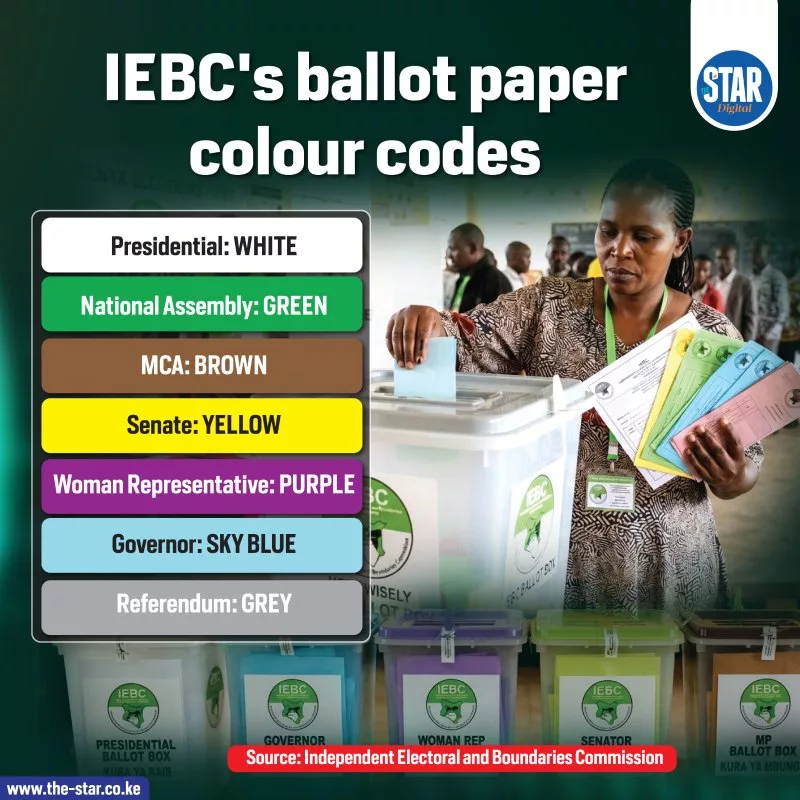
IEBC has restarted its multibillion-shilling ballot papers procurement, restoring stringent security features that had been relaxed in September 'to save costs'.
The Independent Electoral and Boundaries Commission (IEBC) made the move in the wake of a court challenge by Busia Senator Okiya Omtatah.
The fresh tender reinstates seven layers of security designed to make ballot papers difficult to counterfeit, duplicate, alter or reproduce.
The new tender reverses some of the changes that had raised questions about the integrity of materials for next year’s election.
Under the new specifications, ballot papers will be required to have at least one generic watermark integrated into the paper during manufacture and visible under normal light.
Additionally, they will be required to have an IEBC logo visible only under ultraviolet light, and anti-copy features that cause the word ‘copy’ to appear across photocopied or scanned images.
They must also incorporate uniquely generated guilloche security patterns integrated with variable information, including ballot serial numbers, polling station names and codes.
The papers must also have a continuous micro-text carrying ballot serial numbers and polling station codes, visible only under magnification of at least 10 times.
Further, they should be fitted with an embossing bearing the words ‘IEBC and the year of election’, and unique machine-readable QR codes containing variable information and protected against duplication.
Each ballot paper must carry an indelible tapered serial number printed using a combination of colours, with the number on the counterfoil matching that on the voting piece.
The new specifications are a departure from an addendum issued on September 17, which introduced what IEBC described as a ‘technical relaxation to optimise cost and timelines’.
The addendum had accepted single-colour black serialisation instead of multi-coloured numbering, static guilloche patterns and micro-text instead of variable designs, and blind embossing without metallic foil stamping.
The changes triggered a petition by Omtatah's National Reconstruction Alliance party, which argued that the commission was weakening mandatory safeguards without assuring of better protection.
In the fresh procurement, IEBC has gone further by specifying the information will have to be incorporated into each feature.
The QR code must similarly contain the ballot serial number and polling station code, making it possible to associate individual ballot papers with their designated polling stations.
The tender covers the supply and delivery of ballot papers, tactile folders, the register of voters and statutory election result declaration forms under a three-year framework contract.
In a termination notice signed by acting chief executive Ruth Kulundu, IEBC cited substantial technical and security specification realignments.
She also referenced “governance considerations arising from pending judicial proceedings”.
Omtatah had challenged the commission's addendum, arguing that security safeguards were not ordinary commercial specifications that could be weakened simply to reduce production costs.
In his petition, the senator maintained that the original requirements were mandatory and formed part of the technical evaluation of ballot paper samples.
"The issue is not whether the respondents are entitled to procure ballot papers at a reasonable cost. The issue is whether cost and production timelines can lawfully justify the reduction of security specifications applicable to the principal instrument through which citizens exercise their sovereign political will," the petition states.
The party, through secretary-general Amemba Magufuli, argued in an affidavit that the different security mechanisms operated as a layered system, with each serving distinct authentication, traceability and anti-duplication functions.
He said retaining some safeguards did not necessarily compensate for weakening others.
The party further argued that IEBC had not provided a technical assessment demonstrating that the cumulative relaxations would preserve equivalent or superior protection.
The development comes amid concerns about the pace of IEBC's preparations for next year's elections, especially on matters procurement.
Elections Observation Group (ELOG) national coordinator Mule Musau said the repeated changes to procurement processes risked undermining confidence and creating uncertainty among voters.
"IEBC seems to be stuck on a number of issues, especially when you recall the delays on the KIEMS kits," Musau told the Star.
He said repeated reviews and changes could create problems given the limited time remaining before the election.
"The first concern is that too much second guessing will delay the processes given the constricted timelines. The second is that it creates anxiety to the voters and the country when processes are delayed given the mistrust that we have in matters of elections," he said.
He pointed to the 2022 elections, when ballot paper mix-ups disrupted polls in several constituencies, including Mombasa and Kakamega governor contests, as well as Kacheliba, Pokot South, Rongai and Kitui Rural MP races.
Security features on electoral materials have also been a longstanding concern in the country, particularly following the disputed 2017 presidential election.
The Supreme Court, in nullifying the election, cited substantial illegalities and irregularities that undermined the requirement for a secure, accurate, accountable and verifiable electoral process.
Questions surrounding the authentication and verification of election materials and results featured prominently in the proceedings instigated by Raila Odinga in 2022.