
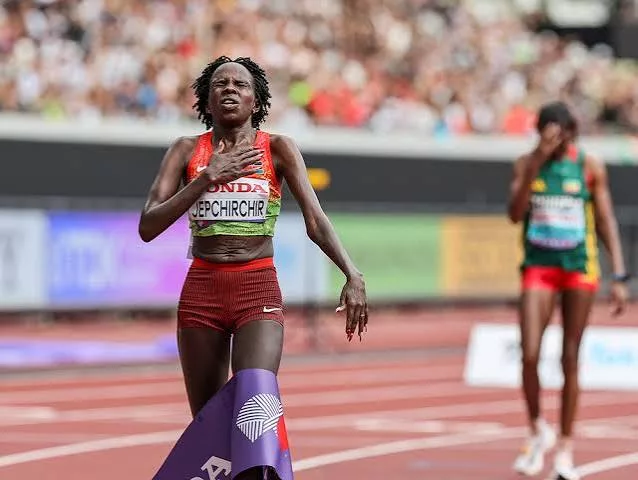
Reigning world marathon champion Peres Jepchirchir has been handed a three-year ban for using the prohibited blood-boosting drug EPO, in a major blow to Kenya’s reputation in distance running.
The 33-year-old former Olympic champion is among three Kenyan athletes sanctioned by the Athletics Integrity Unit (AIU) in its latest crackdown on doping, with fellow runner Veronica Loleo also receiving a three-year suspension while marathoner Ronald Korir has been banned for six years.
Jepchirchir’s suspension comes months after she won the Sydney Marathon in August, adding to her impressive record of victories at some of the world’s biggest road races.
The AIU said an out-of-competition sample collected from the athlete in Kenya on July 17 returned adverse analytical findings for erythropoietin (EPO), a prohibited substance used to stimulate red blood cell production and improve endurance.
The World Anti-Doping Agency-accredited laboratory in Cologne, Germany, reported the presence of EPO in her blood sample on September 17, with subsequent analysis also detecting the substance in two urine samples.
Jepchirchir was provisionally suspended on October 20. Although she initially denied using EPO and said she did not know how the adverse findings had occurred, she later admitted the anti-doping rule violations and accepted the sanctions.
Under the decision, she will be disqualified from all competitive results recorded from July 17, 2026, including her Sydney Marathon victory.
The three-year ban represents a reduction from the mandatory four-year suspension after she admitted the violations and accepted the consequences at an early stage.
EPO is prohibited at all times under the World Anti-Doping Agency's 2026 Prohibited List.
The AIU’s decision also means the 2026 Sydney Marathon title will be taken away from Jepchirchir, who had dominated the women’s race in 2:18:31, finishing more than three minutes ahead of compatriot Irine Cheptai.
Sydney Marathon organisers subsequently announced that Cheptai would be declared the 2026 women’s champion following Jepchirchir’s disqualification.
Jepchirchir had established herself among the most successful Kenyan marathoners, winning the Tokyo Olympic marathon gold medal in 2021 before triumphing at the New York Marathon in the same year, Boston in 2022 and London in 2024.
Her London victory was particularly significant after she clocked 2:16:16, setting a women-only world record at the time.
The latest decision, however, puts her achievements under renewed scrutiny, with the disqualification extending to all competitive results from July 17, 2026.
The AIU also sanctioned Loleo, who won silver in the half-marathon at the 2026 World Road Running Championships, with a three-year ban for EPO use.
The 2026 world number six returned adverse analytical findings from blood and urine samples collected out of competition in Kenya on September 6.
In an interview with the AIU, Loleo denied knowing how the positive findings had occurred but said she had received an injection to treat an injury and associated pain.
The AIU said she could not recall the name of the injection.
She subsequently admitted the anti-doping violations and accepted the three-year suspension, which also carries the disqualification of her results from September 6, including her silver-medal finish at the World Road Running Championships.
Like Jepchirchir, Loleo faced a potential four-year ban but received a one-year reduction after an early admission and acceptance of the consequences.
The third athlete, Korir, received the heaviest punishment, with the AIU imposing a six-year suspension after abnormalities were detected in his Athlete Biological Passport (ABP).
The 35-year-old marathoner, who finished fourth at the 2023 Berlin Marathon, was found to have suspicious variations in blood samples collected over a two-year period.
The AIU analysed 20 blood samples collected between May 6, 2023, and August 18, 2025, before referring the findings to a panel of independent experts.
The panel identified abnormal values in samples collected between January and March 2024, shortly before the Hamburg Marathon, and in January and February 2025, ahead of the Osaka Marathon.
The abnormalities were considered indicative of likely doping.
Korir was notified of the adverse passport findings on May 20, 2026, and later interviewed by the AIU. However, he twice failed to submit written explanations when requested by the integrity body.
The AIU subsequently charged him on September 25 and imposed a provisional suspension.
His failure to respond to the charge within the stipulated period meant he was deemed to have admitted the violation and waived his right to a hearing.
His six-year ban includes disqualification from all competitions dating back to January 19, 2024, when the first abnormal sample was recorded.
Reacting to the latest sanctions, AIU chief executive Brett Clothier said Kenya had made progress in tackling doping but warned that more needed to be done to address the problem.
“The Kenyan authorities have made a lot of progress in the fight against doping in the last five years, but these cases highlight that there is still a long way to go,” Clothier said.
He said the Kenyan government was aware of the situation and had committed to strengthening the Anti-Doping Agency of Kenya (ADAK) and confronting criminal networks facilitating doping.
“The Kenyan government is aware of the current situation and has committed to further strengthen the Anti-Doping Agency of Kenya and take action to address the criminal networks that facilitate doping within the country,” he said.
“We will discuss the details behind these commitments with the Kenyan government in the coming months.”
The three cases add to mounting concerns over doping in Kenyan athletics, which has faced international scrutiny following a growing number of sanctions against its athletes.
The AIU's latest action also raises questions about the effectiveness of existing anti-doping interventions and the networks supplying prohibited substances to athletes.
The three athletes' admissions or failure to contest the charges enabled the AIU to conclude the cases without full disciplinary hearings.