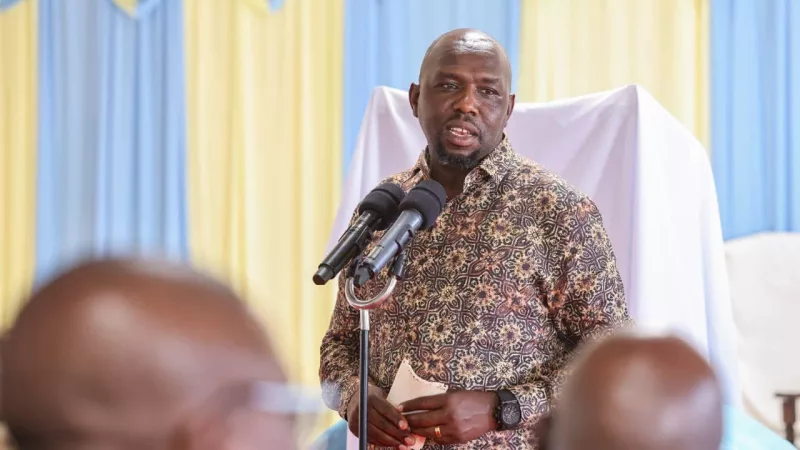
Interior Cabinet Secretary Kipchumba Murkomen has praised Director of Public Prosecutions Renson Ingonga and the Judiciary for securing justice for victims of the Shakahola massacre, following the sentencing of cult leader Paul Mackenzie to 200 years in prison.
Murkomen said the judgement demonstrated the importance of a strong criminal justice system in holding perpetrators of serious crimes accountable. He commended the DPP for what he described as a well-executed prosecution and the Judiciary for delivering justice to the victims.
The CS spoke on Sunday at Bushiangala Church of God in Kakamega County during a fundraising event in aid of a church construction project.
He particularly praised Ingonga and his prosecution team for successfully handling one of the country’s most complex criminal cases, which involved multiple accused persons, hundreds of witnesses and extensive forensic evidence.
Murkomen also raised fresh concerns over Mackenzie’s conduct in prison, saying intelligence reports indicated that the convicted preacher had been attempting to radicalise fellow inmates.
He said the government would ensure Mackenzie was separated from other prisoners to prevent him from spreading his extremist ideology within correctional facilities.
The CS said security agencies were concerned that the preacher could continue influencing vulnerable individuals even while serving his sentence.
Mackenzie, the founder of Good News International Ministries, was on Friday, November 6, sentenced to 200 years in prison by the High Court in Mombasa for his role in the murder of 191 people, including 190 children and one adult, in the Shakahola Forest tragedy.
Justice Diana Kavedza-Mochache handed him consecutive 100-year sentences for 183 counts of murder by starvation and eight counts involving direct homicide.
Twenty-six of his co-accused received prison terms ranging between 100 and 160 years, while two others who entered plea bargains with the DPP were each sentenced to 10 years in prison.
The court found that Mackenzie orchestrated an organised system of religious indoctrination in which followers were instructed to starve themselves and their children to death in preparation for what he described as meeting Jesus.
The prosecution presented extensive evidence, including forensic findings, DNA analysis, medical reports and witness testimony, establishing how the deadly fasting regime was enforced through intimidation, violence and confinement.
However, the judgment does not conclude all legal proceedings arising from the Shakahola tragedy. Separate cases involving manslaughter, radicalisation, terrorism-related offences and crimes against children remain ongoing.
The additional proceedings are expected to address other deaths and alleged criminal activities linked to Mackenzie and his associates.
The court’s decision also directed the government to support survivors through education, healthcare and economic empowerment programmes.
The sentencing marks a significant milestone in the pursuit of accountability for one of Kenya’s deadliest religious extremism-related tragedies.