Health Cabinet Secretary Aden Duale has warned that Kenya faces a Sh15 billion shortfall in funding for its malaria control strategy, calling on African governments to increase domestic investment as international health financing declines.
Duale said Kenya requires Sh17.7 billion annually to implement its malaria strategy but has only Sh2.66 billion available for the current financial year, leaving a funding gap of about Sh15.04 billion.
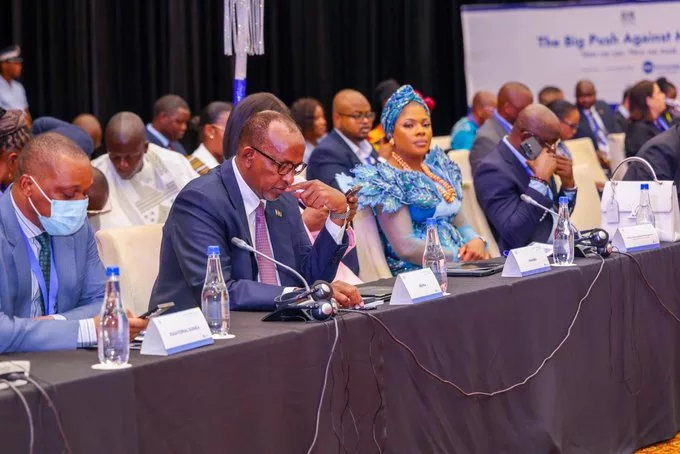
He made the remarks on Thursday while representing President William Ruto at the High-Level Dialogue on Malaria Elimination in Gaborone, Botswana.
The meeting brought together African leaders and health-sector representatives to discuss financing, partnerships and strategies for eliminating malaria.
“Kenya needs Sh17.7 billion annually to implement its malaria strategy, against the Sh2.66 billion available this year, leaving an 85 per cent funding gap,” Duale said in a statement shared on his social media accounts.
He said the funding shortage threatened efforts to sustain progress against the disease, particularly as international financing becomes less predictable.
The CS urged African countries to mobilise domestic resources, strengthen partnerships and invest in local production of essential medicines, mosquito nets and other health commodities.
Duale said Kenya had recorded a decline in confirmed malaria cases, from 5.54 million in 2023 to 3.64 million in the year to September 2026, representing a reduction of 34 per cent.
He also reported a fall in malaria incidence among children under five, from 194 to 119 cases per 1,000 children.
The cabinet secretary said the country was integrating malaria interventions into its Universal Health Coverage reforms through stronger community health services, primary healthcare and digital surveillance.
He also cited efforts to address antimalarial drug resistance through the use of multiple first-line therapies and enhanced pharmacovigilance.
“Malaria knows no borders,” Duale said, calling for greater regional cooperation, including joint surveillance with Uganda and stronger coordination through the East African Community.
Kenya's financing concerns come amid wider pressure on international support for health programmes. Cuts in external financing had exposed the country's reliance on donor support for HIV, tuberculosis and malaria interventions according to a report in October.
The report, drawing on the Global Fund's 2026 Results Report, said the disruption of international funding in 2025 had affected health programmes and increased the need for countries to finance more of their own responses. It noted that Kenya had experienced gaps in services following the temporary suspension of US foreign assistance.
In April, Public Health Principal Secretary Mary Muthoni said Kenya recorded about 4.2 million malaria cases in 2024, with the disease accounting for 18 per cent of outpatient visits. She said about three in every four Kenyans lived in areas where malaria transmission was possible.
Muthoni also raised concerns about implementation gaps at county level, saying malaria control policies needed to be reflected in county plans, budgets and health systems.
She called for increased domestic investment and stronger surveillance, diagnosis and treatment services.
Kenya has also introduced changes to malaria treatment to address emerging drug resistance.
In April, the Ministry of Health said it planned to introduce Multiple First-Line Therapies from October, allowing health facilities to use several approved drug combinations instead of relying mainly on one treatment.
Duale further said Kenya was targeting local production of 50 per cent of essential health commodities through its Health Products and Technologies Local Manufacturing Strategy.
He cited the country's growing capacity to manufacture spatial repellents, saying trials had shown a reduction in malaria infections of about 33 per cent.
Duale said African countries needed to turn political commitments into concrete action, including securing predictable funding and strengthening local manufacturing capacity to sustain malaria control programmes.