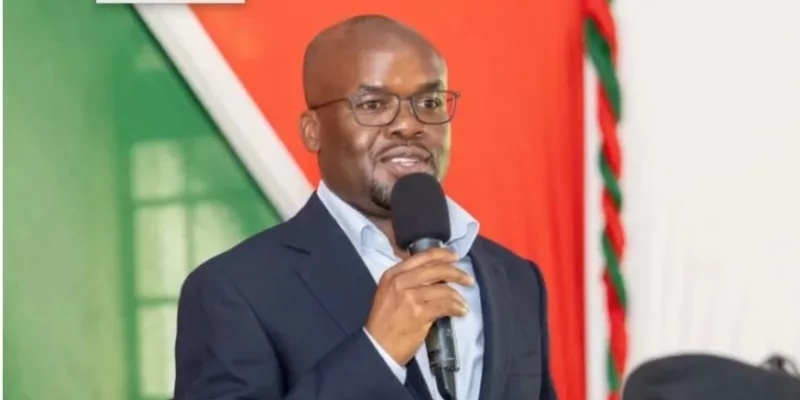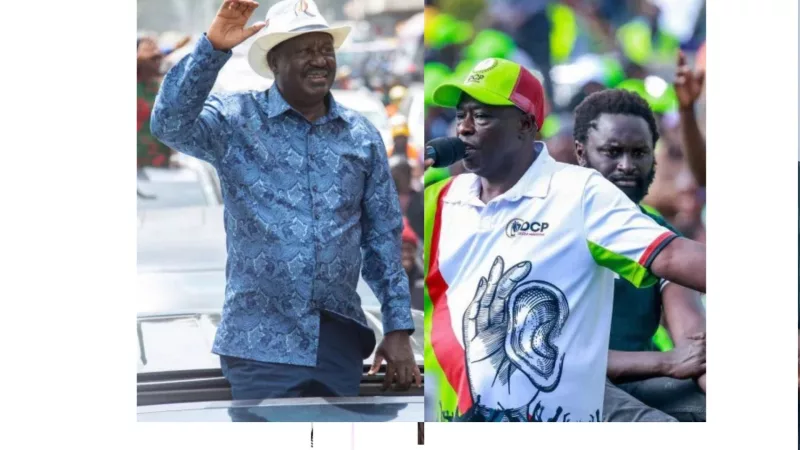
As Kenya’s political landscape takes shape ahead of the 2027 general election, former Deputy President Rigathi Gachagua is emerging as one of the key figures seeking to redefine the country’s political alliances.
Since his impeachment in October 2024, the Democracy for the Citizens Party (DCP) leader has been positioning himself as Mt Kenya’s political kingpin, seeking to occupy the political space left by retired President Uhuru Kenyatta, who left office in 2022.
Through DCP, Gachagua wants to establish a powerful regional political movement capable of determining Mt Kenya’s political direction and negotiating from a position of strength in future coalitions.
One of his ambitions is to have the party elect more than 100 Members of Parliament in 2027, giving the region sufficient numbers to champion its political and economic interests.
In pursuing this ambition, Gachagua has increasingly invoked the political legacy of the late former Prime Minister Raila Odinga, whom he once fiercely opposed but now openly admires.
Gachagua believes Raila’s success in maintaining political influence in Nyanza through the Orange Democratic Movement (ODM), which he founded in 2005, offers a blueprint for Mt Kenya.
Speaking on Wednesday, he said the region needed a strong party with a lasting political identity rather than one that only becomes relevant during election campaigns.
“We have now known the secret of success in a coalition; it is having one big and strong party. I admire the late former Prime Minister Raila Odinga; I admire him for one great thing he did. He built a strong and big party called ODM and placed competitive members of parliament,” Gachagua said.
“I want to build a strong mass movement, a strong political party that will not be winded up after every election,” he added.
But while Gachagua hopes to replicate Raila’s political model, analysts question whether the political conditions that sustained ODM in Nyanza can be reproduced in Mt Kenya.
Political analyst Kipkorir Mutai says Gachagua has the capacity to transform DCP into a formidable political outfit, but maintaining its dominance could prove difficult because of the region’s competing interests.
“Mt Kenya is different from Nyanza. Unlike Nyanza, there are competing political interests. In Mt Kenya, it is largely the voters who decide which political direction to take,” Mutai says.
He cites the 2022 General Election, when Mt Kenya voters overwhelmingly backed President William Ruto despite Uhuru’s last-minute efforts to rally the region behind Raila.
According to Mutai, the election demonstrated that even leaders with considerable political influence cannot always dictate the region’s voting choices.
“In 2022, the region had made its mind to vote for Ruto, having stood with Uhuru. The voters defied Uhuru’s last-minute about-turn on Ruto’s support for presidency. They decided to openly defy Uhuru by massively voting for Ruto’s UDA instead of Raila’s Azimio la Umoja,” he says.
This, he argues, contrasts with the political influence Raila wielded in Nyanza, where ODM remained the dominant political vehicle for nearly two decades.
During much of his political career, Raila commanded substantial loyalty in the region, with ODM providing a platform through which local politicians sought political legitimacy and electoral support.
However, another major distinction between the two leaders lies in their political histories and reform credentials.
Political analysts argue that Raila’s reputation as a champion of multiparty democracy was built through years of confrontation with the administration of former President Daniel arap Moi, including periods of detention without trial.
Raila was detained for several years following the 1982 attempted coup and was subsequently arrested on other occasions for his opposition to the one-party system.
His political activism helped establish his credentials as one of the country's prominent pro-democracy figures.
Gachagua, on the other hand, served in the provincial administration during Moi’s presidency, working as a District Officer between 1989 and 1999 before later joining Uhuru Kenyatta’s political circle.
Political analyst and university lecturer Muchangi Gichuhi says the different paths followed by the two leaders make it difficult to compare their political legacies.
“The histories of the two leaders are different. Raila is a reformist who paid the price for freedom. Gachagua was a system’s insider. He cannot reach Raila’s credentials at all,” Gichuhi says.
He argues that although Gachagua has presented himself as a political victim following his impeachment and his fallout with the Kenya Kwanza administration, his experience cannot be equated with Raila’s longstanding struggle against authoritarian rule.
According to Gichuhi, Gachagua and Raila belong to different political traditions, making comparisons between their political journeys difficult.
The other challenge facing Gachagua is the fragmented nature of Mt Kenya politics.
Unlike Nyanza, where Raila and the wider Odinga political dynasty provided a relatively strong unifying identity, Mt Kenya has historically had competing political interests and personalities.
The region has previously rallied behind leaders such as the late former President Mwai Kibaki and Uhuru, but neither managed to eliminate political competition across its counties.
With Kibaki dead and Uhuru having retired from the presidency, the region is now searching for a new political centre of gravity.
Gichuhi says the absence of a universally accepted regional leader could complicate Gachagua’s efforts to consolidate political influence.
“Mt Kenya is navigating a very unique political path. Even during the times of Mwai Kibaki and Uhuru, there were opposing parties and figures. Due to its rich history and early interaction with the missionaries, the region has never been homogeneous politically. There are always political splinter groups. Therefore, Gachagua may manage to command political influence in a large area, but not all of them,” he says.
The challenge, therefore, is not simply building a party with a large parliamentary presence but sustaining political loyalty beyond individual elections and personalities.