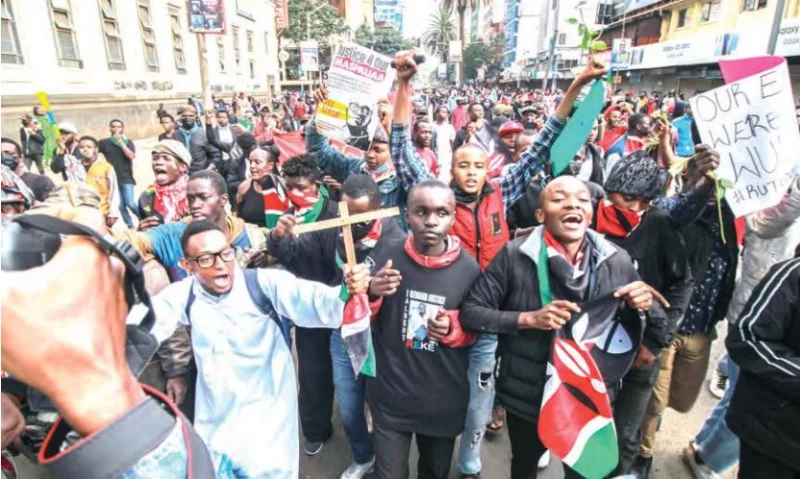
Kenya is experiencing democratic backsliding characterised by rising police brutality, political violence, corruption and restrictions on civil liberties ahead of the 2027 General Election, according to a new human rights report.
The report, titled Democratic Backsliding: State of Human Rights and Governance in Kenya, examines the country's governance record between September 2025 and October 2026, raising concerns over what it describes as increasing reliance on force, surveillance, arrests and intimidation in response to dissent.
Compiled by the Civic Freedoms Forum (CFF), the assessment warns that the reported deterioration in the human rights environment threatens constitutional freedoms and could undermine the credibility of the next general election.
It cites international assessments indicating that Kenya's global freedom score fell from 51 to 49 out of 100 in 2026, with Freedom House retaining the country's "partly free" status.
CIVICUS, another international civic freedoms monitoring organisation, has classified Kenya as "repressed", its second-worst rating.
The report also references a June 2026 assessment by the Kofi Annan Foundation, which rated Kenya's risk of electoral-related violence at 84.1 per cent.
"That pattern is dangerous ahead of 2027, and it borders on the crisis of democratic backsliding, which involves the substantial weakening of democratic practices in a shift towards authoritarianism," the report states.
It identifies the conduct of recent by-elections as an early warning of potential challenges facing the country as political parties prepare for the 2027 contest.
During the November 27, 2025, by-elections, the Kenya National Commission on Human Rights documented three deaths during the campaign period, including two people killed in clashes in Kasipul and another who died during a stampede in Kabuchai.
The report further cites 10 hospitalisations following reported attacks on hotels and homes associated with candidates.
It also highlights findings on the February 26, 2026, by-elections, when 27.3 per cent of observed polling stations reportedly failed to publicly display results forms, while Kenya Integrated Election Management System (KIEMS) kits malfunctioned in 30 per cent of the observed stations.
The July 16 Ol Kalou parliamentary by-election is described in the report as another major warning, with reported allegations of voter bribery, intimidation, property destruction and violence, including the reported loss of one life.
The assessment also raises concerns over police conduct, citing reported killings, arbitrary arrests and enforced disappearances during protests.
It references the Missing Voices 2025 annual report, which documented 131 cases of police violence, including 125 killings and six enforced disappearances.
According to the report, 24 police killings were recorded in May 2026 alone, while demonstrations triggered by rising fuel prices resulted in more than 30 people injured and over 348 arrests.
The second anniversary of the June 25, 2024, Gen Z protests was also marked by reported arrests and disappearances. The report cites KNCHR data documenting 361 arrests across 11 counties and seven cases of enforced disappearance during the June 25, 2026, demonstrations.
Beyond security concerns, the report identifies corruption, public debt and the rising cost of living as major governance challenges, arguing that these factors undermine the government's capacity to deliver essential services.
It also raises concerns over the affordability of education and healthcare, citing findings that 64.9 per cent of learners in day schools had reportedly been sent home or denied access to classes over unpaid levies described in the report as illegal.
The report concludes with 10 demands, including an end to police killings and enforced disappearances, protection of journalists and human rights defenders, credible electoral preparations, accountability for corruption and protection of independent constitutional institutions.
It calls on the Independent Electoral and Boundaries Commission, police oversight bodies, the Judiciary and other accountability institutions to safeguard constitutional freedoms and ensure credible elections.
The forum says the report will be shared with the public, Parliament and international human rights bodies as an alternative assessment of the country's governance record.