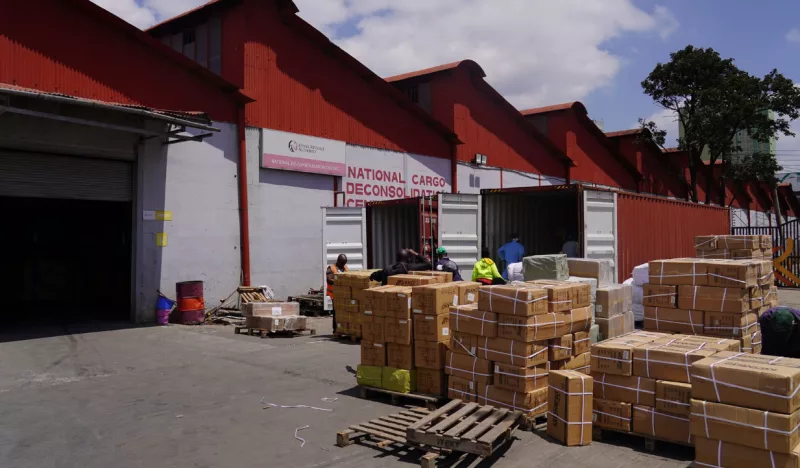
Informal cargo consolidators will now be required to disclose individual importers’ details in a fresh crackdown aimed at sealing potential tax and import duty leaks.
The new Kenya Revenue Authority Rules require cargo consolidators and customs clearing agents to provide each trader’s full name, Personal Identification Number (PIN), national identity card number, telephone contact, description of goods and their value for consolidated shipments.
The directive, which took effect on September 13, 2026, seeks to improve accountability in a trade arrangement widely used by small businesses that cannot afford to import goods in full containers.
In a notice on Tuesday, KRA called for compliance, saying the measure would strengthen transparency, improve tax compliance and enable eligible Value Added Tax (VAT)-registered importers to obtain electronic tax invoices through the Electronic Tax Invoice Management System (eTIMS).
By linking individual consignees to their shipments, the taxman could gain greater visibility into the ownership and value of imported merchandise, making it easier to identify potential under-declaration and undervaluation.
The move also places additional compliance obligations on consolidators and clearing agents, who must ensure the information submitted for every importer is accurate.
The directive comes weeks after protests by small-scale importers over increased customs valuation benchmarks introduced in August.
The dispute centred on the valuation of consolidated 40-foot containers, whose benchmark was raised from Sh2.5 million to Sh3.2 million, prompting complaints that the changes had increased import costs.
Following a meeting between President William Ruto, traders and other stakeholders at State House, Nairobi, the government agreed to reduce the general benchmark to Sh2 million.
The government also committed to vetting cargo consolidators and facilitate designated de-consolidation centres in Nairobi and Mombasa to streamline cargo handling.
The latest disclosure requirements could help KRA distinguish individual traders and their merchandise rather than relying solely on container-level information.
However, industry players say the rules could increase operating costs, particularly for businesses handling door-to-door shipments.
The Kenya Groupage Cargo Handling Association told the Star that its members operate differently from informal consolidators.
Its members submit house manifests to customs, while some informal operators handle door-to-door shipments, submit customs entries and pay duties before delivering cargo to individual consignees.
The association said the new rules hence target the informal consolidators, who are now required to declare the actual consignees of consolidated cargo so that individual traders could receive electronic tax invoices.
“When each consignee is onboarded in eTIMS, that is when the impact will be felt and definitely the cost of doing business will increase,” an official at another consolidation group told the Star.
Shippers Council of Eastern Africa chief executive Agayo Ogambi said accurate documentation was essential in addressing compliance concerns within the industry.
“The sector continues to suffer ‘trust’ issues and we urge the industry to endeavour to be more compliant,” Ogambi said, pointing to multiple and duplicating regulatory requirements.
He urged KRA to adopt know-your-customer procedures while expediting clearance for legitimate businesses.
Ogambi said the proportion of cargo cleared within the free storage period had fallen from more than 90 per cent to below 80 per cent, raising concerns about delays and additional costs.
He added that enforcement measures should distinguish compliant traders from businesses that deliberately evade tax obligations.
“Except for Authorised Economic Operators (AEOs), they go through stringent clearance processes,” he said, urging KRA to introduce dedicated customs account managers for key customers.
For small-scale importers, the success of the new rules will depend on whether improved revenue accountability can be achieved without creating excessive documentation, clearance delays and higher costs for legitimate businesses.