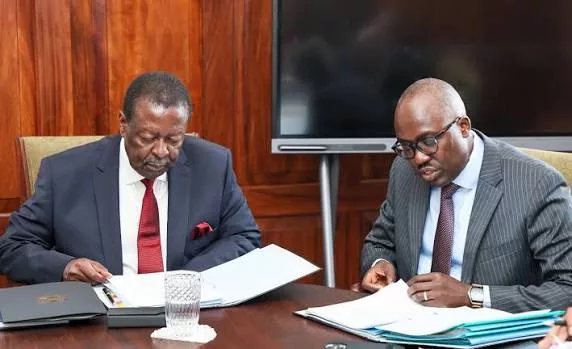
Kenya’s position in the race for UN Secretary-General has been thrown into confusion after Foreign Affairs Cabinet Secretary Musalia Mudavadi and Principal Secretary Korir Sing’oei issued conflicting statements on support for the UAE candidate.
Mudavadi on Monday evening announced Kenya had welcomed the candidature of Emirati diplomat Lana Nusseibeh, citing her extensive experience in multilateral diplomacy and service within the UN system.
But on Tuesday morning, Sing’oei appeared to contradict his boss, insisting Nairobi had not endorsed any of the candidates seeking to succeed outgoing UN Secretary General António Guterres in January.
“Quite to the contrary, Kenya has not expressed support for any candidate at this point,” Sing’oei said in a statement posted on X.
He added that Kenya was closely following the ongoing campaigns, including the entry of new candidates, and was confident that a candidate capable of leading the UN at this critical juncture would receive the backing of Nairobi and a majority of member states.
The conflicting messages leave questions on whether Mudavadi’s statement was a formal endorsement or merely an expression of welcome for Nusseibeh’s entry into the contest.
Prior to that, however, Nairobi had not declared its position on any other candidate in the race, including Olara Otunnu of Uganda.
Mudavadi’s office had said he was speaking on behalf of Kenya, adding that the country looked forward to working with Nusseibeh to strengthen the partnership between the UN and Africa.
The statement was widely interpreted as an endorsement of her bid, particularly because Kenya had not publicly declared its position on the other contenders.
Sing’oei’s subsequent position however, suggests Nairobi has yet to commit to any candidate, raising questions about coordination within the Foreign Affairs ministry over a major multilateral diplomatic contest.
It also leaves open the question of whether Kenya will eventually back Nusseibeh or another contender as the selection process gathers pace.
A diplomatic source who spoke on condition of anonymity indicated that Kenya informally supports Nusseibeh’s candidature but faces political considerations that complicate an outright public endorsement.
The source suggested that diplomatic sensitivities remained around the decision, potentially explaining the conflicting signals from Mudavadi and Sing’oei.
The confusion comes against the backdrop of Kenya’s close diplomatic and economic ties with the UAE.
On October 23, President William Ruto met Sheikh Shakhboot bin Nahyan Al Nahyan, the UAE Minister of State in the Ministry of Foreign Affairs, at State House, Nairobi.
In a statement after the meeting, the President described the two countries as enjoying warm diplomatic relations grounded in shared aspirations.
He said Kenya would continue to deepen the relationship to facilitate greater trade and investment.
The timing of the meeting and subsequent statements could draw attention to the diplomatic implications of Kenya’s position.
Nusseibeh is among several contenders seeking to replace Guterres, whose second term ends on December 31.
Other candidates include Costa Rica’s Rebeca Grynspan, Argentina’s Rafael Grossi, Guyana’s Carolyn Birkett, Ecuadorian diplomat María Garcés, Otunnu and Ivonne A-Baki, who was nominated by Tonga.
The latest reported UN Security Council straw poll before Nusseibeh entered the race placed Grynspan among the leading contenders, alongside Grossi and Birkett.
The informal polls gauge support among the 15 Security Council members, including the five permanent members — China, France, Russia, the United Kingdom and the United States — whose veto powers can block a recommendation.
Under the UN Charter, the Security Council recommends a candidate for appointment by the General Assembly.
Kenya has a significant stake in the process as host to the UN Office at Nairobi, which houses the headquarters of the UN Environment Programme and UN-Habitat.
Nairobi has also supported calls for reforms to international institutions to strengthen Africa’s representation in global decision-making.