Security chiefs and rights monitors warned that civility is dead without justice as fresh data revealed a sharp escalation in pre-election violence ahead of the 10 August 2027 general election.
The chilling assessment emerged during a high-level multi-agency stakeholders forum examining civic space, peace, and national cohesion, where participants reviewed a comprehensive report by the Kenya Human Rights Commission tracking media reporting between January and July 2026. According to the monitoring data covering 12 mainstream media outlets and their digital platforms, the pre-election period recorded 242 unique incidents, resulting in 68 deaths and 3,222 affected persons. Analysts flagged 37 escalation alerts and 149 verified violations, alongside 92 alleged and one disputed record, underscoring a deteriorating environment governed by rising political intolerance. Nairobi accounted for 106 incidents, 21 deaths, 1,189 affected persons, and 17 escalation alerts.
National Police Service representatives and independent watchdogs expressed alarm over the formalisation of political goonism and the weaponisation of state machinery. The data indicated that the National Police Service was implicated in 178 incidents resulting in 58 deaths, including 48 incidents through the Directorate of Criminal Investigations, 13 through the General Service Unit, seven through the Anti-Riot Unit, three through the Administration Police, and 119 where specific units were unnamed. Organised gangs were linked to 39 incidents, the Independent Policing Oversight Authority recorded 49 cases, the Office of the Director of Public Prosecutions 37 records, and the Independent Electoral and Boundaries Commission 31 records. The KHRC presenter warned that specialised units appeared to operate outside formal command, stating that if there is outright deniability despite evidence, these units are operating outside the formal command structure, which is very dangerous, adding that police look likely politicised and there is no safe haven anymore.
Speakers stated that the worrying escalation of human rights violations, political mobilisation against those who speak out, kidnapping, coordinated political violence, threats, impunity, intimidation, disinformation campaigns, evolving digital and online hate speech, cyber harassment, and digital surveillance are all becoming increasingly weaponised to shush citizens, cautioning that peace without justice is dishonest.
Representing the IEBC, an official stated that the commission remains firmly committed to facilitating inclusive, free, fair, transparent, and credible general elections in 2027, stressing that election preparedness goes beyond logistics and that the best way of killing an election is actually suppressing the votes.
Meanwhile, the Office of the Registrar of Political Parties noted that compliance is not optional and urged parties to sign the Political Decency and Peace Charter, pointing out that peace is won in how parties nominate their candidates and speak to supporters. The Interreligious Council of Kenya declared that no campaign slogan, seat, or victory is worth a single Kenyan life, pledging neutral pulpits and calling on authorities to act decisively on early warnings.
National Cohesion and Integration Commission Chairperson Dr Bishop Kepha Omae warned that early warning signs—including the disruption of political gatherings at burials, divisive rhetoric, and the mobilisation of young people to create disorder—must be confronted immediately before they escalate to full-blown destruction. Pointed questions from the floor challenged authorities over inaction on police violations, the culture of political militia encouraged by parties, and the adequacy of penalties for electoral malpractices.
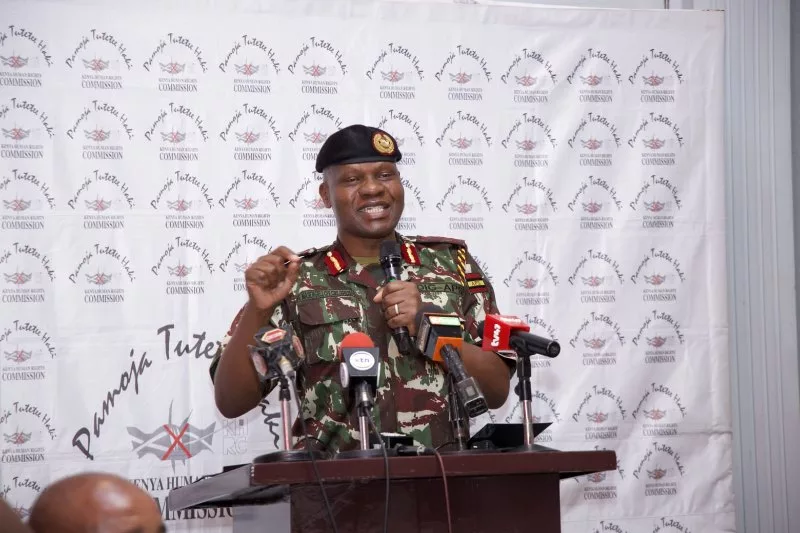
Deputy Inspector General Gilbert Masengeli, reading a speech for the Inspector General, assured participants of total support for ensuring safety, declaring that issues of hate speech, goonism, and election violence must be stopped. However, rights advocates insist that sustainable peace remains impossible without accountability, noting that persistent impunity and a lack of consequences for attacks on civil society and journalists continue to erode public trust.