The United Opposition has reaffirmed its commitment to fielding a single presidential candidate to face President William Ruto in the 2027 General Election amid growing public scepticism about whether the unity agenda can survive competing personal ambitions.
Several opposition leaders have expressed their willingness to unite behind one flagbearer.
However, remarks by some of their allies and supporters suggest the coalition could struggle to reconcile competing interests, with emerging divisions threatening to undermine its unity push.
Fault lines appear to be developing around three leading presidential hopefuls: Nairobi Senator Edwin Sifuna of the Linda Mwananchi Movement, Wiper Patriotic Front leader Kalonzo Musyoka and Jubilee Party's Fred Matiang'i.
Democracy for the Citizens Party (DCP) leader Rigathi Gachagua, who has also declared interest in the presidency, has increasingly positioned himself as a potential unifier and kingmaker in the emerging contest.
The former Deputy President has repeatedly played down concerns about a possible split in the opposition, arguing that the delay in naming a candidate is a strategic move intended to keep political rivals guessing.
"And the day we announce that candidate, the elections will be won that day," Gachagua told Kenyans in the diaspora on October 11 during a Sunday service at St Stephen's ACK Church in Dracut, Massachusetts, in the United States.
He assured supporters that they would be happy with the candidate eventually selected.
However, the confidence contrasts with increasingly uncompromising positions among some of opposition's supporters, raising questions about how they will manage competing demands.
Some leaders and supporters from the Mulembe community have argued that it is their turn to produce a presidential candidate, with some warning that they would not support another opposition contender if Sifuna is overlooked.
Similar sentiments have emerged among sections of the Kamba community, where Kalonzo's supporters are pushing for him to receive the coalition's ticket, with some suggesting they would rather vote for Ruto if he is passed over.
Sections of the Gusii community have expressed comparable expectations around Matiang'i, with some supporters indicating they would back the incumbent if their preferred candidate is not selected.
These positions reflect the pressure facing opposition leaders, although they do not necessarily represent the views of entire communities or the opposition's voting bloc.
In an apparent effort to avert a fallout, Gachagua has been hosting opposition leaders at his Wamunyoro residence in Nyeri county, with consultations on unity taking centre stage.
On October 20, shortly after returning from his US tour, he met Sifuna and members of the Linda Mwananchi team, including Embakasi East MP Babu Owino and Trans Nzoia Governor George Natembeya.
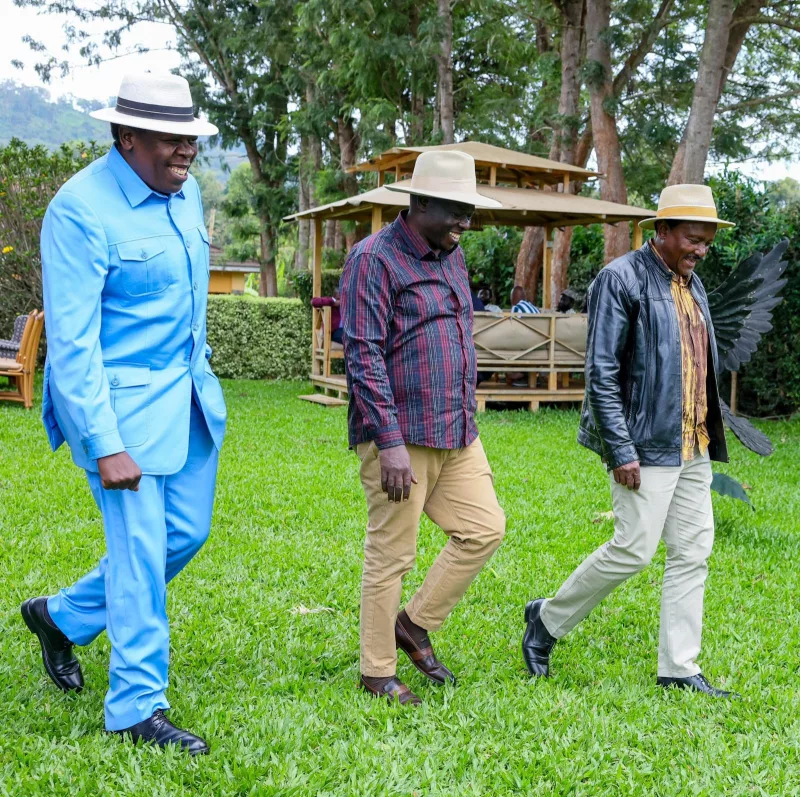
On October 26, he held talks with Kalonzo and Democratic Action Party of Kenya (DAP-K) leader Eugene Wamalwa, highlighting the integral role Wamunyoro is playing in the unity push.
Gachagua said the opposition remained committed to making the necessary compromises to settle on a single presidential candidate.
"We are in agreement that the identification of a single presidential candidate is the surest path to win the next year's General Election, and we are all fully committed to that goal. Gather all and scatter none," he said.
The meetings could signal further consultations with other opposition leaders, including People's Liberation Party leader Martha Karua and Matiang'i, although there has been no confirmation that either is scheduled to visit Wamunyoro.
Amid the consultations, President Ruto has repeatedly mocked the opposition over its failure to agree on a presidential candidate.
This has raised a broader question: could a dramatic endorsement similar to the famous 'Kibaki Tosha' declaration of 2002 be what ultimately settles the contest?
Raila's 'Kibaki Tosha' declaration on October 14, 2002 transformed the opposition's presidential campaign by rallying competing factions behind Mwai Kibaki and helped end KANU's 39-year hold on power.
Addressing a large crowd at Uhuru Park in Nairobi, Raila asked, "Si Kibaki anatosha?" — meaning, "Isn't Kibaki enough?"
The declaration drew an enthusiastic response from the crowd and helped consolidate support behind Kibaki's presidential bid.
The endorsement brought together the National Alliance of Kenya (NAK) and the Liberal Democratic Party (LDP) under the National Rainbow Coalition (NARC), helping transform a fragmented opposition into a formidable electoral force.
NARC went on to win the December 27, 2002 General Election, ending KANU's long rule and paving the way for Kibaki's inauguration as Kenya's third president.
Raila's endorsement came barely three months before the election, demonstrating how a decisive intervention by an influential opposition figure can help resolve a protracted contest over leadership.
The current opposition could consider a similar approach, although whether its leaders would rally behind one contender through a comparable declaration remains uncertain.
Reports suggest the leaders are divided over when to announce their presidential candidate, with discussions continuing on whether to settle the question early or delay the announcement.
After meeting Kalonzo, Gachagua reiterated the need for compromise in a statement on X.
"We are all in agreement that we shall make whatever sacrifices necessary to settle on one presidential candidate to be the captain of our struggle. Consultations continue," he wrote.
Speaking in Nakuru on October 21, Karua said the opposition was committed to fielding a single candidate and would announce its choice at the appropriate time.
She, however, urged leaders to remain open to alternative candidates, warning against behaviour that could undermine efforts to unite the opposition.
"Wacha kila mtu akuje ndani tutawatambua na tabia zao na matamshi yao. Ukiwa na vurugu na ukiwa unapigapiga ndugu zako, wewe tutakujua lakini ukiwa mtu wa kuunganisha, tutakuwa pamoja na wewe," she said.
(Let everyone come in. We will assess them by their conduct and their words. If you are disruptive and keep attacking your colleagues, we will take note. But if you are a unifying force, we will stand with you)
Whether the opposition can turn its public commitment to unity into a workable political agreement remains to be seen.
For now, Gachagua's consultations have placed him at the centre of efforts to bring the competing camps together, but the ultimate test will be whether the leading contenders are willing to put aside their individual ambitions for a common presidential candidate.