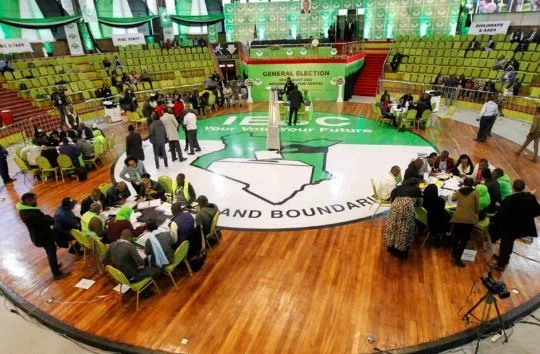
The Elections (Amendment) Bill now returns to the Senate amid confusion over whether changes approved by the National Assembly have weakened requirements for livestreaming election results ahead of next year’s election.
The controversy has exposed competing interpretations of a key provision governing how votes are announced and made accessible to the public, forcing Parliament and the government to issue clarifications.
The dispute is centered on interpretation of Section 39 of the Elections Act, which governs the determination, transmission and declaration of election results.
The National Assembly passed the Elections (Amendment) (No. 2) Bill, 2024, with amendments on October 22, deleting a clause that had proposed replacing the existing section.
Parliament says the decision preserves the requirement for the Independent Electoral and Boundaries Commission to establish a mechanism for livestreaming results announced at polling stations.
But the decision has not ended questions about the legal framework governing giving members of the public a live view of the results, with critics calling for clarity on the precise provisions that will apply during the next election.
The Bill will return to the Senate for consideration of the National Assembly's amendments under Article 110(4).
The confusion arose after the Senate-passed version proposed deleting Section 39 and replacing it with a new provision governing the handling of election results.
The proposed replacement did not expressly retain the requirement for the IEBC to establish a mechanism for livestreaming results as they are announced at polling stations.
That omission triggered concerns that the proposed law could weaken public scrutiny of the electoral process, even as electronic transmission and online publication of results forms remained part of the framework.
The National Assembly subsequently deleted Clause 22, leaving Section 39 in its existing form.
Majority leader Kimani Ichung'wah dismissed reports that MPs had passed a law scrapping livestreaming, saying the provision had not been altered.
Parliament said the decision followed public participation, engagement with stakeholders, including the IEBC, and a High Court judgment delivered on September 22.
The court upheld the constitutionality of Section 39 and Regulation 83(2) of the Elections (General) Regulations, while cautioning Parliament to consider its interpretation of the law when finalising electoral legislation.
The State Department for Parliamentary Affairs also moved to reassure the public, saying the livestreaming requirement remained intact.
Principal Secretary Aurelia Rono said the National Assembly had removed the clause proposing to replace Section 39, thereby retaining the existing legal provisions.
The dispute, however, has highlighted the difference between livestreaming results announcements and electronically transmitting election results.
Livestreaming allows voters, political parties, journalists and election observers to watch results being announced at polling stations.
Electronic transmission, on the other hand, involves sending results through the IEBC's systems, while publication of results forms allows the public to inspect the recorded figures.
Critics argue that the processes serve different purposes and that online publication of results forms cannot automatically substitute for a mechanism that allows the public to follow announcements as they happen.
Former Law Society of Kenya president Faith Odhiambo called for Parliament to publish the final version of the Bill and clarify the implications of the amendments.
She argued that Kenyans should be able to follow how votes translate into election results instead of relying solely on official declarations.
The assertions ignited sharp reactions from state functionaries, dismissing the critics, especially from among the legal fraternity as dishonest.
Lawyers, among them Ahmednasir Abdullahi, took on the critics, including former Chief Justice David Maraga, saying they were misleading Kenyans on the impact of the amendment.
“Stop peddling false narrative. Parliament hasn’t done anything of the sort…just be truthful,” the lawyer said after Maraga claimed that “Parliament wants to switch off the cameras on our elections.”
The dispute comes as the country prepares for the 2027 polls, when the credibility of the results management process is expected to remain a major issue.
The Bill also proposes changes to voter registration, political party nominations, the recall of MPs, and the resolution of electoral disputes.
On voter registration, the proposed law seeks to make the register available for public inspection, subject to specified exceptions during designated periods before an election or referendum.
It also proposes limiting the suspension of voter registration during a by-election to the affected electoral area.
A person registering during the suspension would not be eligible to contest that particular by-election in the affected area.
The proposed amendments would also remove IEBC involvement in political party primaries, giving parties greater flexibility in selecting candidates for elective and party-list positions.
On the recall of elected representatives, the Bill seeks to revise procedures to align them with the constitution.
The changes come against the backdrop of wider debate over how to strengthen electoral accountability while protecting elected leaders from politically motivated recall attempts.
The livestreaming row is likely to remain a point of contention as the Bill returns to the Senate, where lawmakers will have to consider the changes made by the National Assembly.
The two Houses must resolve their differences on the Bill before the legislative process can be completed.
The electoral commission, when it responded to press reports on the livestream matter, said its amendments in a proposed election laws changes stemmed from a court ruling which declared the sections mandating it to livestream invalid.
The National Assembly in an explainer said the law remains in place, meaning IEBC has an obligation to set up a public portal and display the results in public as the results stream in.
The immediate question is whether the Senate will accept the National Assembly's amendments or seek further changes to the provision governing election results.
Until the legislative process is concluded, the Bill remains a proposal rather than an enacted amendment to the Elections Act.