
Special edition: Demand for safe food drives growth of organic farming in Kenya
Growing consumer demand for safe food is pushing more Kenyan farmers to embrace organic farming, but limited awareness, inadequate training and poor market access continue to hinder the sector’s growth.
David Maina, an organic farmer in Kiserian, Kajiado County says consumers are increasingly concerned about how their food is produced, and this has created opportunities for farmers who avoid synthetic pesticides and herbicides.
“The current consumer is very keen on what they are eating and what is on their plates. We have been able to cultivate a culture of eating safe food that is not grown using harmful pesticides or synthetic herbicides, hence the increase in organic farming,” he says.
Maina who is the secretary of 3000Nooya, a registered self-help group that brings together trained organic farmers in Kiserian, says they grow herbs and process agricultural produce into value-added products.
The group makes infused honey, herbal tea bags and cassava flour, among other products, which it sells through a market in Kiserian held every Friday.
He says working collectively has helped the farmers maintain the quality of their produce, reach consumers directly and reduce their reliance on middlemen.
“Farmers are able to get better returns when they sell their produce. It is also an opportunity for them to meet, share what is working and what is not, and grow their agribusinesses,” Maina says.
He adds that the group prioritises soil health through practices such as applying compost and biochar. Its members also make their own pesticides and train farmers on organic production methods.
Biochar is a carbon-rich, charcoal-like substance made by heating organic waste such as wood chips, crop residues, and manure.
Maina however says inadequate information and training remain major barriers to wider adoption.
“There needs to be a lot of training and community awareness about organic foods and the practicalities of production,” he says, adding that demand for their products is already higher than what they can supply.
To address shortages, the group collaborates with other organic farming groups across the country. When it lacks products such as sweet potatoes, it can source them from farmers in Busia for processing and sale.
In Homa Bay County, Eucabeth Achieng’ Mbuya is also turning to value addition to improve the returns from organic farming.
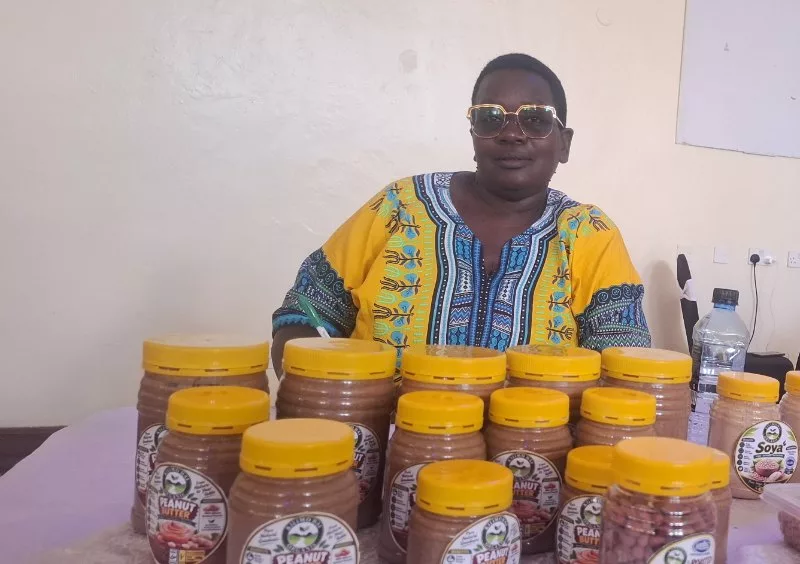
A member of the Homa Organic Farmers Association, she grows cassava, makes beehives and processes groundnuts into peanut butter. The group also produces a soya drink from soybeans.
The association was started in 2017 with 15 members, the association has grown to 50, reflecting increasing interest in collective organic farming and marketing.
Mbuya says, however, that farmers still struggle to obtain good prices for their products, particularly when consumers compare them with cheaper conventional alternatives.
She hopes improved market access and consumer awareness will help more people appreciate the value of organically produced food.
Speaking during the fourth National Participatory Guarantee Systems (PGS) workshop, Eustace Kiarii, team leader at the Kenya Organic Agriculture Network (KOAN) points out the need to strengthen community-based verification of organic and agroecological farming practices.
Kiarii, says PGS gives farmers a central role in determining whether members comply with agreed production standards.
“Under the system, farmers agree on the standards they will follow and conduct peer assessments, visiting one another’s farms to assess practices and share knowledge. This differs from conventional third-party certification, in which external inspectors assess farms, often through scheduled inspections. Participatory Guarantee Systems bring farmers to the centre of decision-making, allowing them to know who is following the rules,” he says.
Farmers who meet the applicable requirements can use the Kilimohai mark, which helps consumers identify products assessed under recognised organic or agroecological criteria.
The Kilimohai Green mark is associated with compliance with the East African Organic Product Standard, while the Kilimohai Blue mark is linked to compliance with the 13 principles of agroecology, assessed through the Kilimohai Agroecology Assessment Tool.
Kiarii estimates that more than 500,000 farmers practise organic or agroecological farming without certification, while about 5,000 farmers are certified organic.
He added that counties including Murang’a, Kirinyaga, West Pokot and Busia have taken steps to support organic farming and markets.
Samuel Ndungu, KOAN’s programmes manager, says Kenya’s organic sector is expanding in both domestic and export markets.
He estimates the domestic organic market is worth about Sh600 million, while the combined domestic and export sector is valued at approximately Sh3 billion. Kenya has about 115 exporters of organic products, with avocados and macadamia among the leading exports and fresh herbs and spices emerging as promising products.
Ndungu called on county governments and other stakeholders to establish more organic and agroecological markets, allowing farmers to sell directly to consumers and explain how their products are grown.
He also urged farmers to harvest and conserve rainwater in small dams to sustain production during dry periods.
Instant analysis
According to the Kenya Organic Agriculture Network (KOAN), the organic market in Kenya offers 347 different products across various categories, with fresh vegetables leading the assortment at 222 organic products, including arrowroots, broccoli, celery, amaranth, carrots, cucumber, and cabbage. Organic agriculture sector in Kenya experienced notable growth in the production and consumption of various products, with sweet potatoes leading at 502,000 units, followed by butternut at 420,000 units, and arrowroot at 410,000 units. Kenya has seen a consistent increase in organic land area, from 84,538 hectares in 2007 to 171,298 hectares in 2022, with growth spikes in 2012-2013 and 2014-2015, reflecting a positive shift towards organic agriculture and highlighting the sector’s resilience and potential for further growth in the country’s agricultural landscape.