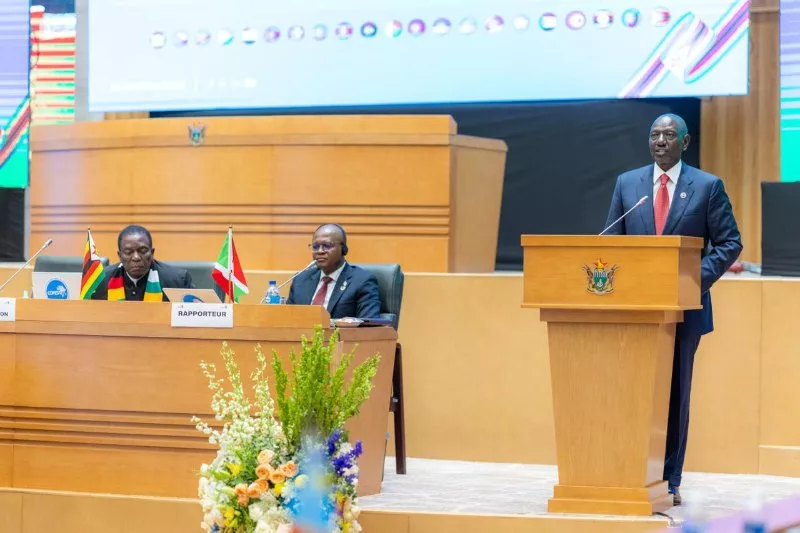
President William Ruto has challenged African countries to increase trade among themselves, warning that the region continues to rely heavily on external markets despite its vast population and economic potential.
Ruto said the Common Market for Eastern and Southern Africa (COMESA), which brings together 21 member states with nearly 700 million people and a combined gross domestic product of more than $1 trillion, must do more to strengthen intra-regional commerce.
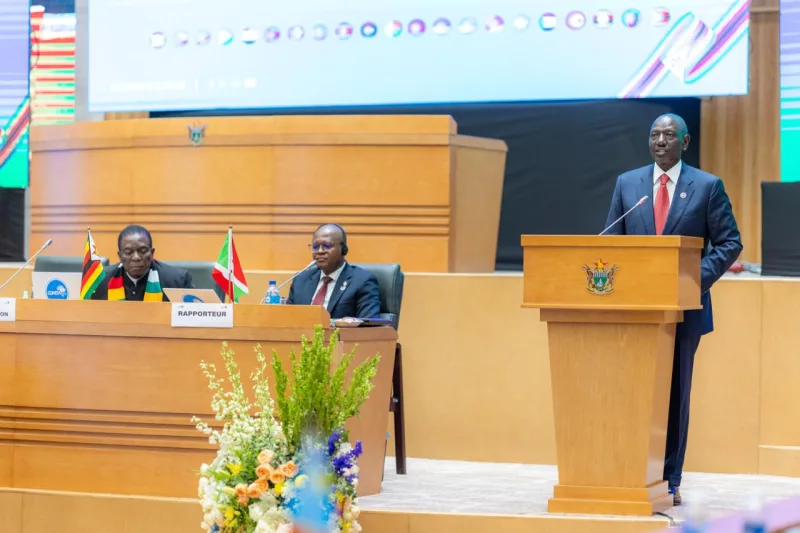
“We are neighbours who buy from strangers,” Ruto said on Thursday during the 25th COMESA Summit of Heads of State and Government in Harare, Zimbabwe.
The summit also saw Ruto hand over the COMESA Authority chairmanship to Zimbabwean President Emmerson Mnangagwa, whom he congratulated on his election to lead the regional bloc.
“Mr Chairperson, you have my support, my counsel, and my full commitment,” Ruto said, adding that he would continue serving as Rapporteur in the new Bureau.
Ruto was speaking during the launch of the COMESA Medium-Term Strategic Plan 2026-2030 and the 2025 Annual Report, which outline priorities for deepening regional integration and expanding trade.
The strategic plan, launched under the theme “One Market, One Future,” targets increasing intra-COMESA trade to 15 per cent of the bloc’s total trade by 2030 through the removal of trade barriers, deeper trade liberalisation and expanded digital commerce.
The President urged African countries to strengthen regional value chains in agriculture, industry and mining by processing raw materials locally instead of exporting them and importing finished products.
“For too long, we have exported the raw materials, imported the finished products, and surrendered the jobs, industries and wealth that should have remained in Africa,” he said.
Ruto argued that stronger regional industrialisation would help countries retain more economic value, create employment and expand business opportunities.
He called for improved physical and digital connectivity, including one-stop border posts and reliable energy infrastructure, to lower the cost of doing business across national borders.
The private sector, he said, must play a central role in driving regional trade, while governments create an environment in which farmers, manufacturers, investors and innovators can operate more easily across the common market.
Ruto said the strategic plan’s success would depend on effective implementation, regular monitoring and accountability by member states and COMESA institutions.
Ruto urged member states to take five practical steps to accelerate regional integration.
These include joining and fully implementing the COMESA Free Trade Area, ratifying the Protocol on the Free Movement of Persons or adopting the COMESA Business Visa, and connecting national payment systems to regional payment platforms.
He also called for the incorporation of regional commitments into domestic law and policy, the resolution of reported non-tariff barriers and the payment of financial contributions to COMESA in full and on time.
“These are not new promises. They are old promises waiting to be kept,” he said.
Ruto said the bloc had made progress in harmonising policies, facilitating trade, promoting investment and supporting regional projects. However, he acknowledged that intra-regional trade must grow faster, connectivity must improve and the benefits of integration must reach more people.
“Plans are launched in halls. They are delivered in our respective countries,” he said, urging member states to focus on implementation rather than commitments alone.
He said stronger regional cooperation would unlock investment, strengthen economic resilience and create a more inclusive and prosperous future for COMESA citizens.