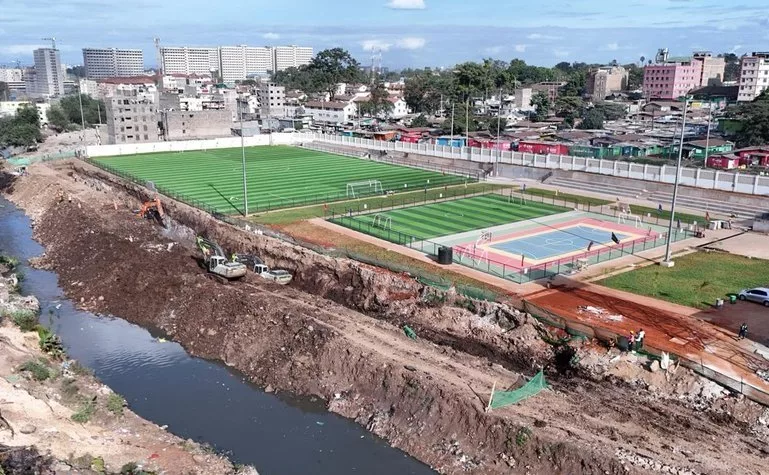
 The ongoing works at Kamukunji Grounds/handout
The Nairobi Rivers Commission is confident it will complete the ongoing rehabilitation of the heavily polluted river basin by January next year.
This is despite delays caused by riparian land encroachment, court cases and the relocation of traders.
Nairobi River Regeneration project officer Colonel Kahigu Njoroge said the commission had resolved several disputes with landowners and was making progress on projects along the river.
“We had a lot of court cases and issues raised by the landowners, but we have been able to address that,” Njoroge, who is seconded from the Ministry of Defence, told the Star.
The commission has been working downstream, particularly between Lucky Summer and Gikomba, where traders operating along the river have had to be relocated to create room for rehabilitation works.
Njoroge said the first phase of a market intended to accommodate the traders had been completed, while those earmarked for the second phase were moved on Monday to pave the way for construction.
“We are targeting to finish all the markets within six months,” he said.
The relocation of traders remains a key challenge, with the commission having to identify alternative trading spaces before work can proceed.
At Grogon, discussions are underway with mechanics to relocate them to Mathare, where designated garages are also being developed.
Works have begun around Globe Roundabout and Grogon, although major excavation is required because of underground rock formations.
The project also includes constructing bridges, widening sections of the river, improving wastewater management and developing markets and non-motorised transport facilities.
Bridge works are planned in areas including Grogon, Gikomba and Kiambiu, while improvements have been undertaken along the stretch from Lucky Summer towards Kiambiu.
Twin trunk sewer lines are being installed on both sides of the river to improve wastewater conveyance.
However, encroachment into riparian areas has affected progress in some locations.
Njoroge said the next phase would move upstream within two weeks, extending beyond the University of Nairobi towards Naivasha Road, where the commission intends to reclaim riparian land.
The deadline came amid the scale of the environmental challenge facing the basin, which stretches more than 70km through Nairobi and drains into the Athi River system.
Rapid urbanisation, untreated sewage, industrial effluent, indiscriminate waste disposal and development along riverbanks have contributed to severe pollution, degraded ecosystems and increased flood risks.
The Nairobi River Basin Regeneration Programme coordinates interventions across Nairobi, Kiambu, Kajiado, Machakos and Makueni counties.
Its recovery strategy identifies priorities including catchment restoration, protection of wetlands, reclamation of riparian reserves and improved waste management.
The multi-agency team has also begun emergency spillway works at Nairobi Dam to strengthen flood preparedness ahead of anticipated heavy rains, alongside the broader restoration programme.
The commission reports it has established 5,513 tree nurseries with 600,000 seedlings, employed 42,000 people, cleaned 84 kilometres of rivers, collected 30,842 tonnes of garbage and conducted 327 clean-ups.
However, meeting the January deadline will depend on resolving remaining land disputes, completing trader relocations and delivering infrastructure works across the basin.
While the reported progress points to significant activity, the ultimate test will be whether the interventions reduce pollution, restore riparian areas and improve the river system’s ability to manage wastewater and flooding.