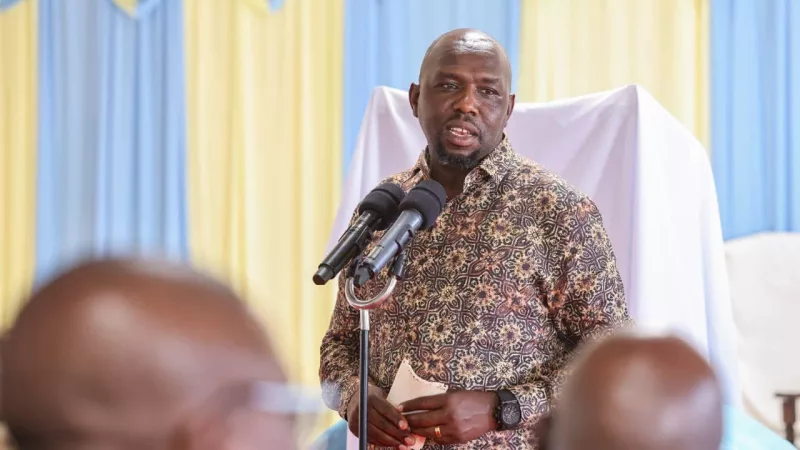
 The National Secretary General of the Kenya Environmental Health and Public Health practitioners (KEHPHPU) Brown Ashira speaking to the press in Garissa.
Public health officers will hold demonstrations in Nairobi on Wednesday next week to pressure the government to resolve grievances that have kept them on strike for nearly three months.
The Kenya Environmental Health and Public Health Practitioners Union (KEHPHPU) had planned the demo on October 14 but moved it to comply with the Public Order Act, which requires organisers of public processions to notify the regulating officer at least three days, but not more than 14 days, before the planned date.
National General Secretary Brown Ashira said their grievances remained unresolved.
“This change notwithstanding, the union’s grievances remain unresolved, with the ongoing industrial action having reached its 85th day. The demonstration will therefore proceed as rescheduled to demand the full resolution and actualisation of the Union’s outstanding demands,” he said.
The union's main demands include the full implementation of Collective Bargaining Agreements (CBAs), confirmation of workers hired under the Universal Health Coverage (UHC) programme on permanent and pensionable terms, an end to career stagnation and payment of delayed allowances.
In August, the Ministry of Health said the national and county governments had reviewed plans to move 7,789 UHC workers to permanent and pensionable terms. The government said it had allocated Sh8.6 billion, including employer contributions, to support the transition. It also said consultations were continuing to establish a sustainable transition framework and address payroll problems.
Public health officers, who number about 8,000 in Kenya, mostly work to prevent diseases from spreading.
Their duties include inspecting food premises and markets, checking sanitation and water safety, investigating disease outbreaks, monitoring public health risks and educating communities on how to prevent infections. They also support disease surveillance, contact tracing and the enforcement of public health rules.
These services help protect communities against diseases such as cholera and other illnesses spread through contaminated food or water. Public health officers are also important in detecting possible outbreaks and helping authorities respond before infections spread widely.
The ongoing strike has raised concerns about disruptions to preventive health services at a time when Kenya is responding to an Ebola case and monitoring the risk of further infections. In September, KEHPHPU warned that the absence of public health workers could weaken disease surveillance, contact tracing and community response.
The union has also raised concerns about the treatment of public health professionals within the health system, including career progression, staffing and the recognition of their role in preventing disease.
In an earlier interview in August, Ashira said disputes over the implementation of CBAs had contributed to repeated health-sector strikes.
“What appears to be simple issues are not being taken seriously. That is why we have these perennial strikes and why the health sector is in the state it is today,” he said.
In its latest notice, the union urged members and branch leaders to remain united and mobilised as they prepare for the demonstrations.
“The change of date should not be interpreted as a retreat from our demands, but as a necessary step towards ensuring that our demonstration is properly coordinated, secure and effective,” the union said.
The union said it remained committed to pursuing its grievances with the Ministry of Health, the Council of Governors, the Salaries and Remuneration Commission and Parliament.
“Our course remains one, our voice remains strong, and our resolve remains unwavering!” it said.