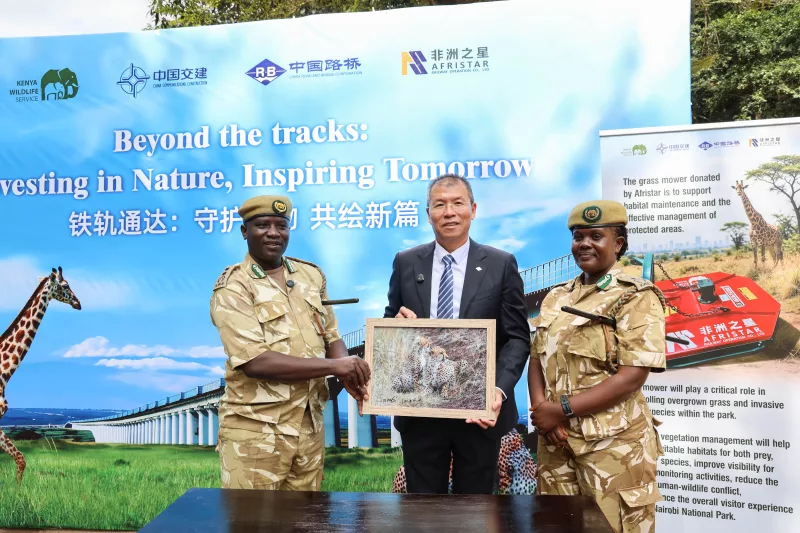
 Afristar Executive General Manager Mr Zhou Jian, alongside Kenya Wildlife Service representatives Mr Paul Wambi and Lilian Nyabicha display a framed photograph of Imara and Sarabi, the sister cheetahs that will be fitted with the donated tracking collars./HANDOUT
Building on its longstanding partnership with the Kenya Wildlife Service (KWS), Africa Star Railway Operation Company Limited (Afristar) officially handed over a three-blade gyromower and two cheetah tracking collars to KWS at Nairobi National Park on Wednesday, October 14.
The equipment was formally handed over during a joint event attended by Afristar management and staff, alongside senior KWS officials, including Paul Wambi, Senior Assistant Director of the Southern Conservation Area, and Lilian Nyabicha, Assistant Director of Nairobi National Park.
The gyromower is already being used to manage vegetation in selected areas of the park.
According to park management, areas that have been mowed have attracted more herbivores, while improved visibility has enhanced visitors’ opportunities to observe wildlife.
Meanwhile, the two tracking collars will be fitted on Imara and Sarabi, a pair of sister cheetahs at Nairobi National Park.
The collars will help conservation teams monitor the animals’ movements and gather valuable information to support wildlife monitoring and management.
“Protecting wildlife requires more than infrastructure. It requires continued vigilance, the right equipment, skilled people and strong partnerships,” said Afristar Executive General Manager Zhou Jian.
“At Afristar, we believe that the true measure of progress is not only how far we travel or how much we carry. It is also how responsibly we move forward,” he added.
He reaffirmed the company’s commitment to protecting Kenya’s natural heritage alongside its railway operations.
Speaking during the ceremony, Lilian Nyabicha, Assistant Director of Nairobi National Park, highlighted the connection between railway operations and wildlife conservation, noting that approximately eight kilometres of the Standard Gauge Railway (SGR) pass through the park.
The sponsorship reflects Afristar’s commitment to environmental conservation, one of the pillars of its corporate social responsibility programme.
It also builds on the environmental safeguards incorporated into the Standard Gauge Railway during construction by China Road and Bridge Corporation (CRBC), including 79 bridges, 572 culverts and protective fencing along the Mombasa–Nairobi corridor.
These structures are designed to support safe railway operations and facilitate wildlife movement.
Wambi welcomed the contribution, highlighting the importance of habitat management and cheetah monitoring in supporting conservation efforts. He thanked Afristar for its support and expressed optimism that the partnership would lead to further collaborative initiatives.
The handover follows Kenya’s recent Mazingira Day celebrations, which highlighted the shared responsibility of protecting the environment.
Through cooperation with KWS and other conservation stakeholders, Afristar continues to support efforts to reduce risks to wildlife along the railway corridor.
The partnership also reflects the connection between conservation and Kenya’s economy.
National parks support tourism, livelihoods and employment, while the Madaraka Express links Nairobi and Mombasa with destinations such as Voi, improving access for tourists and other travellers. The journey also offers passengers views of Kenya’s diverse landscapes and wildlife.
For Afristar and KWS, the initiative reinforces a shared objective: ensuring that economic development and transport connectivity advance alongside the protection of Kenya’s wildlife and natural heritage.