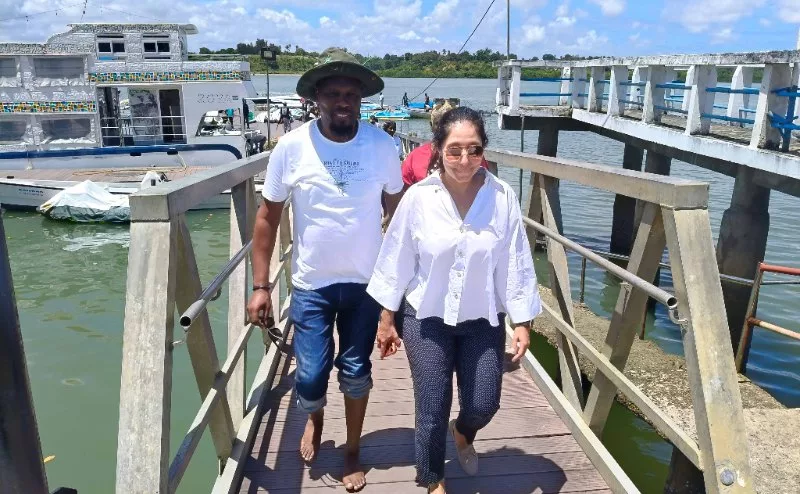
 Development economist Hamisi Mwaguya and Costa Rica ambassador to Kenya Veronica Garcia at Tudor Water Sports in Tudor on Saturday / BRIAN OTIENO
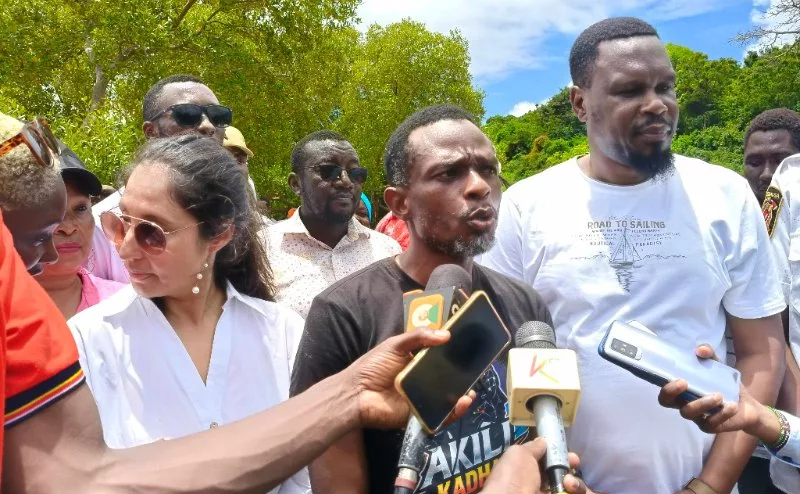 Pamoja Alliance chair Juma Mashuhuri flanked by Costa Rica ambassador to Kenya Veronica Garcia and Development economist Hamisi Mwaguya at Manyani beach in Junda on Saturday / BRIAN OTIENO
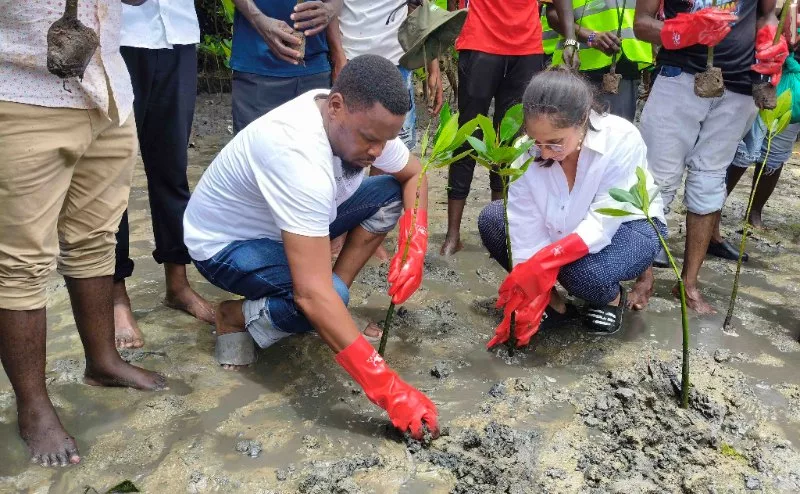 Development economist Hamisi Mwaguya and Costa Rica ambassador to Kenya Veronica Garcia at Manyani beach in Junda on Saturday / BRIAN OTIENO
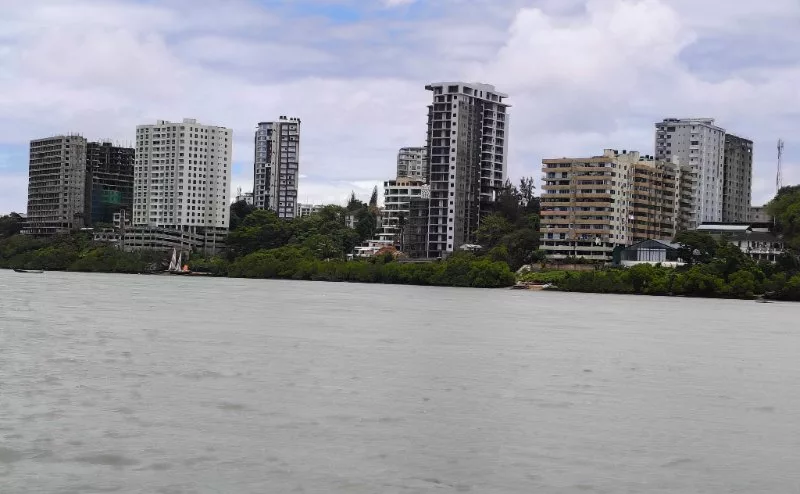 Developments in Tudor along the Tudor Creek / BRIAN OTIENO
Environmentalists have decried the encroachment of riparian lands along the Tudor Creek.
The environmentalists on Saturday said this affects the marine ecosystem by interfering with the breeding grounds for fish, encouraging the wanton destruction of mangroves, and killing the livelihoods of thousands of fisher folk and their families who depend on the sea for survival.
As a result, the effects of climate change are felt more.
Development economist Hamisi Mwaguya said the encroachment of the Tudor Creek by private developers has seen thousands of mangrove trees along the creek cut down.
The constitution allows development after 60 meters from the highest water mark.
However, Mwaguya said, private developers have come up buildings within 20 metres from the highest water mark.
“That means they have developed properties on riparian land. This affects the marine ecosystem here which has ripple effects,” the Business Registration Service chairman said.
He spoke after accompanying Costa Rican ambassador to Kenya Veronica Garcia in planting mangroves at Manyani beach to commemorate the Mazingira Day, at the same time President William Ruto was in Endebess, Trans Nzoia county to lead the Mazingira Day celebrations.
The private properties discharge raw sewage into the sea, risking the health and lives of those who swim at the Tudor and Manyani beaches, and the fishers.
Mwaguya, who is eying the Mombasa senator seat, called on the Mombasa county government to work with the national government to guard against the encroachment of the creek.
He said conservation work should be a collaboration between all stakeholders, adding that the community has a role to play in conserving the mangroves and the marine ecosystem.
“We would like the community to conserve these mangroves because the communities around the creek benefit from the mangroves.
“Fish breed in the mangroves and if you destroy the mangroves you are destroying the livelihoods of fisher folk,” Mwaguya, who is also the Business Registration Service chair, said.
He also cautioned the community against disposing of plastics in the sea.
At the Manyani beach in Junda, they collected about two tonnes of plastics from the coastline on Saturday alone.
“That shows there is a lot of pollution that is going in around Junda and Mshomoroni,” he said.
Garcia said Costa Rica and Kenyan have a lot of similarities and both countries live out of their nature.
She noted the two countries almost the same climate and environment with mangroves offering not only breeding grounds for fish but also natural barriers to storms and flooding.
“The mangroves are key to mitigating the climate change effects that we are witnessing today,” she said.
She said the fact that the mangrove restoration exercise in Junda, Kisauni subcounty is a community-led effort is very encouraging, adding the community has to own these efforts for posterity.
The ambassador said national and county policies, regulations and laws to be implemented strictly to ensure nature is protected.
She noted that although Costa Rica is a very small country that fits 11 times into Kenya, it has made deliberate efforts to increase forest cover in the country.
“We experienced lots of deforestation back in the ‘80s when we had about 25 per cent of the country covered by forests.
“Right now we have 60 per cent of the country covered by forests and this was due to a combination of things, mostly laws and policies,” Garcia said.
She said at the end, the laws and policies related to the community who embraced them because they benefitted from the natural resources.
Mwaguya called on residents to continue the mangrove restoration exercise even beyond Mazingira Day.
“There is need for us to restore our forests, and conserve the mangroves that we have because these forests, trees and the mangroves are the ones that give us the fish and bring us the rains that we enjoy,” Mwaguya said.
The development economist has been working with the Mshmoroni Beach Management Unit for the last four years in a bid to restore the Manayani beach to its former state.
The beach, apart from encroachment, has also seen its mangrove cover reduced significantly due to human activities.
The shoreline had been turned into a dumpsite by residents before about 30 local organizations that formed the Pamoja Alliance said enough is enough and started restoration activities.
So far, about 4.5 acres of mangroves at the beach have been restored, with over 20,000 mangroves being planted so far.
“We are hoping that we will continue to plant more,” Mwaguya, who is eying the Mombasa senator position, said.
Pamoja Alliance chair Juma Mashuhuri the organizations have turned the Manyani beach from a dumpsite to a recognizable beach in the last four years.
“We collect garbage after every two months at the beach,” Mashuhuri said.
He said plastics had been choking the beach but after massive sensitisation campaigns together with the local Beach Management Unit and the residents, residents now understand the importance of conserving the beaches and planting trees.
“So far, we have planted over 20,000 mangrove trees. This area had witnessed wanton destruction of the mangroves for various reasons,” Mashuhuri said.
Those who had been cutting mangroves are now planting them, he said, adding that the journet us still far from over.
They plan to plant more than 60,000 mangroves there.
Mshomoroni BMU chair Ali Mwaito said fisher folk have benefited from the conservation efforts.
“Fish stock had been depleted here. But since the conservation efforts started, we are now catching more fish. We had been suffering because of the cutting down of the mangroves and haphazard disposal of plastics,” Mwaito said.
He said the families of the fisher folks now live better because of more money available to take their children to school, live in better houses and eat more regularly.