The race for the Moyale parliamentary seat is taking shape ahead of the 2027 General Election, with four aspirants seeking to position themselves for a contest in which clan loyalties, development records and promises of better leadership are likely to feature prominently.
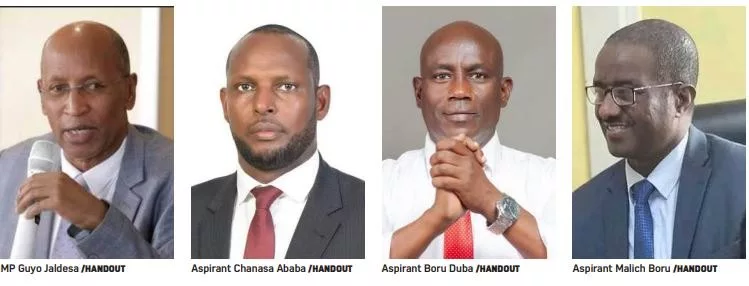
Incumbent MP Prof Guyo Jaldesa faces challenges from former aspirant Chanasa Ababa, former IEBC officer Boru Duba and public health practitioner Malicha Boru.
While the candidates are advancing different development agendas, the contest is also exposing the influence of clan structures in a constituency where elders have traditionally played a role in shaping political choices through consultations and endorsements.
The emerging contest presents a test of whether clan backing can translate into electoral support, particularly where candidates draw from the same community, and whether aspirants can build coalitions beyond their traditional bases.
Ababa, who is making his third attempt to win the seat, has secured the endorsement of elders from his Karayu clan and is optimistic that he will finally make it to Parliament.
But his path to victory could be complicated by the presence of Jaldesa, who comes from the same clan. The two candidates could compete for a section of the same support base, making it important for each to attract voters from other communities.
For Ababa, the challenge will be to turn the endorsement into broader support, while persuading voters that his development promises offer something different from the incumbent’s record.
Duba, meanwhile, enters the race as the only aspirant from his DM clan, giving him an opportunity to consolidate support within that community as he reaches out to voters elsewhere.
The former IEBC officer has been meeting residents from different clans, presenting himself as an alternative to the existing political leadership and arguing that Moyale needs fresh leadership capable of accelerating development.
His challenge will be to convert his public service experience and community engagements into a constituency-wide campaign, particularly in a contest where clan identity could influence how voters assess candidates.
Boru, a public health practitioner who has received the endorsement of elders from his DN clan, is also seeking to distinguish himself through promises of inclusive leadership, improved security, infrastructure development and transparent bursary distribution.
The incumbent, however, enters the contest with a record of projects he says he has delivered since taking office in 2022, giving him an opportunity to defend his performance against the challengers’ promises.
Jaldesa cites the construction of 61 classrooms, 10 administration blocks and 29 staff houses among his achievements. He has also embarked on the construction of a hostel at a technical and vocational education and training institution to support young people pursuing technical skills.
He further points to his contribution to the establishment of a new subcounty and several administrative units, as well as road construction in previously underserved areas and education support for vulnerable students.
His development agenda has focused on education, infrastructure and improving learning environments, including the expansion of classrooms, establishment and equipping of science laboratories, construction of administration blocks and installation of sanitation facilities.
“Quality education is not a privilege but a right. Our focus has been to ensure that learners study in a dignified environment,” Jaldesa said.
He has also cited the drilling of seven boreholes as part of efforts to address perennial water shortages.
These projects provide the incumbent with a basis on which to seek re-election, but the contest will also turn on how voters assess their reach, quality and impact on daily life. The number of facilities constructed is one measure of performance; whether they adequately serve communities and respond to residents’ needs is another.
The challengers are seeking to make that distinction central to their campaigns, although their proposals will ultimately be judged against their feasibility and ability to deliver if elected.
Duba has placed poverty reduction and sustainable economic empowerment at the centre of his agenda, proposing investments in food security, water infrastructure, agribusiness and entrepreneurship.
He argues that lasting development requires partnerships and communities that can become economically self-reliant.
If elected, he has pledged to prioritise education and water provision, two challenges that residents have grappled with for decades.
“I will not only depend on CDF funds but also use my network to support bright but needy students,” Duba said.
On water, the former IEBC officer has promised to drill boreholes and establish water points across settlements to improve access to clean water.
He has also proposed economic empowerment programmes for young people and women, including savings and credit cooperative societies (saccos). Commercial motorcycle riders, he said, could benefit from such arrangements to enable them to buy their own motorcycles rather than rely on hired ones.
Duba has further pledged to work with the Rural Electrification and Renewable Energy Corporation (Rerec) to improve access to reliable electricity and thus strengthen learning institutions.
“Providing quality education to residents of Moyale is central to my development agenda. If elected to serve my people, I will partner with Rerec to install solar panels in all schools,” he said.
Ababa has also placed education, social cohesion and economic empowerment at the centre of his campaign, promising to improve the management of public resources and expand opportunities for young people through partnerships with other organisations.
He has pledged to establish a technical training institution in the constituency and support bright but needy students, saying improved access to education would help raise enrolment and academic performance.
On infrastructure, Ababa intends to lobby the national government to improve roads across the constituency, some of which he says have remained impassable for years.
The former aspirant has also promised to push for increased funding for women and youth enterprise programmes.
“My objective is to see a better Moyale, where people will enjoy better roads, women and youth are economically empowered, and there are better education standards,” he said.
“I have a lot of hope that the people of Moyale will give me the opportunity to represent them in Parliament so that we can take the area to the next level in terms of development. I want to assure them that I will not let them down if they give me that chance.”
Boru, meanwhile, is making inclusivity and accountability key pillars of his campaign, alongside promises to improve security, infrastructure, healthcare and opportunities for young people and women.
The public health practitioner says he will work with relevant government agencies to improve road networks, promote digital skills and entrepreneurship among young people and advocate for better-equipped health facilities and improved access to quality care.
“My aspiration is founded on a proven record of community service and a desire to accelerate development through practical, people-centred leadership,” he said.
Boru has also urged voters to scrutinise candidates’ track records, accessibility and capacity to deliver services rather than rely solely on political endorsements.
“Moyale is cosmopolitan, and it is home to all tribes. It requires unique leadership, which I believe I possess,” he said, pledging to serve residents fairly and without discrimination.
His appeal highlights a central question facing all four candidates: Whether they can persuade voters to look beyond clan affiliations and assess what each offers in terms of service delivery, accountability and inclusive development.
Clan endorsements may help aspirants mobilise support, but they do not automatically guarantee that voters will follow the decisions of elders. Candidates must still convince residents that their leadership can address persistent challenges, including access to water, roads, education, healthcare and economic opportunities.
For Jaldesa, the challenge is to demonstrate that his first-term record has translated into meaningful improvements for residents. For the challengers, it is to show that their promises are credible, practical and sufficiently distinct from the incumbent’s agenda.
As the 2027 election approaches, the contest is likely to revolve around the balance between inherited political loyalties and voters’ expectations of tangible results. The candidate who can build support across clan lines while offering a convincing plan for Moyale’s development will be better placed to make a broad appeal to the constituency.
INSTANT ANALYSIS
Moyale’s 2027 parliamentary race will test whether clan endorsements can translate into electoral support or whether voters will prioritise performance and credible development plans. Incumbent Guyo Jaldesa must defend his record against challengers promising better education, water, roads, healthcare and economic opportunities. While elders remain influential in candidate selection, the contest will ultimately expose the gap between campaign pledges and delivery, with voters weighing representation, accountability and tangible improvements in their lives.