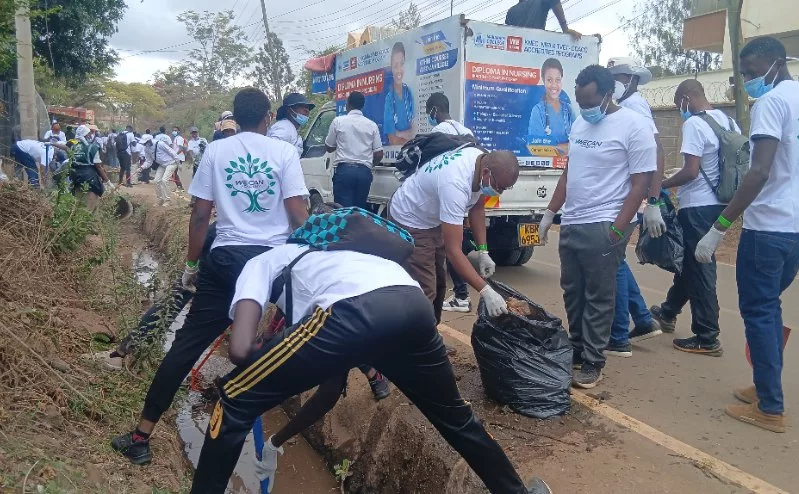
 WeCan Academy students participating in a clean-up exercise during Mazingira Day in Nairobi County on October 10, 2026.
More than 1,000 young people took to the streets of Nairobi with brooms, gloves and seedlings on Saturday, collecting tonnes of waste, unclogging drainage systems and planting more than 5,000 trees to mark Mazingira Day.
The students from WeCan Academy joined community members in Roysambu Sub-County for the exercise, which was organised by the International Youth Fellowship (IYF) in partnership with the Nairobi City County Government.
Nairobi County Principal Environment Officer Maryvine Nyanchoka said the exercise resulted in the collection of 30 tonnes of solid waste in a single day.
The volunteers also cleaned informal settlements, sensitised traders on proper waste disposal and encouraged residents to take greater responsibility for keeping their surroundings clean.
“Today, as a county government, we have partnered with WECAN Academy, which is part of our stakeholders, to celebrate Mazingira Day. We are here to share experiences and give our best as a county,” Nyanchoka told reporters.
She warned that careless waste disposal could block drainage channels and increase flooding risks as the country prepares for anticipated El Niño rains.
“Every time you litter, you do improper solid waste management, our drainages get full, and if it rains, like now we are preparing for El Nino rains, our drainages get filled with litter, bottles, they get blocked since storm water can’t flow hence flooding,” she said.
Nyanchoka urged Kenyans to dispose of waste responsibly, including avoiding throwing rubbish out of vehicles, saying litter eventually finds its way into drainage systems.
She also called on people who had erected structures on drainage channels to remove them, noting that the obstructions made it difficult for county teams to clean and expand the waterways.
The environment officer challenged residents to abandon the belief that keeping the city clean was solely the responsibility of county government workers.
“You hear people say ‘watu wa kanjo watafanya’, but you see, if we have these numbers and we show people, this is what we do on daily basis, this is what we are supposed to be doing, the country becomes clean,” she said.
She called on more institutions in the corporate sector to partner with the county government in environmental conservation initiatives.
WeCan Academy Principal Aeneas Wanyonyi said the exercise was intended to change how young people and residents view their responsibility towards the environment.
“Today, we young people from WeCan Academy took to the streets along Thika Road not in protest, but with brooms, gloves, and seedlings — proving that caring for the environment begins with a change of the mind,” Wanyonyi said.
He said the initiative was based on encouraging people to take personal responsibility rather than blame others for environmental problems.
“At WeCan Academy, we teach before any skill: change from ‘someone should do it’ to ‘I will do it’. This clean-up was a mindset class in action. Mazingira Day is not about one day of cleaning; it is about changing the heart that litters daily. A clean heart creates a clean environment,” he added.
Wanyonyi said Roysambu's waste management challenges required more than occasional clean-up campaigns, calling for sustained action by residents, schools, businesses and other institutions.
The exercise also involved planting more than 5,000 trees along the Thika Road corridor as part of efforts to promote environmental conservation.
WeCan Academy, a free vacation training centre run by IYF and formerly known as the Free Weekend Academy, trains young people in practical skills including artificial intelligence, media, design, broadcasting, leadership and digital skills.
Nairobi generates an estimated 2,400 tonnes of waste daily, with less than half collected, according to figures cited in the report. Roysambu, which had more than 230,000 residents in the 2019 census, accounts for an estimated 175 tonnes of waste daily, highlighting the scale of the waste management challenge facing the area.