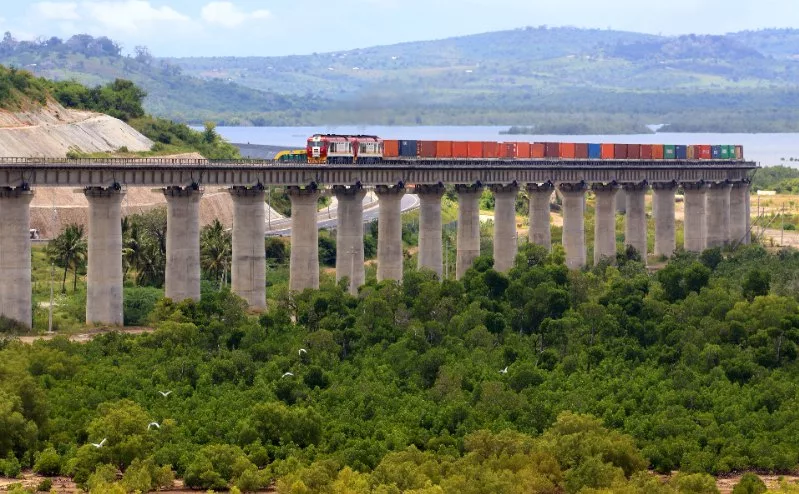
 Kenya’s SGR freight train glides across elevated bridges above mangrove forests, allowing the ecosystem below room to thrive. It is an example of how railway infrastructure can support biodiversity conservation while keeping Kenya’s economy moving./HANDOUT
As Kenya celebrates Mazingira Day, the Standard Gauge Railway (SGR) stands out as a prime example of how modern transport infrastructure can successfully drive economic growth while advancing environmental protection and wildlife conservation.
Since its launch in May 2017, the Madaraka Express has become an important part of Kenya’s transport network.
According to the Kenya National Bureau of Statistics, SGR passenger numbers reached 2.73 million in 2025, an 11.6 per cent increase from the previous year, while freight volumes rose 12.3 per cent to 7.33 million tonnes.
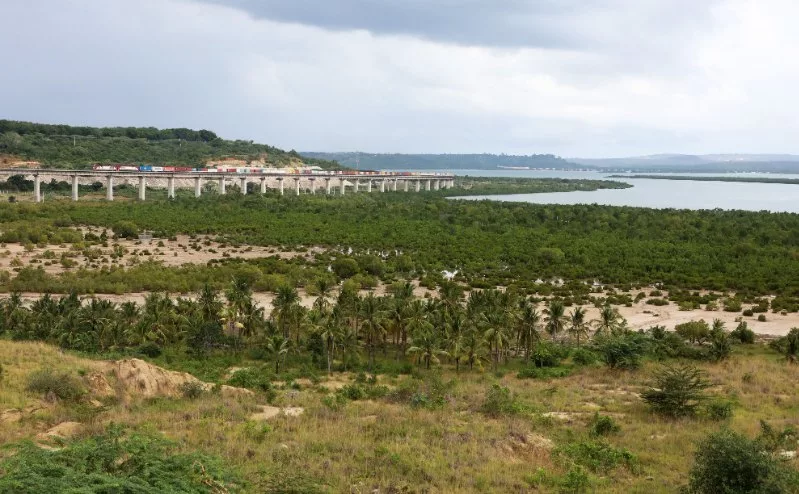 Kenya’s SGR freight train glides across elevated bridges above mangrove forests, allowing the ecosystem below room to thrive. It is an example of how railway infrastructure can support biodiversity conservation while keeping Kenya’s economy moving./HANDOUT
The true environmental breakthrough of the SGR lies in its ability to take heavy, carbon-intensive traffic off national highways.
Afristar’s 2024 Environmental, Social and Governance (ESG) report highlights that shifting freight from road to rail has already eliminated more than 800,000 tonnes of cumulative carbon dioxide equivalent emissions since operations began.
Citing World Bank estimates, the report notes that moving just one million tonnes of freight from road to rail avoids over 20,200 tonnes of carbon emissions.
Beyond emissions reductions, the SGR demonstrates that heavy infrastructure can harmonise with delicate ecosystems.
The SGR passes through landscapes that include the Tsavo ecosystem, where wildlife and railway operations share the same environment.
Its environmental design incorporates bridges, culverts, protective fencing and designated wildlife crossing points to reduce the risk of conflict between trains and animals.
Afristar’s environmental programme includes approximately 900 kilometres of protective fencing, 79 bridges and 572 culverts.
In areas with frequent wildlife activity, 59 warning signs have been installed, while speed controls are applied along sections of the railway within Tsavo National Park.
Joint patrols with the Kenya Wildlife Service also support wildlife protection and railway safety.
“From the mangrove ecosystems of the coast to the wildlife corridors of Tsavo and the open landscape beneath Nairobi National Park’s elevated viaduct, Kenya’s SGR highlights the need to make environmental considerations part of infrastructure planning, construction and operation,” Nelson Asienwa, communications officer at Afristar, said.
Afristar’s commitment to sustainability also extends deeply into daily operational practices and resource circularity. The SGR wastewater treatment facility processes roughly 1,168 tonnes of industrial wastewater annually while remaining fully compliant with environmental discharge standards.
Additionally, in 2025, three failed locomotive oil-air coolers were successfully repaired and rigorously tested to meet performance standards rather than being replaced, slashing material consumption by 98 per cent.
Other initiatives feature 98 solar-powered lights installed across railway facilities and native tree-planting campaigns at Ngong Road Forest.
“The SGR demonstrates that moving goods and people can also move the climate agenda forward. By shifting freight from road to rail, Kenya is showing how transport infrastructure can support economic growth while contributing to lower emissions,” Asienwa added.
As Kenya honours Mazingira Day, the SGR demonstrates that economic opportunity and environmental stewardship do not have to be competing priorities, but rather partners on the same track towards a greener future.