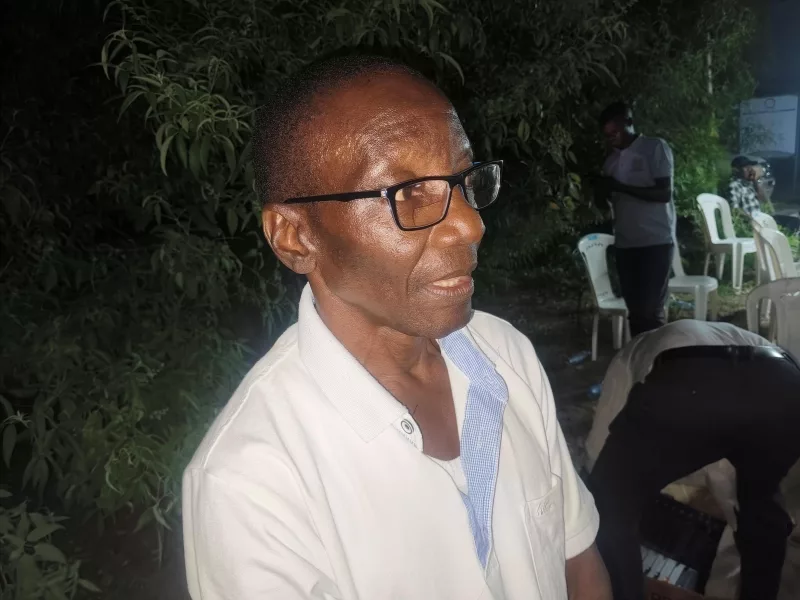
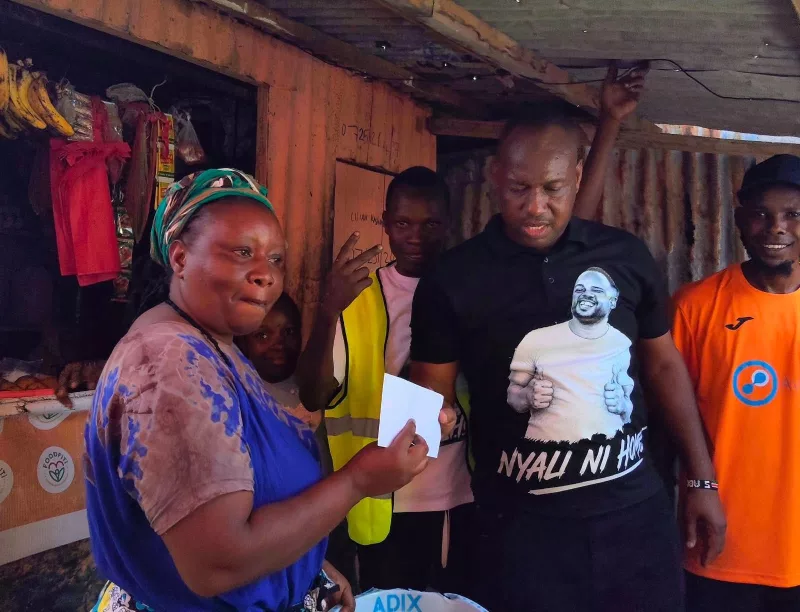
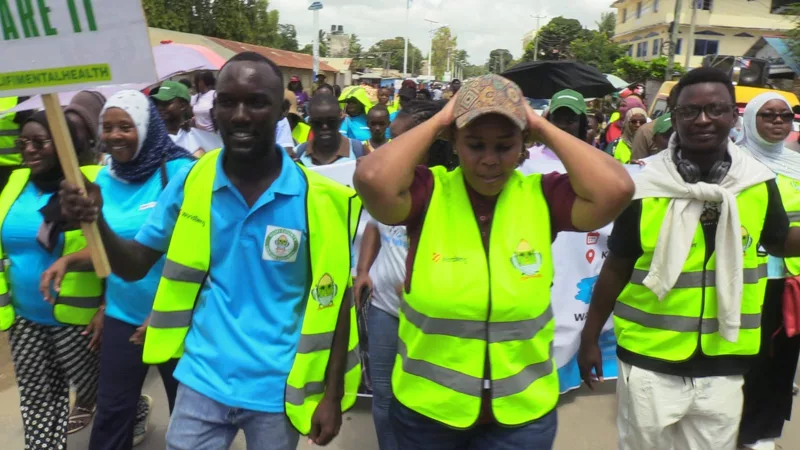
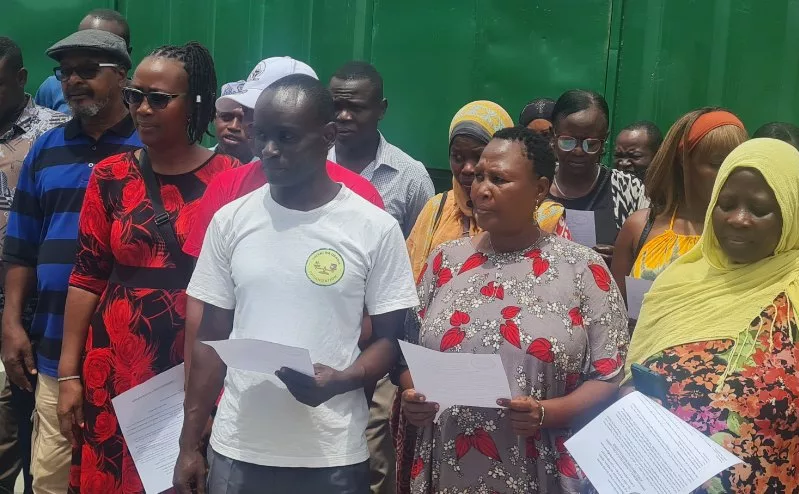
 Uhaki na Usawa executive director Salim Suleiman [in white] and Changamwe and Jomvu residents in Chaani on Friday / BRIAN OTIENO
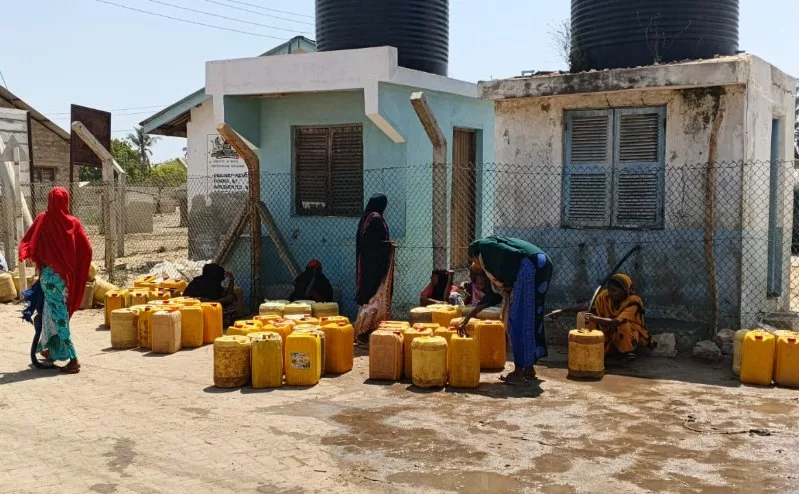 Residents fetch water at designated water points /BRIAN OTIENO
Water scarcity in Jomvu and Changamwe is causing severe hardship, with residents accusing Mombasa Water and Sanitation Company of doing little to salvage the situation.
Residents believe cartels are causing an artificial water shortage, noting that while some parts of the subcounties suffer dry taps, water flows freely in others.
Uhaki na Usawa executive director Salim Suleiman on Friday said the artificial water shortage is designed to inflate prices so cartels can profit.
He said cartels in the water sector have existed since the tenure of Hassan Joho as governor.
“These cartels are people of means. Perhaps they are more powerful than the governor. But our simple request is for the county government to work closely with the national government to rein in these cartels," Suleiman said.
"I am sure the cartels cannot match the combined power of the national and county governments.”
He alleged some cartel members maintain strong ties with key offices, allowing them to operate with impunity.
“It is inexplicable that we are told there is no water in our taps, yet private water bowsers always have fresh water. Where do they get it?” Suleiman posed.
Mary Taura, a Chaani resident, said households have suffered for months without official intervention.
“It is as if we do not have elected leaders. We cannot continue surviving on unsafe water from boreholes,” Taura said.
Purchasing fresh water from vendors is costly, with a 20-litre jerrycan retailing at between Sh30 and Sh40.
For most residents, this remains unaffordable, forcing them to rely on salty and potentially unsafe borehole water.
George Olang’, a Chaani resident and local representative of Bunge la Wananchi, said delegations have visited the offices of Mowasco and the Coast Water Works Development Agency (CWWDA) repeatedly, receiving assurances that yield no action.
“The notices they issue are mere public relations. We do not want PR; we want action,” he said.
Olang’ highlighted skewed water distribution in Changamwe and Jomvu subcounties, noting that certain areas enjoy uninterrupted supply while neighbouring zones experience prolonged dry spells.
The Bunge la Wananchi representative called for an immediate remedy to the water crisis in both subcounties while the county awaits the completion of the Mwache Dam and Mzima 2 Springs projects.
The Sh20 billion Mwache Dam in Kinango subcounty, Kwale county, is 85 per cent complete.
It features a reservoir capacity of 136 million cubic metres and is projected to supply 186,000 cubic metres of clean water daily to Mombasa and Kwale counties.
However, the Sh35 billion Mzima 2 Springs project—which entails constructing a 220-kilometre transmission pipeline to boost daily supply by more than 100,000 cubic metres to Mombasa and Taita Taveta counties—has hit headwinds as costs deter potential investors.
The project was originally structured as a public-private partnership (PPP) or Build-Operate-Transfer (BOT) arrangement involving entities such as CWWDA and private consortiums including Sichuan Roads and Bridges Group.
It was intended to complement the ageing 1966 Mzima Phase One pipeline, which suffers from frequent bursts and leaks.
Mombasa’s daily water demand stands at about 200,000 cubic metres, but Mowasco supplies only 40,000 to 50,000 cubic metres daily, leaving a deficit of about 150,000 cubic metres.
Furthermore, roughly 60 per cent of the daily supply is lost to leakages and illegal connections.
Mowasco has attributed the shortfall to infrastructure damage and illegal tie-ins.
“We have been experiencing serious leakages on our bulk transmission line,” Mowasco said in a statement.
The company noted that a major burst occurred along the Mzima pipeline bulk transmission system in Tsavo West National Park on September 12, causing severe disruption in the West Mainland, including Jomvu and Changamwe subcounties.
On September 17, CWWDA reported another major leak along the Baricho-Mombasa transmission line, affecting supply in Matanomanne, parts of Kilifi, Chonyi, Ganze, Kaloleni and Mombasa North Mainland.
Suleiman dismissed the utility's explanations as public relations manoeuvres.
“The reality on the ground is that taps were dry long before those notices were published," he said.
"Residents of Changamwe, Jomvu, and almost the entire Mombasa County have gone for months without clean water, forcing households to rely on expensive and unsafe supplies from vendors.”
Suleiman said the burden falls heaviest on women, children, and low-income families.
Citing Article 43 (1) of the Constitution, which guarantees every Kenyan the right to clean and safe water, Suleiman added, “This persistent failure to provide water is a violation of this constitutional right and an affront to human dignity.”
Uhaki na Usawa urged elected Mombasa leaders to intervene decisively, while also calling for the resignation of CWWDA leadership or the disbandment of its board for failing to fulfill its statutory mandate.
Olang’ urged Governor Abdulswamad Nassir to take stern action against county water officials.
Mzee Wakusimba, a resident of Port Reitz ward, said it was unjust for citizens to elect leaders only to be left to defend their rights alone.
“I am confident this is a matter Governor Nassir can address, though there may be underlying challenges. We urge the Governor to act on his campaign promise to safeguard our interests and resolve this water crisis,” Wakusimba said.