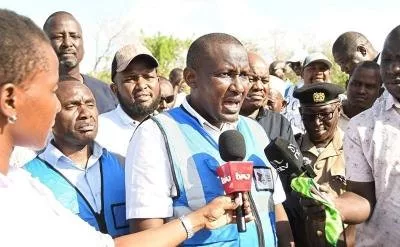
Irrigation PS Kimotho
The government is stepping up efforts to harvest rainwater ahead of the expected El Niño.
The state is targeting more than 100 million
cubic metres from household waterpans and rehabilitated dams.
Irrigation Principal Secretary Ephantus Kimotho said the government had constructed more than 35,000 household waterpans, each with an average capacity of 1,000 cubic metres, giving farmers the potential to harvest about 35 million cubic metres of water.
The Ministry of Water, Sanitation and Irrigation has also rehabilitated 600 large dams with a combined capacity of about 60 million cubic metres.
“We are expecting to harvest over 100 million cubic metres to ensure the water will not go to waste,” Kimotho said.
He said the government was working with the ministries of Defence and Health to prepare communities living downstreams for heavy rains and possible flooding.
He urged people living in vulnerable areas to move to safer and higher grounds.
“We are also doing a canal to get water to Tiaty, where
we want to get 100,000 acres using that water,” he said.
The measures are part of a wider government plan to expand irrigation and reduce Kenya’s dependence on rain-fed agriculture as the country grapples with climate change.
Kimotho said the government was targeting to put 1.5 million acres under irrigation over the next 10 years, including 500,000 acres under large-scale commercial irrigation.
The planned commercial schemes include 200,000 acres at Galana Kulalu, 135,000 acres at Bura and 35,000 acres at Mwache. A further 30,000 acres are planned for Isiolo and 100,000 acres at Grand Falls Dam.
Under farmer-led irrigation development, the government is targeting another 350,000 acres, while a further 350,000 acres will be developed through community irrigation schemes involving farmers organised in groups and cooperatives.
Kimotho said about 114,000 acres had been added to the area under irrigation over the past four years, bringing the total irrigated area to about 778,000 acres.
The large commercial schemes will focus on strategic food and industrial crops, including seed maize, rice and sugarcane.
“At Bura, we are doing 35,000 acres for rice, which is giving us a very high yield of six tonnes per acre, which comes to 210,000 metric tonnes. If we apply two seasons, we get 420,000 metric tonnes,” he said.
The government is also targeting to reduce sugar imports by 250,000 metric tonnes, while community irrigation schemes will focus on high-value crops such as African leafy vegetables and tomatoes.
Kimotho said expanded irrigation will support County Aggregation and Industrial Parks by providing a reliable supply of agricultural produce for processing.
The government plans to increase water storage through the development of 19 large dams.
“Thwake is now complete and we'll start harvesting next year in April. For Galana Dam, we will be groundbreaking in the next month, and the others are currently undergoing detailed studies,” he said.
Kimotho said the government was working with the National Infrastructure Fund to attract private capital into water infrastructure, while developing mechanisms to reduce risks faced by private investors.
“One key thing is a programme we are calling K-Rise, and in it we have embedded three key things. One is a results-based finance model, whereby the irrigation equipment supplier gets paid after verified results that the equipment is actually working,” he said.
Kimotho said irrigation should increasingly be treated as a business capable of supporting food security, exports and agro-processing.
He spoke during the Eastern and Southern Africa Private Sector Forum on Irrigation, jointly hosted by the World Bank, the African Union Development Agency (AUDA-NEPAD) and the Water ministry.