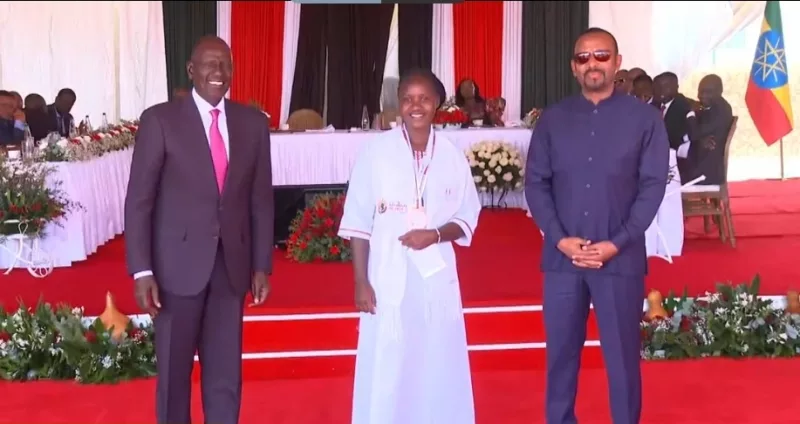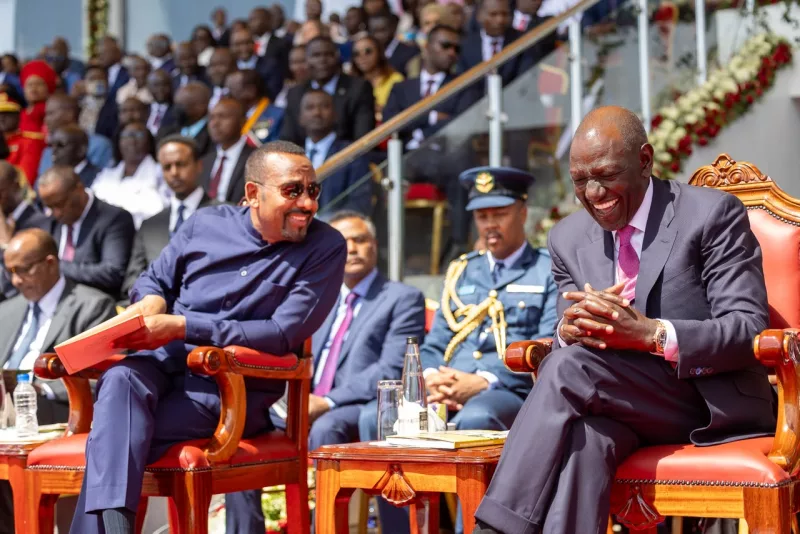
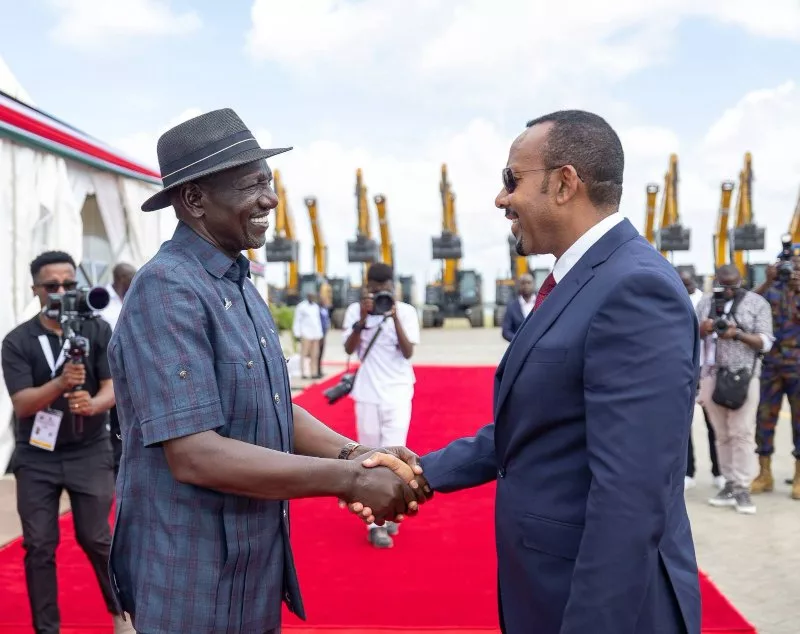
President William Ruto shakes hands with the Ethiopian Prime Minister Abiy Ahmed as he welcomes him to the Dangote East Africa Petroleum Refinery ground breaking ceremony in Lamu County.
For the ordinary Kenyan, US$16 billion can sound like a figure from another world.
Behind the investment are questions: What does it mean for me? Will my child get a job? Will my business get a contract? Will there be better services? And will young people in Lamu and the wider Coast share in the opportunities created in their backyard?
These questions give meaning to the Lamu groundbreaking.
President William Ruto captured the significance of the moment by describing the project as much more than a refinery.
“Today, we break ground in Lamu. We turn a proposal into an industry. We transform a long-held ambition into real opportunity for Kenya, for East Africa and for Africa,” he said.
For Lamu, a historic centre of Swahili trade, the project represents a new economic chapter.
UNESCO recognises Lamu Old Town as the oldest and best-preserved Swahili settlement in East Africa. Yet Lamu has often remained at the margins of industrial development.
The refinery could place the county and the wider Coast at the centre of an economic ecosystem.
The proposed US$16 billion petrochemical complex is designed to process up to 700,000 barrels of crude oil daily and generate up to 1,000 megawatts of power, with some electricity potentially serving needs beyond the refinery.
Its significance goes beyond barrels, dollars and megawatts. It will ultimately be felt through workers, families and businesses participating in the economy around it.
Current estimates envisage up to 60,000 direct and indirect jobs. During peak construction, billions of shillings could flow into wages, creating demand for shops, hotels, restaurants, transport, housing, food suppliers and professional services.
For small businesses, it could open a route into a major industrial supply chain.
President Ruto therefore called for clear recruitment and training programmes so welders, technicians, engineers and managers required by the project can be trained in advance.
Young people from Lamu, neighbouring counties and across Kenya, he said, should have an opportunity to acquire skills needed to compete for jobs.
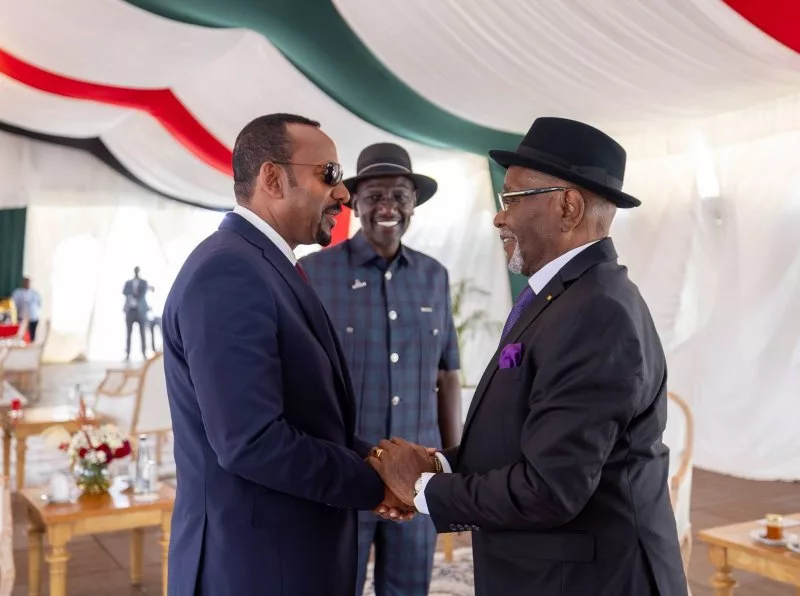
President William Ruto welcomes the Togolese President, Jean-Lucien Kwassi Lanyo Savi de Tové and the Ethiopian Prime Minister Abiy Ahmed to the ground breaking ceremony for the Dangote East Africa Petroleum Refinery in Lamu County.
The same applies to enterprises. The project will require transporters, contractors, engineers, construction-material suppliers, accommodation providers, food vendors, logistics companies, maintenance firms and professional-service providers.
The refinery is also being positioned as an anchor for wider industrialisation.
President Ruto linked it to the LAPSSET Corridor and the Port of Lamu, arguing that infrastructure becomes transformative when it generates commerce.
“A corridor without commerce is just a road. A port without industry is just a harbour,” he said.
The refinery could give the port and corridor stronger economic purpose. Around them, enterprises can emerge, transport networks expand, industries develop, skills transfer and services grow. That is how infrastructure becomes an economy.
The investment also addresses a wider African challenge: extracting greater value from the continent’s resources.
President Ruto pointed to the contradiction of Africa producing crude oil while importing refined petroleum products. Figures he cited from Afreximbank show Africa produced approximately 6.8 million barrels of crude oil per day in 2024 while consuming about 4.5 million barrels of refined petroleum products.
Kenya alone spent about Sh530 billion importing petroleum products last year.
The Lamu refinery will not eliminate that import bill overnight. Its significance lies in building refining capacity closer to markets and developing industries around the value chain.
For decades, much of Africa’s model has involved exporting raw materials and importing finished products. Crude oil leaves and refined products return. Cotton leaves and garments return.
Greater value lies in processing resources, where skills, industries, jobs, incomes and wealth are created.
The Lamu investment therefore forms part of a broader ambition to build an Africa that increasingly processes, manufactures and adds value at home.
Ugandan President Yoweri Museveni echoed the message by emphasising African ownership and regional integration, while Ethiopian Prime Minister Abiy Ahmed highlighted infrastructure and industrialisation in strengthening trade and connectivity.
Deputy President Kithure Kindiki similarly linked the refinery to Kenya’s energy security and industrialisation agenda, emphasising employment, skills and enterprise opportunities associated with large-scale investment.
For Dangote Group President and Chief Executive Aliko Dangote, the project demonstrates the potential of African capital and enterprise to address African needs.
The investment follows the success of the Dangote Refinery in Lekki, Nigeria, which President Ruto visited shortly before the Lamu groundbreaking.
For Kenya, the project illustrates what private investment can contribute alongside Government support, infrastructure and policy certainty.
President Ruto stressed that the project is Government-enabled but private-sector driven.
Government provides policy certainty, coordination, infrastructure and regulation, while private enterprise mobilises capital, brings technical expertise and assumes commercial responsibility.
For citizens, investment must go hand in hand with responsible development.
Communities in Lamu have legitimate concerns about land, livelihoods, fishing, water, the coastline, mangroves and cultural heritage. President Ruto acknowledged these concerns, saying they were not obstacles to development but questions responsible development must answer.
He pledged that land matters would be handled lawfully and fairly, while environmental and social impacts would be rigorously assessed and safeguards enforced during construction and operation.
The government also plans to address needs accompanying population and economic growth.
President Ruto said plans would advance for a new mainland town, while the Affordable Housing Programme could help provide homes for workers and families.
Water is also critical, with plans for a major project to bring clean water from the Tana River to Lamu.
The implications extend beyond the refinery. Jobs attract families, who need homes, water, transport, schools and services. Businesses emerge to meet those needs, while infrastructure expands.
Opportunities could extend beyond Lamu. President Ruto urged young people and businesses in Kilifi, Tana River, Garissa, Mombasa, Kwale, Taita Taveta and the wider Coast to prepare to participate.
“They should not be spectators, but participants—providing services, building businesses and developing the skills required by the new industrial landscape.”
Ultimately, success will not be measured only by barrels processed or dollars invested, but by young people gaining skills, enterprises growing, families earning sustainable incomes and communities whose livelihoods and environment are protected.
President Ruto put it succinctly: “This refinery’s scale will not be measured in barrels and dollars. Its success must be measured in skills gained, enterprises built, livelihoods protected and public trust earned.” That captures the meaning of the project for ordinary Kenyans.
A US$16 billion investment may begin as a figure on an investment document. Its value will be determined by what it does in people’s lives.
If the refinery creates industries, skills, businesses, jobs and stronger infrastructure, its impact will extend beyond Lamu. It will contribute to a broader African ambition: moving from exporting raw materials towards producing, processing, manufacturing and trading higher-value goods.
President Ruto described this as the unfinished economic work of sovereignty.
“Our forebears secured the flag,” he said. “Our generation must build the industries that make independence real in the lives of every citizen.”
And so, in Lamu, the story is no longer simply about breaking ground for a refinery. It is about whether a mega-investment can translate into opportunity at household level; whether a port can become an engine of commerce; whether a corridor can become an economic lifeline; and whether African resources can generate more African value.
For Lamu and millions of Kenyans, that is the measure that will matter.
Lawrence Kinoti works at the Office of the Government Spokesperson.