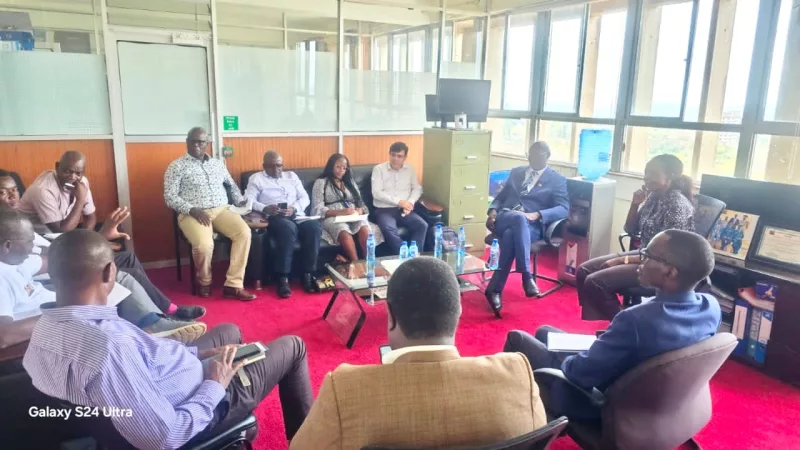
 Some officials from the Lake Victoria Basin International Conference and Exhibition during their meeting with Kisumu County Government officials in Kisumu/Robert Omollo
Climate change experts want the national and county governments to put in place measures to protect Lake Victoria from pollution with the imminent El Niño rains.
There are concerns that the long rains will push sewage discharge, agricultural runoff and industrial waste into the lake.
Climatologist and National Coordinator of the Lake Victoria Basin International Conference and Exhibition (LVBICE) Clifford Omondi, alluded to the fact that heavy rains will wash loose objects from the land into the lake.
He said sewage and some urban runoff will increase, with drainage and wastewater systems emptying into the lake during El Niño rains.
“There is a need to strengthen wastewater treatment to ensure poorly treated sewage does not find its way into rivers and the lake. El Niño rains should not wreak havoc, including polluting Lake Victoria,” Omondi said.
Stakeholders in climate change are already organising the Lake Victoria Basin International Conference and Exhibition (LVBICE) in Kisumu.
The conference is meant to push for the implementation of bankable research findings.
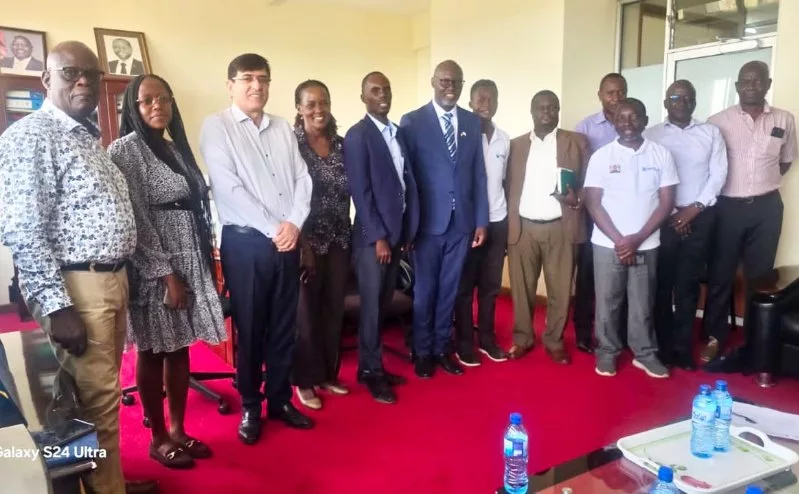 Lake Victoria Basin International Conference and Exhibition stakeholders pose for a photo after their meeting in Kisumu town/ Robert Omollo
Omondi said a lot of research has been done by scholars, PhD students and other organisations, but the findings have never been implemented.
“A lot of research and publications have been done to address the negative impact of climate change. The meeting will push for implementation of research results for the climate change issues,” he said.
Such issues include flooding and displacement, pollution and waste management, public health and soil erosion.
Omondi said the basin conference focuses on the 45 million people who are directly and indirectly affected by climate change.
“The sustainability of the Lake Victoria Basin is fundamental to the livelihoods, economies, ecosystems and future resilience of millions of people across the region,” he said.
Omondi added, “As pressures from climate variability, population growth, urbanisation and pollution intensify, ecosystem degradation worsens and there is a need for evidence-based planning.”
The conference, which will run from October 4 to 9, is expected to bring together water resource professionals, researchers, policymakers and development partners to push for effective governance and practical action.
LVBICE Regional Coordinator Ibrahim Oluoch said there is a gap between academic research and market-ready innovation.
He said turning student research and AI concepts into bankable proposals can bridge the gap between brilliant ideas and real-world impact.
“We are exploring the use and the opportunities of AI in innovation and technology,” Oluoch said.
Planning Green Future Programme Manager James Nelson said they have partnered with an AI technology solutions company to use forecasting and scenario models to understand the biggest environmental and sustainability challenges the globe will face over the next 25 years.
He noted that challenges faced in the Lake Victoria Basin are more than what is on the surface.
“The issue must be given a holistic approach to protect the future of Lake Victoria and its surroundings. We want a multi-stakeholder partnerships, not only in Kenya but also across the entire international community,” Nelson said.
Deputy Director of Environmental Policy at the Ministry of Environment, Climate Change and Forestry Dominic Mumbu said the conference will bring six countries together to discuss policy integration.
“We have been having countries doing their policies in isolation. We are looking forward to getting the key issues which are going to emanate from the conference, and the issues will be packaged, and then they will form part of our policy brand,” Mumbu said.
Kisumu County Water Executive Judith Oluoch said there is a need for action to combat climate change.
“We will come up with action items that emphasise the heritage of the lake, the shared responsibilities, who does what. And how do we even have review meetings to assess these action items,” she said.