Somewhere in Nairobi, there is probably a photograph of Wangarĩ Maathai doing what we have collectively decided Wangarĩ Maathai should always be doing. Standing beside a tree smiling and dignified. Perhaps holding a seedling.
It is a useful photograph. It tells us who she was in one frame. But it tells us almost nothing about the woman. For that, you need to catch her somewhere less poised. At a party dancing in a short dress. Heartbroken. Arguing. Getting divorced. Getting arrested. Or, apparently, being discussed and insulted in Parliament for 45 straight minutes.
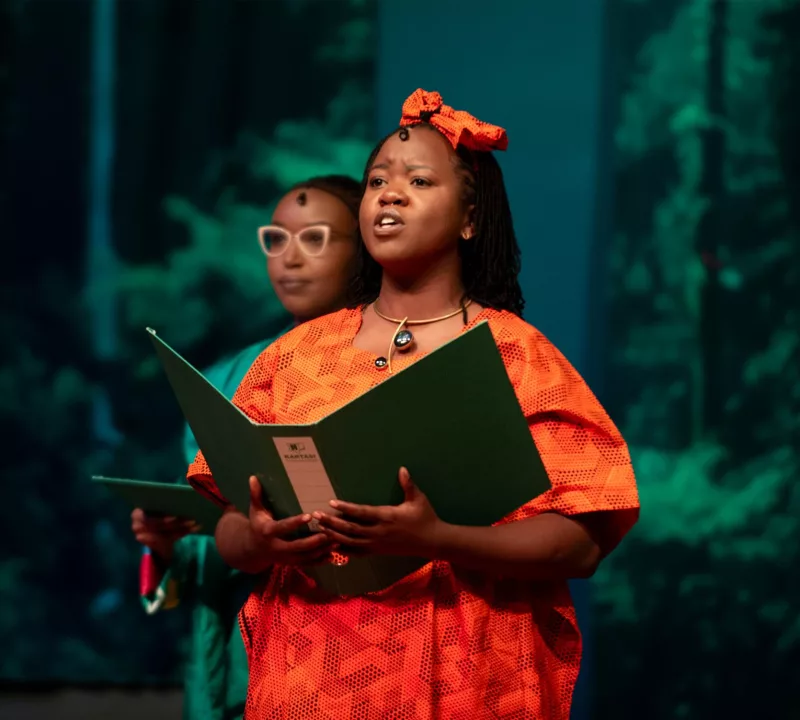
That is the Wangarĩ Maathai walking onto the stage in Shawry for Trees: The Shawry Is Back!, the Too Early For Birds production returning to Nairobi from 25 to 27 September 2026 after its April run. And if you arrive expecting three hours of solemn national-hero worship, you may be in for a surprise. The production's Wangarĩ is not interested in behaving. Neither, it seems, are the people playing her.
If there is one thing Red Brenda, 26, who plays younger Wangarĩ wishes audiences understood before they enter the theatre, it is this: we have underestimated the woman. Not her achievements. Her life. “We know her for trees,” Brenda says. “But she had a full freaking life.”
The phrase lands because it sounds almost like an accusation. We know the trees. We know the Nobel. We know the Green Belt Movement. But somewhere between becoming a global icon and becoming a chapter in Kenyan history, Wangarĩ Maathai lost some of her humanity. Brenda found it again in the play’s research. The woman who could be vulnerable, angry, ambitious and unsure. “She was a normal person going through normal people experiences,” Brenda says.
And suddenly the story changes. Because a superhuman does not teach you very much about courage. A woman who is frightened, heartbroken, exhausted or furious — and does the thing anyway — does. That is the Wangarĩ Too Early For Birds is interested in. Not the woman who was fearless. The woman who kept going.
Akinyi Oluoch, 30, playing older Wangarĩ knows something about how dangerous it can be to turn Wangarĩ Maathai back into a person. Playing a real person is different from inventing one. There is nowhere to hide. You cannot simply decide what the character would do. There is a life behind every gesture. A real voice. A real history. Real people who remember the person you are pretending to be. So Oluoch went looking for Wangarĩ physically. Her voice. Her walk. Her cadence. Then the curtain came down in April. “It took about a week, if not more, actually, about two weeks, to step away from embodying Wangarĩ,” Oluoch says. But the surprising part is not that the role was emotionally exhausting. It is that she did not particularly want to leave it. “If I had my way, I would not put her down.”
That sentence hung over the production like a challenge. Because what does it mean to put Wangarĩ down? To stop talking about her? To stop fighting the fights she fought? To remember her once a year and then return to business as usual? Or to carry something of her stubbornness forward? Oluoch’s answer is unequivocal. “I don't want her spirit to die in me.”
That is where the play quietly stops being a history lesson. It becomes inheritance. Perhaps because playing Wangarĩ has forced Oluoch to confront the question every generation eventually faces. What do you inherit from people who fought before you?
“I am standing on the shoulders of Kenyan women who pushed for their rights before me and I have a responsibility to pass something forward.” Oluoch reflects.
That said, she also discovered another lesson in Wangarĩ 's life. You cannot do everything alone. Wangarĩ did not plant millions of trees herself. She built a movement. She got people to plant them. And that, Oluoch believes, matters for young women trying to build careers and communities today. Collaboration is not a consolation prize.
For director Martin Kigondu, 37, the danger was never getting the audience to admire Wangarĩ Maathai. That part is easy. The harder thing is making admiration uncomfortable. “The production artistically juxtaposes the past and the present in more layers than one,” Kigondu says. “The invitation becomes bigger than remembrance. It becomes a mirror of the present.”
A mirror is a dangerous theatrical object. It gives the audience nowhere to hide. Because it is possible to love Wangarĩ Maathai and still not live by the things she fought for. It is possible to celebrate the Nobel laureate while ignoring the environmental questions she spent her life raising. It is possible to commemorate the activist while accepting shrinking civic space. It is possible to praise the woman while continuing to live in a society where women are discriminated against and harmed.
Kigondu's production is, therefore, not content to say: Look how remarkable she was. It wants to ask: What does her remarkable life reveal about us? And perhaps that is why the September timing feels so potent. The rerun begins on 25 September exactly 15 years after Maathai died and the coincidence feels almost theatrical in itself. A dead woman returns to the stage on the anniversary of her death. Fifteen years later, the questions are still here.
Sam Arlcons, 26, has perhaps the most intriguing job in the cast. He does not play Wangarĩ but instead plays some of the people who stood in her way. And he thinks that is precisely why his characters matter. “The play embodies a forest. Every tree is rooted in its role within its ecosystem.” Arlcons explains.
It is a deceptively simple metaphor. Because a hero without opposition is just a person being praised. Put Wangarĩ in a room with people who doubt her, mock her, obstruct her or try to silence her, and suddenly you can see what courage costs. “I love that my characters allow the audience to see Wangarĩ as an everyday citizen who chooses again and again to do what’s right no matter who is against it.” Arlcons expounds. There is that word ‘again’. Not once. Not during one spectacular protest. Not only when history is watching. Perhaps that is what makes her legacy so difficult to ignore.
Looking at the ages of the people resurrecting her, they belong to a generation that knows Wangarĩ Maathai as history, even as the consequences of her battles remain very much in the present. And they understand something else about being Kenyan artists. Nobody gets to be one thing. Arlcons moves between theatre, film, modelling, writing and dramaturgy. Brenda works across producing, storytelling, theatre and film. Oluoch is a psychologist and drama therapist alongside her performance career. The Kenyan creative economy produces shape-shifters.
Wangarĩ was a shape-shifter long before that became an occupational necessity. Perhaps this is why the actors do not experience her as impossibly distant. They recognise something. The need to keep adapting. The need to keep building. The need to keep finding another way when the first one closes. But they also recognise the cost. “There is fatigue and emotional exhaustion that naturally comes with shape-shifting into different roles,” Arlcons says, “I had to learn to rest, ‘de-role’ and when to say no to another ‘just shape shifting’ chance.”
Too Early For Birds has spent almost a decade digging into the places where Kenyan history has become too polished. Shawry for Trees may be its most ambitious resurrection yet because Wangarĩ Maathai is already everywhere. Her name is known. So how do you surprise people with a story they think they know? You give them the woman. The heartbreak. The ambition. The inconvenient opinions. The people who fought her. The people she fought. The woman who refused to stay in the shape history had made for her.
From 25 September, the lights will go down at Nairobi's Jain Bhavan. For a few hours, the dead will become inconveniently alive. Oluoch will find Wangarĩ's voice. Brenda will find the girl inside the icon. Arlcons will embody some of the people who tried to stop her. Kigondu will hold the whole ‘forest’ together. And somewhere in the audience, somebody who thought they knew the Wangarĩ Maathai story may suddenly realise they don't.
Because perhaps the greatest insult we can do to a person like Wangarĩ Maathai is to make her too easy to admire. She was complicated. She was human. And then, when the world kept telling her that one person could not change very much, she did something almost offensively simple. She picked up a shovel. And started digging.